


For much of the past decade, artificial intelligence was viewed as a powerful digital tool. Organizations adopted AI to automate customer support, analyze data, recommend products, or detect fraud. These systems were often implemented as isolated solutions designed to solve specific business problems.
But the role of AI is now evolving beyond individual tools.
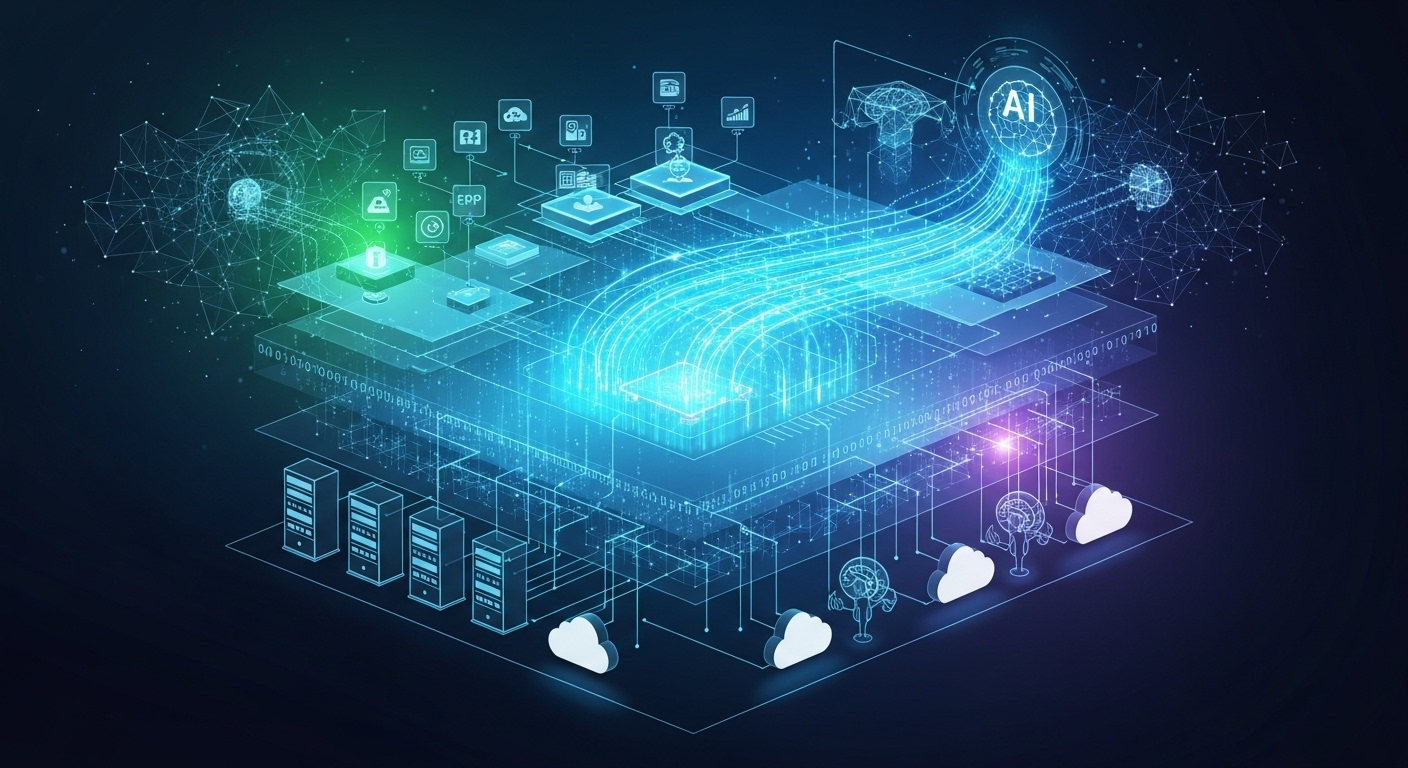
In 2026 and beyond, artificial intelligence is rapidly becoming core digital infrastructure embedded deeply within software platforms, operating systems, cloud environments, and enterprise workflows. Rather than simply supporting applications, AI is increasingly becoming the intelligence layer that powers them.
This transformation represents a fundamental shift in how technology systems are designed and how businesses operate. AI is no longer just improving digital systems; it is becoming a structural component of the digital economy itself.
From Specialized AI Tools to Integrated Systems
The earliest wave of commercial AI adoption focused on specialized applications. Businesses implemented AI in narrow areas where automation and predictive capabilities could deliver clear benefits.
Common examples included:
- recommendation engines for e-commerce
- fraud detection in financial services
- predictive analytics in marketing
- chatbots for customer support
- image recognition systems in security
These tools delivered measurable value, but they typically operated within defined boundaries. AI models were integrated into particular features rather than embedded across entire platforms.
As technology advanced, however, organizations began to recognize that AI could do much more than automate isolated tasks.
The true potential of AI lies in system-level intelligence where AI continuously analyzes information, learns from data, and optimizes digital processes across entire infrastructures.
The Drivers Behind AI’s Infrastructure Transformation
Several technological and economic trends are accelerating the shift from AI tools to AI infrastructure.
Explosion of Data
Modern digital environments generate vast amounts of data from customer interactions, connected devices, operational systems, and online platforms.
Organizations now rely on AI to process this data and transform it into actionable insights. Without AI-driven analytics, the sheer volume of information would be impossible to interpret effectively.
AI infrastructure enables companies to convert data into strategic intelligence continuously.
Advances in Cloud Computing
Cloud platforms provide the computational power required to train and deploy large-scale AI models. These platforms allow businesses to integrate AI services into applications without building infrastructure from scratch.
Major cloud providers now offer AI capabilities as built-in services, including:
- machine learning platforms
- natural language processing engines
- computer vision systems
- predictive analytics tools
This integration means that AI is no longer an optional add-on it is becoming a default component of digital platforms.
The Rise of Large Language Models
Recent breakthroughs in large language models and generative AI systems have dramatically expanded what AI can accomplish.
These systems can:
- write and summarize documents
- generate code
- analyze complex data
- interact conversationally with users
- assist with research and decision-making
Because of these capabilities, AI is now being embedded directly into productivity tools, development platforms, and enterprise software.
In many cases, AI is becoming the primary interface between users and technology.
AI Across the Modern Technology Stack
The transition from AI tools to AI infrastructure is happening across multiple layers of the digital ecosystem.
User Experience Layer
At the top of the technology stack, AI enhances user experiences by making applications more intuitive and personalized.
Examples include:
- conversational interfaces that allow users to interact with software using natural language
- personalized product recommendations
- AI-assisted search that understands user intent
- automated content generation
These capabilities allow users to interact with digital systems more naturally and efficiently.
Application Layer
Within business applications, AI is transforming how software processes information and makes decisions.
AI-powered applications can now:
- forecast market trends
- optimize logistics operations
- analyze financial risks
- personalize healthcare treatment recommendations
- automate customer engagement
These systems allow organizations to operate more intelligently and adapt more quickly to changing conditions.
Platform Layer
At the platform level, AI is increasingly used to manage digital operations and optimize workflows.
AI-powered platforms can monitor system performance, detect anomalies, and recommend improvements automatically.
For example, AI can help:
- optimize cloud resource allocation
- predict system failures before they occur
- analyze cybersecurity threats in real time
- automate large-scale data processing
In these environments, AI acts as a control layer that continuously improves system efficiency.
Infrastructure Layer
Perhaps the most profound shift is occurring at the infrastructure level.
AI is now being embedded directly into infrastructure systems that manage computing resources, networks, and data environments.
Examples include:
- AI-driven cloud orchestration systems
- intelligent network traffic management
- automated cybersecurity defense systems
- predictive infrastructure maintenance
In these systems, AI does not simply assist operators it actively manages digital environments.
AI as the Intelligence Layer of the Digital Economy
Many technology leaders now describe AI as the intelligence layer of modern infrastructure.
Just as electricity powers physical infrastructure and the internet connects digital networks, AI provides the cognitive capabilities that allow systems to learn, adapt, and optimize.
In the near future, AI may become so deeply integrated that users no longer perceive it as a separate technology.
Instead, AI will simply be part of how digital systems operate.
Implications for Businesses
The transition toward AI infrastructure has profound implications for organizations across industries.
Strategic Competitive Advantage
Companies that integrate AI deeply into their infrastructure gain significant advantages in efficiency, innovation, and decision-making.
AI-powered systems can identify opportunities, predict risks, and automate complex workflows faster than traditional software systems.
Organizations that fail to adopt AI infrastructure may struggle to compete with AI-driven competitors.
Changes in Workforce Skills
As AI becomes embedded within digital infrastructure, demand for AI-related skills will increase.
Key capabilities will include:
- machine learning engineering
- data engineering
- AI governance and ethics
- AI product design
- AI systems integration
Businesses will need professionals who understand both technology and the strategic implications of AI.
New Governance and Ethical Challenges
Embedding AI deeply into infrastructure raises important governance questions.
Organizations must address issues such as:
- algorithmic bias
- transparency in automated decisions
- data privacy protection
- accountability for AI-driven actions
Responsible AI governance will become a critical aspect of future technology systems.
The Rise of AI-Native Organizations
One of the most important consequences of AI infrastructure is the emergence of AI-native organizations.
AI-native companies design their systems, workflows, and strategies around AI from the start rather than adding AI later.
These organizations integrate AI into areas such as:
- product development
- customer support
- operations management
- financial forecasting
- market analysis
By embedding AI into their core operations, these companies operate with greater agility and intelligence.
AI Infrastructure and Global Innovation
AI infrastructure is also shaping innovation at a global scale.
Countries and technology ecosystems that invest heavily in AI research, computing infrastructure, and data ecosystems are likely to gain long-term economic advantages.
Governments around the world are now supporting initiatives to develop AI infrastructure, including:
- national AI research programs
- high-performance computing centers
- public AI data platforms
- AI startup ecosystems
These investments reflect the growing recognition that AI infrastructure will play a central role in the future global economy.
The Next Phase of AI Infrastructure
The evolution of AI infrastructure is still in its early stages. Several emerging developments will shape the next phase of this transformation.
Autonomous AI Systems
Future AI systems may manage digital environments autonomously, optimizing operations and solving problems with minimal human intervention.
AI Agents and Automation
AI agents capable of performing multi-step tasks will increasingly automate complex workflows across industries.
These agents could coordinate activities such as software development, data analysis, and operational management.
Distributed AI Networks
Edge computing and decentralized AI systems will allow AI capabilities to operate closer to devices and users, improving speed and reducing reliance on centralized systems.
Conclusion
Artificial intelligence is undergoing a profound transformation. What once functioned as a set of specialized tools is rapidly evolving into the foundational infrastructure that powers modern digital systems.
As AI becomes embedded across applications, platforms, and infrastructure layers, it will reshape how organizations operate, how technology systems are built, and how decisions are made.
The most successful organizations of the next decade will not simply adopt AI tools they will design their systems with AI as a core infrastructure component.
In the future of technology, AI will not just enhance digital systems.
It will define them.
For more Contact US
Similar Posts

AI
Cybersecurity Insurance Market Experiences Rapid Growth
As cyber threats continue to evolve in complexity and scale, businesses around the world are facing unprecedented digital…

AI
Sports Analytics Trends Powered by Machine Learning in 2026
The world of sports is undergoing one of the biggest technological transformations in history. For decades, sports success…