


Introduction
Speed has become the defining factor in modern software development. Organizations are releasing updates daily, sometimes multiple times a day, driven by Agile practices, cloud-native architectures, and global digital demand. But with speed comes risk particularly when it comes to application performance.
A slow application is no longer just a technical issue; it directly impacts user experience, revenue, and brand reputation.
In this environment, traditional performance testing methods executed late in the development cycle are no longer sufficient. Instead, organizations are embracing a new paradigm: continuous performance testing embedded within CI/CD pipelines.
This approach ensures that performance is not an afterthought but a core, continuously validated component of software delivery.
Why Performance Has Become a Business-Critical Metric
Before diving into continuous performance testing, it’s important to understand why performance has taken center stage.
1. User Expectations Are Higher Than Ever
Users expect applications to respond instantly. Even a delay of a few seconds can lead to abandonment.
2. Digital Experiences Drive Revenue
For e-commerce, SaaS, and fintech platforms, performance directly influences conversions and customer retention.
3. Systems Are Increasingly Complex
Modern applications are built using:
- Microservices architectures
- APIs and third-party integrations
- Distributed cloud environments
This complexity makes performance issues harder to detect and resolve.
4. Always-On Availability
Downtime or performance degradation is unacceptable in a 24/7 digital economy.
The Limitations of Traditional Performance Testing
Traditional approaches were designed for slower development cycles and monolithic systems.
Key Limitations:
Late Testing
Performance testing was conducted only after development was complete, making fixes costly and time-consuming.
Static Scenarios
Tests were based on predefined scripts, often failing to capture real-world usage patterns.
Limited Scalability
Simulating large-scale user traffic required significant infrastructure and effort.
Siloed Responsibility
Performance testing was often treated as a QA task rather than a shared responsibility.
Lack of Continuous Feedback
Teams lacked real-time insights into how changes impacted performance.
Continuous Performance Testing: A New Paradigm
Continuous performance testing transforms how organizations approach performance by making it:
- Continuous instead of periodic
- Automated instead of manual
- Integrated instead of isolated
- Proactive instead of reactive
Definition:
Continuous performance testing is the practice of embedding automated performance tests and monitoring throughout the entire CI/CD pipeline, ensuring performance is validated at every stage of development and deployment.
Deep Dive: CI/CD as the Foundation
CI/CD pipelines are the backbone of modern software delivery.
Continuous Integration (CI)
- Code is integrated frequently
- Automated tests run on every commit
- Performance checks validate incremental changes
Continuous Deployment (CD)
- Code is deployed automatically
- Performance is validated in real environments
- Monitoring ensures stability post-deployment
By integrating performance testing into CI/CD, organizations create a continuous feedback loop that identifies issues early and enables rapid resolution.
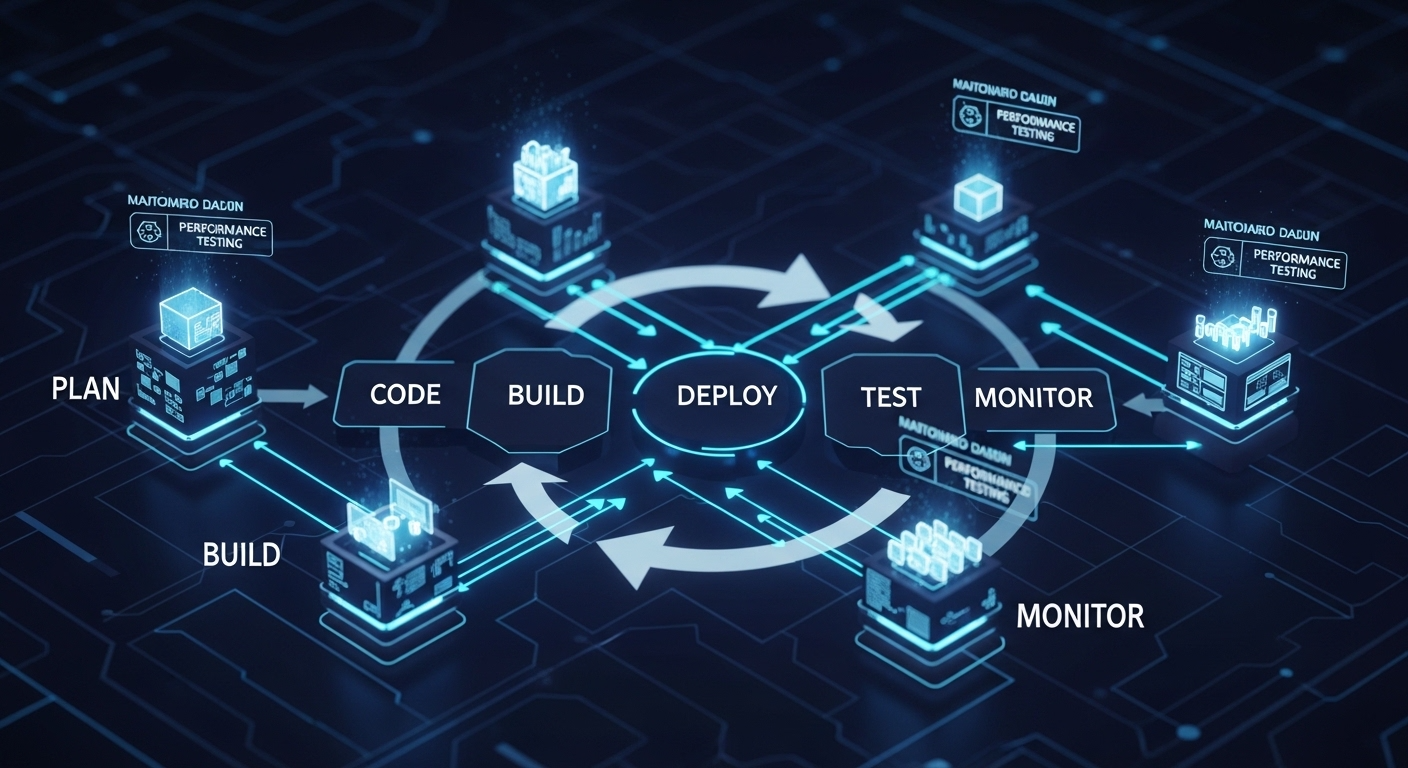
End-to-End Performance Testing Lifecycle in CI/CD
1. Code Commit Stage
- Lightweight performance checks
- Detect immediate regressions
2. Build Stage
- Validate application responsiveness
- Ensure no major performance degradation
3. Integration Testing Stage
- Simulate interactions between components
- Identify bottlenecks in system communication
4. Pre-Production Stage
- Run full-scale load and stress tests
- Validate scalability under realistic conditions
5. Production Monitoring
- Continuously track performance metrics
- Detect anomalies and performance drops in real time
This lifecycle ensures performance validation is continuous and comprehensive.
Key Metrics That Drive Continuous Performance Testing
To be effective, continuous performance testing relies on measurable indicators:
- Response Time: How quickly the system responds to requests
- Throughput: Number of requests handled per second
- Error Rate: Frequency of failed requests
- Latency: Delay in system communication
- Resource Utilization: CPU, memory, and network usage
Tracking these metrics continuously enables teams to identify trends and predict issues before they occur.
Role of Cloud in Continuous Load Testing
Cloud computing has made continuous performance testing scalable and accessible.
Benefits:
- On-Demand Scalability: Simulate millions of users without infrastructure constraints
- Global Testing: Test performance across different regions
- Cost Efficiency: Pay only for resources used
- Faster Execution: Run large-scale tests quickly
This enables organizations to create realistic testing environments that mirror production systems.
Integration with DevOps and Shift-Left Strategy
Continuous performance testing aligns with the shift-left approach, where testing is moved earlier in the development process.
Benefits of Shift-Left Performance Testing:
- Early detection of issues
- Reduced cost of fixes
- Faster development cycles
- Improved collaboration between teams
Performance becomes a shared responsibility across developers, testers, and operations teams.
Real-World Scenarios Where It Matters
E-Commerce Platforms
- Handle peak traffic during sales events
- Ensure checkout processes remain fast
SaaS Applications
- Maintain consistent performance across updates
- Support growing user bases
Banking & Fintech
- Process high transaction volumes
- Ensure system stability and compliance
Media & Streaming Services
- Deliver content seamlessly under heavy loads
- Optimize streaming quality
Challenges in Implementation
Despite its advantages, adopting continuous performance testing comes with challenges:
Tool Integration
Selecting and integrating the right tools into CI/CD pipelines can be complex.
Environment Consistency
Replicating production environments accurately is difficult.
Data Management
Ensuring realistic and consistent test data is critical.
Cost Management
Large-scale testing can increase cloud costs.
Skill Gaps
Teams need expertise in both performance testing and DevOps practices.
Best Practices for Success
Automate Test Execution
Eliminate manual intervention to ensure consistency and speed.
Use Realistic Scenarios
Simulate real user behavior for accurate insights.
Define Performance Baselines
Set clear benchmarks to detect deviations.
Monitor Continuously
Track performance metrics throughout the lifecycle.
Start Small, Then Scale
Focus on critical workflows before expanding.
The Future: Autonomous Performance Engineering
Continuous performance testing is evolving into autonomous performance engineering, powered by AI.
Emerging Trends:
- AI systems that predict performance issues
- Automated generation of test scenarios
- Self-healing applications that fix issues automatically
- Real-time optimization without human intervention
This will transform performance from a testing activity into a self-optimizing capability.
Strategic Insight
Most organizations today:
- Run performance tests occasionally
- Treat performance as a secondary concern
- React to issues after deployment
However, leading companies:
- Embed performance testing into CI/CD pipelines
- Treat performance as a core engineering discipline
- Build systems that continuously optimize themselves
This difference is becoming a key competitive advantage.
Conclusion
The rise of continuous performance testing represents a fundamental shift in software quality assurance.
By integrating performance testing into CI/CD pipelines, organizations can:
- Detect issues early
- Deliver faster releases
- Maintain consistent performance
- Build scalable and reliable systems
In a digital-first world, where performance directly impacts success, continuous performance testing is no longer optional it is essential for staying competitive.
For more Contact US
Similar Posts

Software Testing & QA
7 Essential Cloud-Native Load Testing Strategies for Global Scale
As businesses continue their digital transformation journeys, cloud-native applications have become the backbone of modern software development. Organizations…

Software Testing & QA
AI Testing Is the Fastest-Growing Trend in 2026
The world of software testing is undergoing one of the biggest transformations in its history. For years, automation…