


Introduction
Modern software is no longer a single application it’s an ecosystem of services, integrations, and real-time interactions. As user expectations rise and systems grow more complex, traditional development models struggle to keep up.
In 2026, two architectural approaches have become the backbone of modern systems:
Microservices architecture
API-first development
These are not just technical patterns they are foundational strategies that define how scalable, flexible, and intelligent applications are built today.
Why Architecture Matters More Than Ever
Applications today must:
- Scale to millions of users
- Integrate with multiple platforms
- Deliver real-time experiences
- Update continuously without downtime
Traditional monolithic architectures cannot handle these demands efficiently.
The solution:
Break systems into modular components and connect them through APIs
Deep Dive: What Is Microservices Architecture?
Microservices architecture is an approach where an application is divided into:
- Small, independent services
- Each responsible for a specific function
- Communicating through APIs
Key Characteristics:
- Independence: Services operate separately
- Scalability: Each service scales individually
- Flexibility: Different technologies can be used
- Resilience: Failure in one service doesn’t break the system
Deep Dive: What Is API-First Architecture?
API-first development means:
Designing APIs before building the application
Instead of:
- Writing backend code first
You:
- Define API contracts
- Standardize communication
- Build services around APIs
Why API-First Matters:
- Ensures consistency
- Enables faster development
- Simplifies integrations
- Improves collaboration between teams
Evolution: From Monolith → Microservices + API-First
Monolithic Systems
- Single codebase
- Tight coupling
- Difficult to scale
Modern Systems
- Distributed services
- API-driven communication
- Independent deployments
This evolution enables speed, agility, and scalability
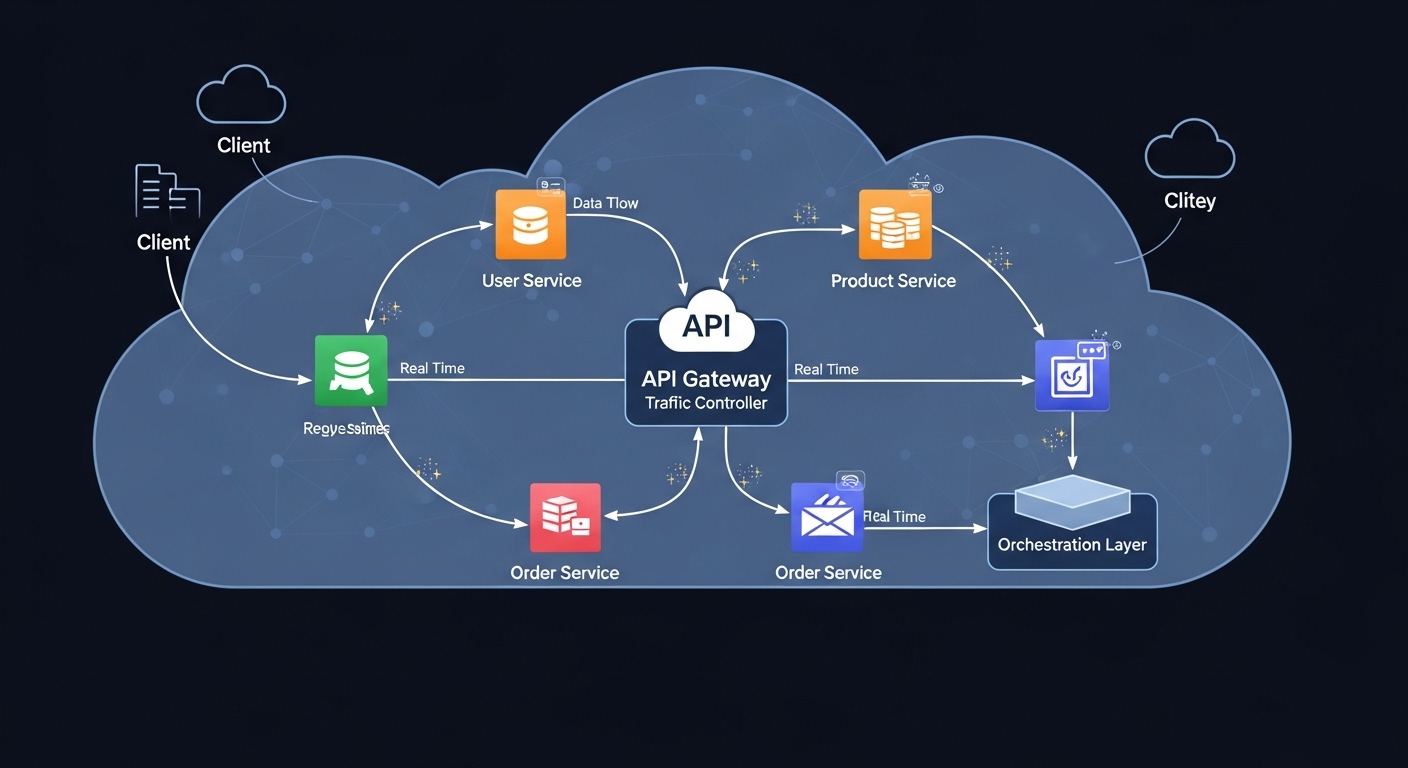
How Microservices & API-First Work Together
🔄 System Flow:
- User sends request
- API Gateway receives request
- Request routed to relevant microservices
- Services process data independently
- Response returned to user
APIs = Communication layer
Microservices = Execution layer
Core Components of Modern Architecture
1. API Gateway
- Entry point for all requests
- Handles authentication, routing, throttling
2. Microservices
- Independent services handling business logic
3. Containers (Docker)
- Package services for consistent deployment
4. Orchestration (Kubernetes)
- Manage scaling, deployment, and failover
5. Service Mesh
- Controls communication between services
- Enhances security and observability
6. Observability Stack
- Logs, metrics, tracing
- Real-time system monitoring
Advanced Architecture Patterns
1. Event-Driven Architecture
Services communicate via events instead of direct calls.
Benefits:
- Loose coupling
- Real-time responsiveness
2. Domain-Driven Design (DDD)
Services are aligned with business domains.
Example:
- Order service
- Payment service
- Inventory service
3. Backend for Frontend (BFF)
Separate backend services for:
- Web apps
- Mobile apps
4. API Composition
Multiple services combined into a single response.
Real-World Use Cases
E-Commerce Platforms
- Separate services for orders, payments, and inventory
- Handle massive traffic during sales
Streaming Platforms
- Content delivery
- Recommendation engines
- User analytics
Fintech Applications
- Transaction processing
- Fraud detection
- Compliance systems
SaaS Platforms
- Modular services for billing, authentication, integrations
Benefits of Microservices & API-First Architecture
1. Scalability
Scale only what’s needed, reducing costs and improving efficiency.
2. Faster Time-to-Market
Teams deploy features independently.
3. Continuous Delivery
Frequent updates without downtime.
4. Flexibility
Use different technologies for different services.
5. Resilience
System remains stable even if one service fails.
6. Ecosystem Integration
APIs enable seamless third-party integrations.
Challenges and How to Overcome Them
Complexity
Use orchestration tools and automation
Data Consistency
Implement eventual consistency patterns
Latency
Optimize API communication and caching
Security
Use API gateways, authentication, encryption
Skill Gap
Invest in training and DevOps practices
Best Practices for Implementation
- Design APIs before writing code
- Keep services small and focused
- Use standardized API formats (REST, GraphQL)
- Automate deployment pipelines
- Monitor everything in real time
- Implement strong security practices
Role of Cloud-Native Development
Microservices thrive in cloud environments:
- Serverless computing
- Containerization
- Managed infrastructure
Cloud enables:
- Auto-scaling
- High availability
- Faster deployments
AI + Microservices: The Next Evolution
Modern architectures are integrating AI:
- AI-powered APIs
- Intelligent service orchestration
- Predictive scaling
Systems are becoming:
- Self-optimizing
- Autonomous
- Intelligent
Strategic Insight
Most organizations:
- Are transitioning from monoliths
- Adopting microservices gradually
Leading companies:
- Design API-first systems from day one
- Build modular, scalable ecosystems
- Treat APIs as products
This creates a massive competitive advantage
Conclusion
Microservices and API-first architecture are no longer optional they are the standard for modern software development.
They enable organizations to:
- Build scalable systems
- Deliver faster updates
- Integrate seamlessly
- Create resilient applications
In a digital-first world, adopting this architecture is essential for long-term success.
For More Contact US
Similar Posts

Development
Autonomous Testing and Agentic Quality Engineering Are Transforming Software Quality in 2026
The software industry is experiencing one of the most significant transformations in its history. As organizations accelerate digital…

Development
5 Game-Changing Factors Behind GitOps Adoption Growth
The modern software industry is evolving at an extraordinary pace. Organizations today are deploying applications faster than ever…