


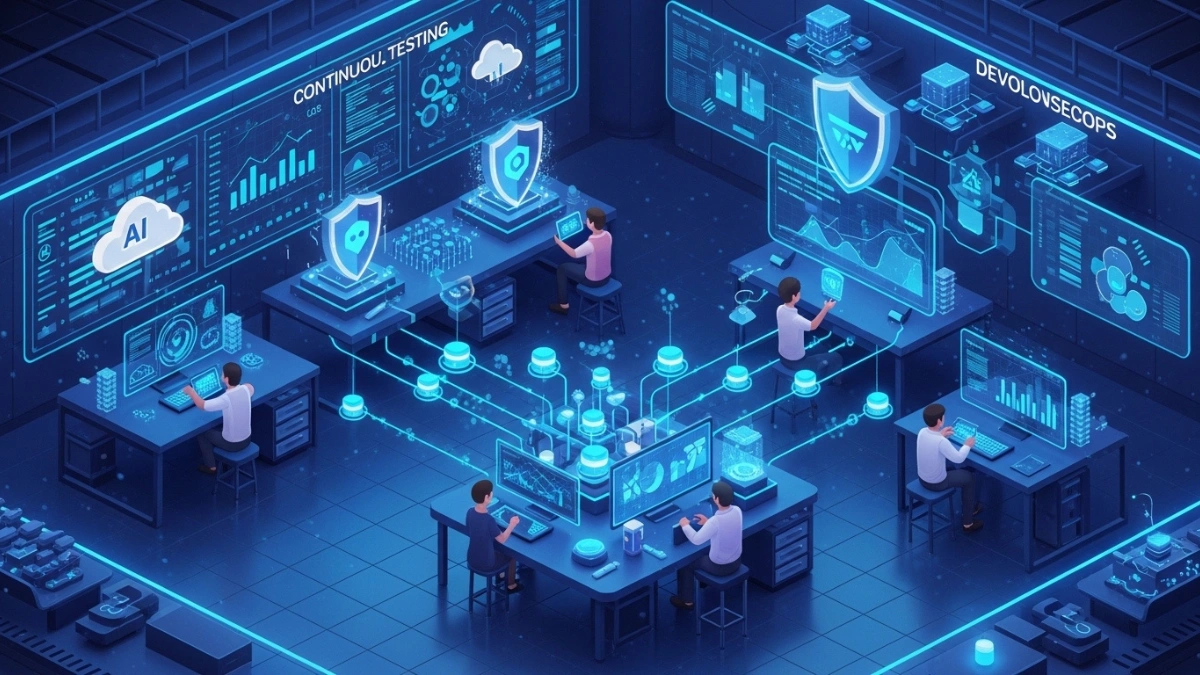
Software development has evolved dramatically over the last decade. Traditional release cycles that once took months are now compressed into days, hours, or even minutes. Businesses today compete on speed, reliability, and security, forcing engineering teams to rethink how software is built, tested, and deployed. In this fast-moving digital environment, two practices have emerged as game changers: Continuous Testing and DevSecOps.
Organizations are no longer treating testing and security as separate stages performed at the end of development. Instead, they are embedding quality assurance and security directly into the software delivery pipeline. This shift has transformed modern engineering workflows and is now dominating CI/CD pipelines across industries.
Continuous Testing combined with DevSecOps is helping businesses release software faster while maintaining high levels of reliability, compliance, and protection against cyber threats. As companies accelerate digital transformation initiatives, these practices are becoming essential rather than optional.
Understanding Continuous Testing
Continuous Testing is the process of executing automated tests continuously throughout the software development lifecycle. Instead of waiting until development is complete, testing happens at every stage of the pipeline.
The primary goal is to provide immediate feedback about software quality, performance, and stability.
Key Characteristics of Continuous Testing
1. Automated Test Execution
Automated tests run every time developers commit code changes. This ensures bugs are identified early before they become expensive problems.
2. Faster Feedback Loops
Teams receive instant validation on whether new code changes break existing functionality.
3. Risk Reduction
Continuous validation minimizes deployment risks and improves release confidence.
4. CI/CD Integration
Continuous Testing works closely with Continuous Integration and Continuous Deployment pipelines.
5. Scalable Quality Assurance
Testing can scale across thousands of builds, environments, devices, and APIs.
What Is DevSecOps?
DevSecOps stands for:
- Development
- Security
- Operations
It is an approach that integrates security practices directly into the DevOps lifecycle instead of treating security as a separate department or final checkpoint.
The core philosophy of DevSecOps is:
“Security should be everyone’s responsibility.”
Rather than identifying vulnerabilities after deployment, DevSecOps introduces proactive security validation throughout development.
Why Continuous Testing and DevSecOps Are Growing Rapidly
Modern applications are:
- cloud-native,
- API-driven,
- containerized,
- microservices-based,
- and continuously updated.
Traditional testing and security methods cannot keep up with this speed.
Organizations now require:
- rapid deployments,
- real-time validation,
- automated security scanning,
- and continuous monitoring.
This demand has accelerated the adoption of Continuous Testing and DevSecOps pipelines worldwide.
The Evolution From Traditional QA to Continuous Quality Engineering
In older development models:
- Developers wrote code
- QA teams tested later
- Security teams audited before release
- Operations deployed manually
This process was:
- slow,
- siloed,
- expensive,
- and inefficient.
Modern engineering pipelines now combine:
- automation,
- observability,
- AI-driven analysis,
- security validation,
- and continuous testing into a single workflow.
This transformation is called:
Continuous Quality Engineering
Quality is now integrated into every phase of development instead of being treated as a final gate.
Core Components of Continuous Testing Pipelines
1. Unit Testing
Unit tests validate individual functions and components.
Benefits:
- fast execution,
- early bug detection,
- improved code reliability.
Developers often execute unit tests automatically during commits.
2. API Testing
Modern applications heavily depend on APIs.
API testing validates:
- data exchange,
- authentication,
- performance,
- and business logic.
API-first testing has become critical in microservices environments.
3. Integration Testing
Integration tests verify that multiple services work together correctly.
This helps detect:
- communication failures,
- dependency conflicts,
- and broken workflows.
4. UI and End-to-End Testing
These tests simulate real user interactions.
They validate:
- workflows,
- navigation,
- user experience,
- and functionality across devices.
Modern tools now use AI to stabilize UI automation.
5. Performance Testing
Performance engineering has become essential for scalable applications.
Performance tests analyze:
- response times,
- scalability,
- load handling,
- and system stability.
Companies increasingly run performance tests continuously rather than only before launch.
The Role of DevSecOps in Modern Pipelines
1. Shift-Left Security
Security testing starts early during development.
Developers now identify vulnerabilities before deployment.
Benefits include:
- lower remediation costs,
- faster fixes,
- reduced cyber risks.
2. Automated Security Scanning
Modern pipelines automatically scan:
- source code,
- containers,
- APIs,
- dependencies,
- and infrastructure.
This helps detect:
- malware,
- vulnerabilities,
- exposed secrets,
- insecure configurations.
3. Infrastructure as Code Security
Cloud infrastructure is now programmable.
DevSecOps tools validate:
- Terraform,
- Kubernetes,
- Docker configurations,
- and cloud policies.
This prevents infrastructure misconfigurations.
4. Continuous Compliance
Organizations must comply with:
- GDPR,
- HIPAA,
- ISO standards,
- SOC 2,
- and financial regulations.
DevSecOps automates compliance checks throughout pipelines.
How CI/CD Pipelines Are Changing
Modern pipelines are evolving from:
“Build and Deploy”
to:
“Build, Test, Secure, Monitor, and Optimize”
Continuous validation now happens automatically at every stage.
Benefits of Continuous Testing + DevSecOps
1. Faster Software Releases
Automation eliminates manual bottlenecks.
Teams can deploy:
- multiple times daily,
- weekly,
- or even hourly.
2. Improved Software Quality
Continuous feedback identifies issues early.
This reduces:
- production bugs,
- downtime,
- customer complaints.
3. Enhanced Security
Security vulnerabilities are detected before reaching production.
This significantly lowers:
- breach risks,
- data exposure,
- compliance violations.
4. Lower Operational Costs
Fixing issues earlier is cheaper than resolving production incidents.
Automation also reduces manual labor costs.
5. Better Developer Productivity
Developers receive immediate validation on code changes.
This minimizes debugging time and accelerates innovation.
AI Is Revolutionizing Continuous Testing and DevSecOps
Artificial Intelligence is becoming a major force in QA and security engineering.
AI-powered systems now help with:
- automatic test generation,
- predictive defect analysis,
- self-healing test automation,
- anomaly detection,
- intelligent security monitoring.
AI can analyze large volumes of pipeline data faster than humans.
Self-Healing Test Automation
One major innovation is self-healing automation.
Traditional automated tests often fail when:
- UI elements change,
- layouts shift,
- identifiers update.
AI-driven testing tools automatically adapt to these changes, reducing maintenance costs.
Observability Is Becoming Critical
Modern pipelines now rely heavily on observability.
Observability combines:
- logs,
- metrics,
- traces,
- monitoring,
- and analytics.
This helps teams detect issues in real time.
Continuous monitoring enables:
- faster troubleshooting,
- proactive maintenance,
- production intelligence.
Cloud-Native Testing Is Expanding
Applications are increasingly deployed on:
- Kubernetes,
- serverless platforms,
- distributed cloud environments.
This has created demand for:
- container testing,
- orchestration validation,
- resilience engineering,
- chaos testing.
Testing strategies are evolving alongside cloud-native architectures.
The Rise of Shift-Right Testing
Traditional testing focused mostly before deployment.
Now organizations also test in production environments using:
- synthetic monitoring,
- canary deployments,
- feature flags,
- real-user monitoring.
This approach is known as:
Shift-Right Testing
It improves real-world reliability and customer experience.
Major Challenges in Continuous Testing and DevSecOps
Despite its advantages, implementation can be challenging.
Common Challenges
1. Tool Complexity
Organizations often use multiple testing and security tools.
Managing integrations can become difficult.
2. Cultural Resistance
Teams must adopt collaborative workflows.
Breaking traditional silos takes time.
3. Test Maintenance
Large automation suites require ongoing updates.
4. Security Skill Gaps
Developers may lack advanced cybersecurity expertise.
5. Infrastructure Costs
Scalable automation environments can be expensive initially.
Best Practices for Successful Adoption
1. Start Small
Begin with critical workflows before scaling automation.
2. Prioritize Automation
Automate repetitive and high-risk processes first.
3. Integrate Security Early
Embed security scanning directly into development pipelines.
4. Use AI Strategically
Leverage AI for optimization, not total replacement.
5. Focus on Observability
Real-time insights are essential for pipeline health.
Industries Leading Adoption
Continuous Testing and DevSecOps are heavily adopted in:
- banking,
- fintech,
- healthcare,
- SaaS,
- e-commerce,
- telecommunications,
- gaming,
- government technology.
These industries require:
- rapid releases,
- strong security,
- regulatory compliance,
- high system availability.
The Future of Continuous Testing and DevSecOps
The future of software engineering will focus on:
- autonomous pipelines,
- AI-driven quality engineering,
- predictive security,
- intelligent release orchestration.
Emerging innovations include:
- autonomous testing agents,
- generative AI QA assistants,
- real-time risk scoring,
- fully automated compliance systems.
Software pipelines are evolving into intelligent ecosystems capable of self-monitoring and self-optimization.
Final Thoughts
Continuous Testing and DevSecOps are no longer optional practices reserved for large enterprises. They are becoming the foundation of modern software delivery.
Organizations that embrace these approaches gain:
- faster innovation,
- stronger security,
- higher software quality,
- and better customer trust.
As software systems become more complex and cyber threats continue to rise, businesses need pipelines that can continuously validate, secure, and optimize applications at scale.
The future belongs to engineering teams that combine:
- automation,
- AI,
- observability,
- and security-driven development into one unified delivery strategy.
Continuous Testing plus DevSecOps is not just a trend it is the future of software engineering.
For more Contact Us
Similar Posts
Development
Autonomous Testing and Agentic Quality Engineering Are Transforming Software Quality in 2026
The software industry is experiencing one of the most significant transformations in its history. As organizations accelerate digital…

Development
5 Game-Changing Factors Behind GitOps Adoption Growth
The modern software industry is evolving at an extraordinary pace. Organizations today are deploying applications faster than ever…