


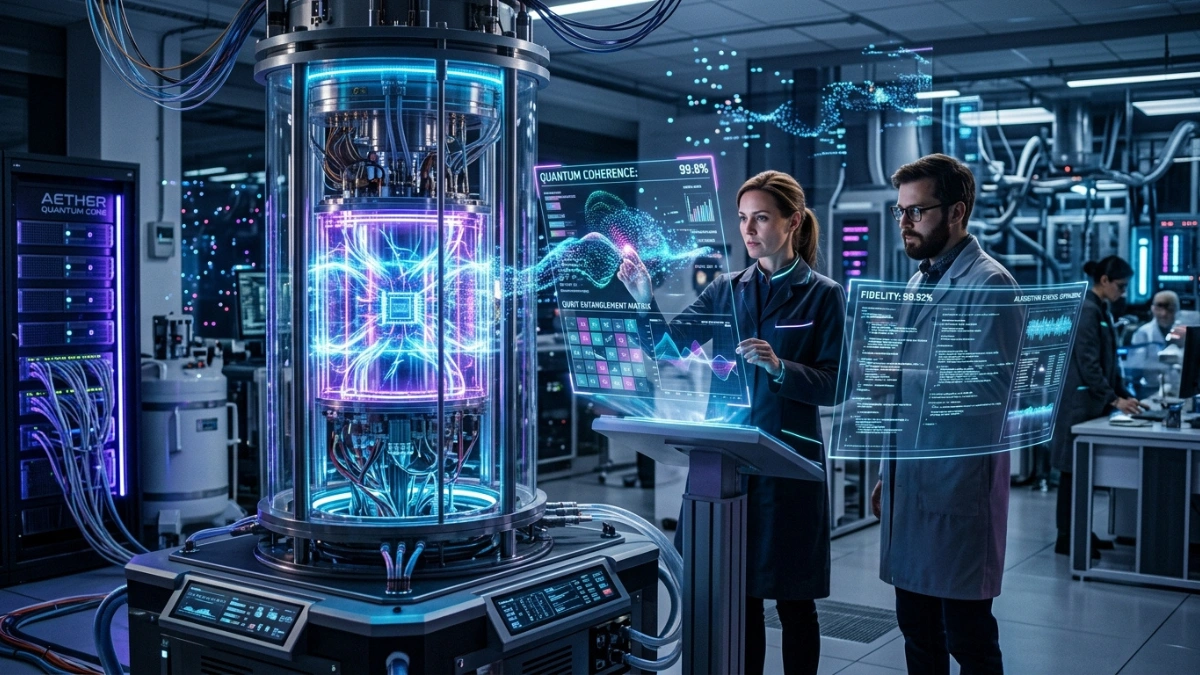
The world of technology is entering a completely new era, and at the center of this transformation is Quantum Computing. For decades, quantum computing was viewed as a futuristic concept discussed mainly in scientific journals and university laboratories. Today, however, it is becoming one of the most important technological races in the world.
Major companies such as IBM, Google, Microsoft, and Amazon are investing billions of dollars into quantum research and infrastructure. Governments are also launching national quantum programs because they believe the technology will shape future economic power, cybersecurity, defense systems, healthcare, and artificial intelligence.
Unlike traditional computers that have powered the digital revolution for decades, quantum computers operate using the laws of quantum mechanics a branch of physics that studies how particles behave at atomic and subatomic levels.
The result is a machine capable of solving certain problems exponentially faster than even the world’s most advanced supercomputers.
Although quantum computing is still in its early stages, progress is accelerating rapidly. Researchers are overcoming technical barriers, businesses are experimenting with practical applications, and industries are preparing for a future where quantum technology becomes commercially viable.
In 2026, quantum computing is no longer science fiction.
It is moving closer to reality.
Understanding Quantum Computing
To understand why quantum computing is such a revolutionary breakthrough, it is important to first understand how traditional computers work.
Traditional computers process information using:
Bits
A bit can only exist in one of two states:
- 0
- 1
Every application, website, video, or software system in the world ultimately runs on combinations of these binary states.
Quantum computers work differently.
They use:
Qubits (Quantum Bits)
A qubit can exist as:
- 0
- 1
- or both at the same time
This property is known as:
Superposition
Because qubits can represent multiple possibilities simultaneously, quantum computers can process enormous numbers of calculations at once.
Another important principle is:
Entanglement
Entangled qubits become connected in ways that classical physics cannot fully explain. When one qubit changes state, another entangled qubit reacts instantly, regardless of distance.
These properties allow quantum systems to tackle extremely complex computational challenges far beyond the capabilities of conventional computers.
Why Quantum Computing Is a Big Deal
Quantum computing matters because many modern problems are becoming too large and complicated for classical systems.
Even the fastest supercomputers struggle with:
- molecular simulations
- weather prediction
- optimization problems
- advanced AI calculations
- cryptography
- protein folding
- large-scale financial modeling
Some calculations could take traditional computers:
- decades
- centuries
- or even longer
Quantum computers may eventually complete these tasks in minutes or hours.
This computational leap could unlock scientific discoveries and technological innovations that are currently impossible.
The Evolution of Quantum Computing
Quantum computing did not appear overnight.
The idea was first proposed in the 1980s when scientists realized classical computers had limitations when simulating quantum physics.
Over time, advancements in:
- physics
- materials science
- cryogenics
- engineering
- AI
- semiconductor technology
helped researchers build experimental quantum systems.
Initially, these systems were highly unstable and impractical.
Today, however:
- qubit counts are increasing
- error rates are improving
- cloud quantum platforms are emerging
- commercial experimentation is growing
The industry has moved from pure theory into early-stage practical development.
How Quantum Computers Work
Quantum computers require highly specialized environments to function properly.
Most quantum processors operate at temperatures close to:
Absolute Zero
This is colder than outer space.
The reason is simple:
Qubits are extremely sensitive.
Heat, vibrations, electromagnetic interference, and environmental noise can easily disrupt calculations.
Quantum computers therefore require:
- advanced cooling systems
- specialized hardware
- error correction mechanisms
- precise engineering
This complexity is one reason quantum computing remains expensive and technically challenging.
Types of Quantum Computing Technologies
Different companies are pursuing different approaches to quantum computing.
1. Superconducting Qubits
Used by:
- IBM
These rely on superconducting electrical circuits cooled to ultra-low temperatures.
2. Trapped Ion Systems
Used by companies like:
- IonQ
- Honeywell
These systems use electrically charged atoms controlled by lasers.
3. Photonic Quantum Computing
This approach uses particles of light (photons) for quantum calculations.
Benefits include:
- room-temperature operation
- faster communication potential
4. Topological Quantum Computing
This is a highly advanced and experimental approach being explored by Microsoft.
It aims to create more stable and error-resistant qubits.
Industries That Quantum Computing Could Revolutionize
Quantum computing has the potential to reshape almost every major industry.
1. Healthcare & Drug Discovery
One of the most exciting applications of quantum computing is in medicine.
Drug development is extremely expensive and time-consuming.
Scientists must simulate molecular interactions, chemical structures, and biological systems tasks that require massive computational power.
Quantum computing can potentially:
- accelerate drug discovery
- improve molecular simulations
- develop personalized medicine
- analyze DNA faster
- improve cancer research
- optimize vaccine development
This could dramatically reduce:
- research timelines
- development costs
- laboratory trial failures
Future medical breakthroughs may depend heavily on quantum simulations.
2. Artificial Intelligence & Machine Learning
AI systems are becoming increasingly complex.
Training advanced AI models requires:
- massive datasets
- huge computational resources
- significant energy consumption
Quantum computing could improve:
- machine learning efficiency
- pattern recognition
- optimization algorithms
- predictive analytics
- neural network performance
The combination of AI and quantum computing may create entirely new forms of intelligent automation.
Some researchers believe:
Quantum AI
could become one of the most transformative technologies of the century.
3. Cybersecurity & Encryption
Modern internet security depends heavily on encryption.
Current encryption systems are based on mathematical problems that classical computers cannot solve efficiently.
Quantum computers could eventually break some traditional encryption methods much faster.
This creates both:
- opportunity
- risk
As a result, companies and governments are investing heavily in:
Post-Quantum Cryptography
This includes:
- quantum-safe encryption
- advanced cybersecurity systems
- next-generation authentication technologies
Cybersecurity experts believe organizations must begin preparing now for the “quantum threat.”
4. Financial Services & Banking
Financial markets generate enormous amounts of data every second.
Quantum computing may improve:
- portfolio optimization
- fraud detection
- market forecasting
- risk analysis
- trading strategies
- financial simulations
Banks are already experimenting with hybrid quantum systems to explore future applications.
Financial institutions that adopt quantum technology early may gain significant competitive advantages.
5. Logistics & Supply Chain Management
Supply chains involve millions of variables.
Quantum computing could optimize:
- shipping routes
- warehouse operations
- inventory forecasting
- transportation scheduling
- fuel efficiency
This could save companies billions of dollars while improving operational speed and sustainability.
6. Climate Change & Environmental Research
Climate simulations are among the most computationally demanding scientific tasks.
Quantum systems may help scientists:
- model climate patterns
- predict extreme weather
- improve renewable energy systems
- optimize power grids
- accelerate carbon capture research
This could become crucial in global sustainability efforts.
7. Manufacturing & Materials Science
Quantum computing may help companies design:
- stronger materials
- lighter components
- advanced batteries
- efficient semiconductors
This could revolutionize industries including:
- automotive
- aerospace
- electronics
- renewable energy
Battery innovation alone could transform electric vehicles and energy storage systems worldwide.
The Global Quantum Race
Quantum computing is now a global strategic competition.
Countries are investing heavily because they believe quantum leadership could determine future economic and military power.
Major quantum investment regions include:
- United States
- China
- Canada
- Germany
- United Kingdom
- Japan
- South Korea
Governments are funding:
- quantum labs
- university research
- private partnerships
- defense applications
- national innovation programs
The global race is accelerating rapidly.
Big Tech Companies Leading Quantum Innovation
IBM
IBM is one of the leaders in enterprise quantum computing.
The company offers:
- quantum cloud access
- quantum software tools
- research platforms
IBM aims to build large-scale fault-tolerant quantum systems in the coming years.
Google achieved a major milestone called:
Quantum Supremacy
This demonstrated that a quantum processor could complete a specialized task faster than classical supercomputers.
Google continues investing heavily in quantum AI and scalable hardware systems.
Microsoft
Microsoft focuses on:
- topological qubits
- quantum software ecosystems
- developer platforms
The company aims to create more stable and scalable quantum systems.
Amazon
Amazon offers quantum computing services through cloud infrastructure.
This allows businesses and researchers to experiment with quantum technologies remotely.
Challenges Preventing Mass Adoption
Despite rapid progress, quantum computing still faces serious obstacles.
1. Quantum Error Rates
Qubits are highly unstable.
Even tiny environmental disturbances can cause:
- computational inaccuracies
- system failures
- data corruption
Error correction remains one of the industry’s biggest technical challenges.
2. Hardware Complexity
Quantum systems require:
- specialized cooling
- advanced engineering
- expensive materials
- precision manufacturing
This makes large-scale production difficult.
3. High Costs
Quantum research requires billions of dollars in investment.
Only governments and large corporations currently have the resources to fund major development programs.
4. Lack of Skilled Professionals
The industry needs experts in:
- quantum physics
- AI
- mathematics
- engineering
- cryptography
There is currently a global shortage of quantum talent.
5. Commercial Readiness
Many applications are still experimental.
Businesses are exploring practical use cases, but mainstream adoption may still take years.
Quantum-as-a-Service (QaaS)
One major trend is the rise of:
Quantum-as-a-Service (QaaS)
Instead of buying expensive hardware, organizations can access quantum systems through cloud platforms.
Benefits include:
- lower barriers to entry
- easier experimentation
- cloud accessibility
- reduced infrastructure costs
This is helping startups, researchers, and enterprises begin exploring quantum applications.
The Future of Quantum Computing
Experts believe the next decade will bring major breakthroughs.
Future trends may include:
- hybrid quantum-classical systems
- quantum AI integration
- enterprise quantum software
- advanced quantum cybersecurity
- scalable quantum cloud platforms
- commercial quantum processors
- quantum internet research
Over time, quantum systems may become part of mainstream enterprise infrastructure.
How Businesses Should Prepare
Even though widespread adoption is still developing, businesses should begin preparing strategically.
Companies should:
- monitor quantum developments
- modernize cybersecurity systems
- invest in innovation teams
- explore quantum education
- evaluate future industry impact
Early preparation could provide enormous long-term advantages.
Conclusion
Quantum computing represents one of the most important technological revolutions of the modern era. While the technology is still evolving, the pace of advancement is accelerating rapidly across industries and governments worldwide.
From healthcare and AI to cybersecurity and climate research, quantum computing has the potential to solve problems that traditional computers cannot realistically handle.
Although challenges remain, the progress being made today suggests that quantum computing is steadily moving from theory into practical reality.
The companies, industries, and nations that prepare early for this transformation may lead the next generation of technological innovation.
The future of computing is changing and quantum technology could redefine the world as we know it.
For more Contact Us
Similar Posts

Industry Insights & Trends
Bank for International Settlements (BIS): Why Businesses Shouldn’t Ignore AI Bubble Risks
Artificial Intelligence (AI) has become one of the most transformative technologies of the decade. From automating customer support…

Industry Insights & Trends
Usage-Based Artificial Intelligence Pricing Is Becoming a Critical Business Concern in 2026
Artificial Intelligence is no longer an emerging technology reserved for innovation labs and tech giants. It has become…