


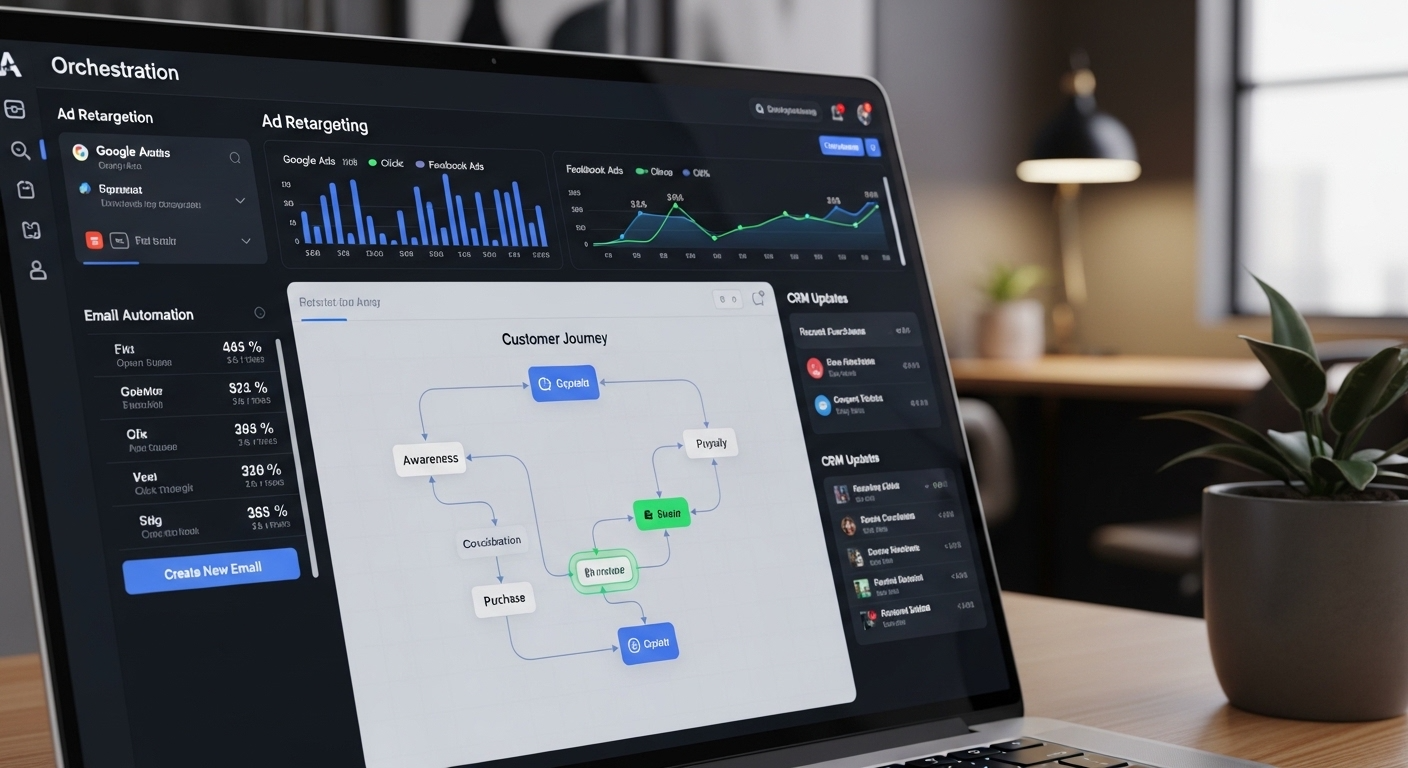
Marketing automation has moved far beyond scheduled email sequences and rule-based drip campaigns. Today, we are witnessing the rise of autonomous orchestration of marketing workflows a transformational shift where AI systems don’t just execute predefined instructions, but intelligently manage, optimize, and evolve entire customer journeys in real time.
This evolution represents a move from automation to intelligent autonomy. Instead of marketers manually configuring every branch of a workflow, AI now monitors behavior, predicts intent, adjusts messaging, and reallocates resources automatically.
The result? Marketing that is faster, smarter, and continuously improving.
What Is Autonomous Orchestration?
Autonomous orchestration refers to AI-powered systems capable of:
- Continuously analyzing customer behavior
- Dynamically triggering multi-step, cross-channel journeys
- Optimizing messaging and timing in real time
- Adjusting budget allocation automatically
- Predicting next-best actions for each individual user
Traditional automation follows if-this-then-that logic. Autonomous orchestration uses machine learning to make decisions based on patterns, probability, and behavioral signals.
Example Scenario
A prospect:
- Visits your website
- Downloads a whitepaper
- Watches 50% of a product demo
- Opens but does not click a follow-up email
An autonomous system will:
- Recalculate lead score
- Identify drop-off friction
- Send a personalized case study
- Trigger retargeting ads
- Alert sales with contextual insights
All without manual reconfiguration.
Why Traditional Automation Is No Longer Enough
For years, marketing automation platforms focused on efficiency sending emails at scale, nurturing leads with structured paths, and tracking engagement metrics.
However, modern customers:
- Switch between devices frequently
- Engage across multiple channels
- Expect personalization
- Respond differently based on timing and context
Static workflows cannot keep up with dynamic consumer behavior.
Autonomous orchestration solves this by enabling real-time adaptive marketing journeys instead of fixed campaign flows.
Core Technologies Powering Autonomous Orchestration
This evolution is driven by multiple AI-driven components:
Predictive Analytics
Forecasts user intent, churn probability, and conversion likelihood.
Generative AI
Creates personalized content variations subject lines, ad copies, landing pages automatically.
Behavioral Tracking Engines
Monitor user interactions across websites, apps, email, social media, and CRM systems.
AI Decision Engines
Select optimal channels, timing, and messaging based on live performance data.
Unified Customer Data Platforms (CDPs)
Ensure data from all touchpoints feeds into a centralized intelligence layer.
Major marketing platforms such as HubSpot, Salesforce, and Adobe are embedding AI-driven orchestration capabilities into their ecosystems to enable these intelligent workflows.
Business Impact and Strategic Advantages
Autonomous orchestration is not just a technical upgrade it fundamentally changes marketing performance.
Higher Conversion Rates
AI adapts content, timing, and channel mix based on individual user behavior, increasing relevance.
Faster Campaign Iteration
Instead of waiting for monthly performance reviews, optimization happens continuously.
Improved ROI
Budget allocation shifts automatically toward high-performing audiences and channels.
Scalable Personalization
One-to-one marketing becomes achievable at enterprise scale.
Stronger Sales Alignment
Real-time behavioral insights provide sales teams with actionable, contextual intelligence.
From Campaigns to Continuous Journey Management
One of the biggest mindset shifts is moving from “campaign-based marketing” to “continuous journey orchestration.”
Traditional mindset:
- Launch campaign
- Monitor metrics
- Adjust manually
Autonomous mindset:
- Define objectives
- Allow AI to test and adapt continuously
- Monitor strategic KPIs instead of tactical execution
Marketing teams shift from operators to strategists.
Challenges and Governance Considerations
While autonomous orchestration offers immense potential, it requires maturity in:
- Data quality and integration
- Privacy compliance and consent management
- AI governance policies
- Performance monitoring frameworks
Without clean data and oversight, intelligent automation can amplify mistakes quickly.
Successful implementation requires:
- Clear business goals
- Human supervision
- Ethical AI practices
- Cross-functional collaboration between marketing, IT, and analytics teams
The Future of Marketing Is Autonomous
As AI continues to evolve, autonomous orchestration will likely become the standard rather than the exception. Marketing systems will increasingly operate like intelligent ecosystems constantly learning, adapting, and optimizing across channels.
In the near future, marketers will focus primarily on:
- Strategy
- Brand positioning
- Creative direction
- Customer experience innovation
While AI handles:
- Testing
- Execution
- Optimization
- Scaling
The brands that adopt early will benefit from faster growth cycles, improved efficiency, and superior customer engagement.
Conclusion
Autonomous orchestration of marketing workflows represents the next frontier of marketing intelligence. By combining predictive analytics, generative AI, and real-time behavioral insights, businesses can shift from static automation to dynamic, adaptive customer journeys.
This transformation is not about replacing marketers it is about empowering them. Organizations that embrace intelligent orchestration will move beyond reactive campaign management and toward proactive, self-optimizing marketing ecosystems.
The future of marketing is not just automated it is autonomous.
For more Details let’s connect on Contact Us
Similar Posts

Marketing
4 Powerful Hyper-Personalization Strategies for Marketing Automation Success
The modern customer expects more than generic advertisements, mass emails, and one-size-fits-all marketing campaigns. In today’s digital-first business…
Marketing
B2B Brands Are Focusing More on Trust Infrastructure in 2026
Why Trust Has Become the Most Important Growth Asset in 2026 The B2B business environment has changed dramatically…