


Category
Share on

This project was executed as part of a strategic collaboration with Data Spark, a performance-driven marketing brand focused on scaling E-Commerce businesses through data-backed email marketing systems.
As Data Spark expanded its presence in the E-Commerce industry, a clear operational bottleneck surfaced. While their strategy and client acquisition capabilities were strong, they lacked the internal infrastructure and execution bandwidth required to manage large-scale outbound email campaigns, structured customer nurturing, and revenue-focused lifecycle marketing.
They weren’t looking for ideas.
They needed scalable execution.
Our mandate was to architect and deploy a fully managed email marketing backend that would drive consistent engagement, repeat purchases, and revenue growth for E-Commerce brands — without disrupting their existing operations.

The requirements were performance-driven, not creative.
A fully managed 12-member team
Focused exclusively on E-Commerce email marketing
Clear accountability across strategy, execution, and optimisation
E-Commerce brands as the primary focus
Niche-based segmentation (Fashion, Electronics, D2C, Beauty, etc.)
Location and audience-level targeting
Clean, verified, and purchase-intent data
Multiple sending domains
Proper account warm-up
Deliverability and sender reputation protection
Engagement-qualified prospects
Structured handover to sales or internal growth teams
No cold or unfiltered contact lists
This project was infrastructure-heavy and revenue-focused.
Dataspark had:
Strategy capabilities
Creative direction
Client acquisition strength
But lacked a scalable email marketing engine to consistently drive retention and repeat sales for E-Commerce brands.
Building this internally would require:
Hiring a lifecycle marketing team
Tool stack configuration
Deliverability testing
Automation workflows
They chose outsourced execution to accelerate deployment.
Email marketing at scale fails when:
Domains are not warmed properly
Sending volumes spike too quickly
Authentication records are misconfigured
Lists are poorly segmented
In E-Commerce, poor deliverability directly impacts revenue. Protecting inbox placement was mission-critical.
Sending emails is easy.
Driving conversions is not.
Customer data had to be:
Behaviour-based
Purchase-history segmented
Cart-abandonment tracked
Engagement-qualified
Precision targeting was essential to maximise ROI.
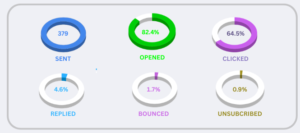
We built a full-stack E-Commerce email marketing backend designed to operate independently while generating measurable revenue growth.
A 12-member team was structured across:
Data analysis & segmentation
Email infrastructure & deliverability
Campaign creation & automation
Performance optimisation & reporting
Each function operated independently to ensure clarity and measurable output.
We implemented structured workflows using platforms like:
Initial focus:
Abandoned cart users
First-time buyers
Repeat customers
High-value segments
All lists were cleaned, segmented, and behaviour-tagged before campaign execution.
We deployed a multi-domain sending model:
8–10 sending domains
2–4 email accounts per domain
Gradual warm-up over 4–6 weeks
Actions included:
DNS configuration
SPF, DKIM, DMARC setup
Controlled sending increases
Deliverability monitoring
This ensured:
Strong inbox placement
Domain health protection
Long-term scalability
Campaigns included:
Welcome sequences
Abandoned cart flows
Post-purchase nurturing
Product recommendation emails
Re-engagement campaigns
All messaging was personalised and conversion-focused: no aggressive sales tone.
Performance was tracked based on:
Open rates
Click-through rates
Conversion rates
Revenue per campaign
Only high-performing segments were scaled.
Engaged users were:
Flagged for upsell or cross-sell
Routed to sales (if high-ticket products)
Retargeted through automation
No random blasts.
No unsegmented campaigns.
Only structured, revenue-driven execution.
If you want such powerful solutions, please Contact us