


Introduction
For years, Artificial Intelligence has been framed as a decision-support system analyzing vast datasets, identifying patterns, and assisting humans in making informed choices. While this capability transformed business intelligence, it still relied heavily on human interpretation and action.
In 2026, that paradigm is fundamentally shifting.
AI is no longer just assisting decisions it is making and executing them autonomously. This evolution marks a turning point in enterprise operations, where systems are not just intelligent but self-operating, self-correcting, and continuously optimizing.
This is not automation as we knew it. This is autonomous intelligence at scale.
The Evolution of AI: From Passive Insights to Active Execution
Understanding this shift requires looking at how AI has evolved across three distinct stages:
Stage 1: Descriptive & Diagnostic
- Focus: What happened and why
- Tools: Dashboards, reports, analytics
- Limitation: Human-driven interpretation
Stage 2: Predictive & Prescriptive
- Focus: What will happen and what should be done
- Tools: Machine learning models, forecasting systems
- Limitation: Still dependent on human approval
Stage 3: Autonomous (Current Shift)
- Focus: Acting in real time without human intervention
- Capabilities:
- Detect changes instantly
- Evaluate decisions dynamically
- Execute actions automatically
- Learn from outcomes continuously
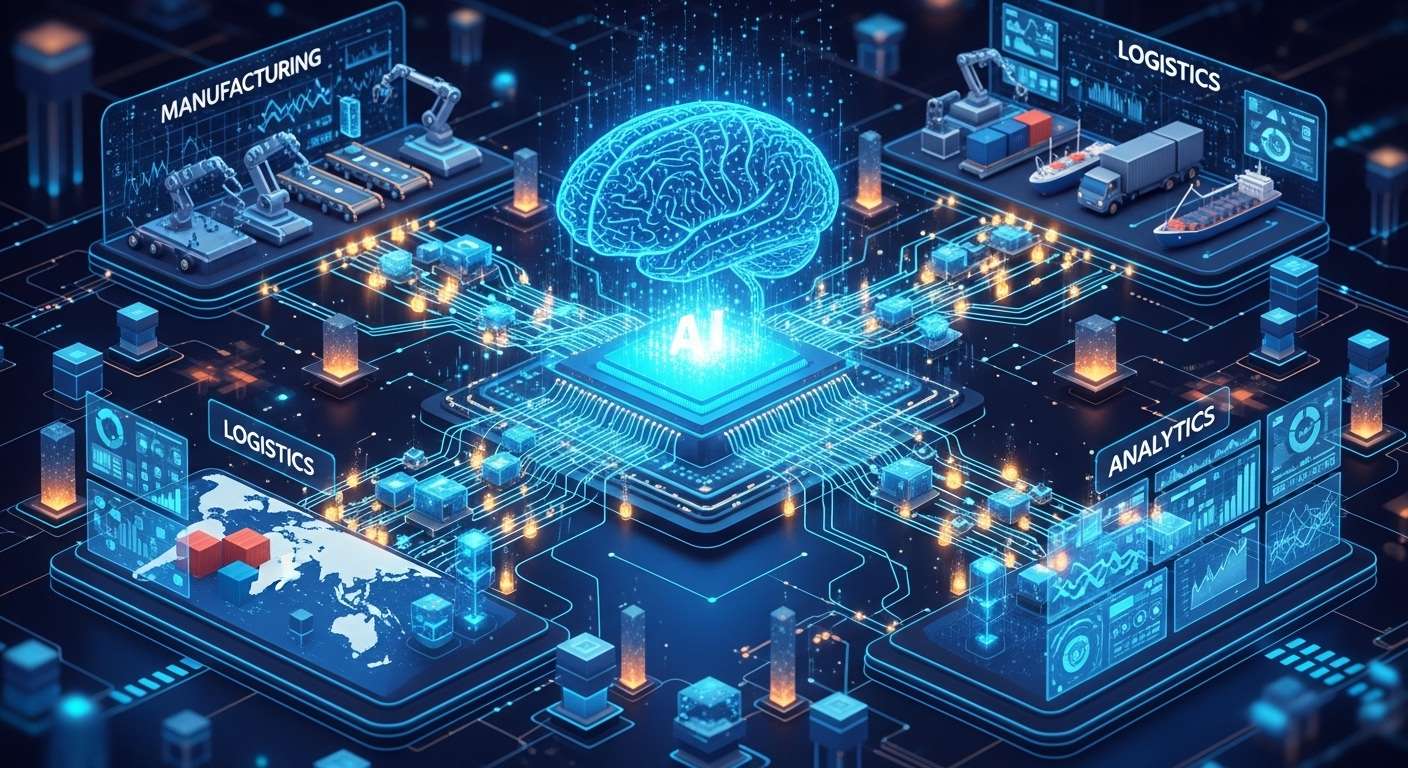
This third stage introduces a new operational model AI as an active decision-making layer embedded across the enterprise.
What Does Autonomous Decision-Making Actually Mean?
Autonomous decision-making in AI refers to systems that can:
- Interpret real-time data streams
- Identify deviations or opportunities
- Choose the best course of action
- Execute decisions instantly
- Refine future behavior through feedback loops
Unlike traditional automation (which follows predefined rules), autonomous Artificial intelligence systems are:
- Adaptive (adjust to changing conditions)
- Context-aware (understand broader system impact)
- Self-improving (learn continuously)
This enables a new level of intelligence systems that don’t just follow instructions, but evolve strategies.
The Core Engine: Closed-Loop Optimization
At the heart of autonomous Artificial intelligence lies closed-loop optimization, a system architecture where decision-making becomes continuous and self-reinforcing.
How It Works:
- Monitor
Artificial intelligence collects real-time data across systems - Analyze
Detects inefficiencies, anomalies, or opportunities - Decide
Evaluates multiple possible actions using advanced models - Act
Implements the optimal decision automatically - Learn
Measures results and updates decision logic
This loop runs continuously creating a system that improves every second, not just periodically.
Key Technologies Powering This Shift
Autonomous decision-making is not driven by a single innovation, but by the convergence of multiple technologies:
1. Reinforcement Learning
Allows AI to learn through trial and error, optimizing decisions based on outcomes.
2. Edge Computing
Enables faster decision-making by processing data closer to its source.
3. Digital Twins
Virtual replicas of real-world systems that allow Artificial intelligence to simulate and test decisions before execution.
4. Real-Time Data Pipelines
Provide continuous streams of data required for instant decision-making.
5. AI Agents & Multi-Agent Systems
Autonomous entities that collaborate and coordinate across workflows.
Real-World Applications Across Industries
Manufacturing: Self-Optimizing Production Lines
AI dynamically adjusts machine parameters such as temperature, speed, and pressure to maximize output and minimize waste.
Supply Chain: Autonomous Logistics Networks
AI reroutes shipments, balances inventory, and adapts to disruptions without human intervention.
Financial Services: Real-Time Risk Decisions
AI systems assess risk, detect fraud, and execute transactions in milliseconds.
IT & DevOps: Self-Healing Infrastructure
Systems detect performance issues, fix them automatically, and prevent downtime.
Energy & Utilities: Intelligent Resource Optimization
AI optimizes energy consumption, reduces costs, and aligns operations with sustainability goals.
Business Impact: Beyond Efficiency
The move toward autonomous decision-making is not just about doing things faster it’s about redefining how businesses operate.
1. From Reactive to Proactive Operations
Problems are prevented before they occur, rather than solved after the fact.
2. From Periodic Improvement to Continuous Evolution
Optimization is no longer a project it’s an ongoing process.
3. From Human Bottlenecks to Scalable Intelligence
Decision-making is no longer limited by human capacity.
4. From Siloed Systems to Integrated Intelligence
Artificial intelligence connects and optimizes processes across the entire organization.
The Human Role in an Autonomous Enterprise
A common misconception is that autonomous AI replaces humans. In reality, it redefines their role.
Humans Move Toward:
- Strategic decision-making
- Goal setting and system design
- Ethical oversight and governance
- Exception handling
Artificial intelligence Handles:
- Execution
- Optimization
- Real-time adjustments
- Data-driven decisions
This creates a collaborative model, where humans focus on direction and AI focuses on execution.
Challenges and Considerations
While the potential is immense, organizations must navigate several critical challenges:
Trust & Explainability
Leaders need visibility into how Artificial intelligence makes decisions.
Data Dependency
Poor-quality data can lead to incorrect decisions at scale.
Integration Complexity
Legacy systems may not support real-time AI execution.
Governance & Risk Management
Clear policies are required to define AI autonomy boundaries.
Change Management
Organizations must adapt culturally not just technologically.
A Practical Framework for Adoption
To successfully transition toward autonomous decision-making, organizations should follow a structured approach:
Step 1: Identify High-Impact Use Cases
Start with processes that benefit from real-time optimization.
Step 2: Build Data Infrastructure
Ensure reliable, real-time data pipelines.
Step 3: Introduce Artificial intelligence in Assisted Mode
Begin with decision support before moving to autonomy.
Step 4: Implement Closed-Loop Systems
Enable AI to execute and learn from decisions.
Step 5: Scale Across the Enterprise
Expand autonomous capabilities across departments.
The Competitive Advantage of Early Adoption
Organizations adopting autonomous AI are already seeing:
- Faster decision cycles
- Reduced operational costs
- Improved system resilience
- Enhanced customer experiences
More importantly, they are building adaptive enterprises capable of evolving continuously in response to changing conditions.
Future Outlook: Toward the Autonomous Enterprise
The next phase of AI evolution will go beyond isolated systems.
We are moving toward fully autonomous enterprises, where:
- Artificial intelligence systems coordinate across departments
- Decisions are made in real time across the value chain
- Operations become self-optimizing at scale
This will redefine industries, reshape competition, and establish new performance benchmarks.
Conclusion
AI’s transformation from a support tool to an autonomous decision-maker marks one of the most significant shifts in modern business.
Organizations that embrace this change will not just improve efficiency they will unlock a new operating model defined by intelligence, speed, and adaptability.
The future belongs to enterprises that move beyond insights and embrace action-driven AI systems.
For more Contact US
Similar Posts
Business & Consulting
7 Powerful Reasons Profitability Consulting Is Replacing Growth-Only Advisory
For more than a decade, startup consulting was heavily centered around one objective: growth. Advisors helped founders optimize…

Business & Consulting
How Startup Funding Is Unlocking New Opportunities Across Europe
For more than a decade, European tech funding has been dominated by a handful of major hubs cities…