



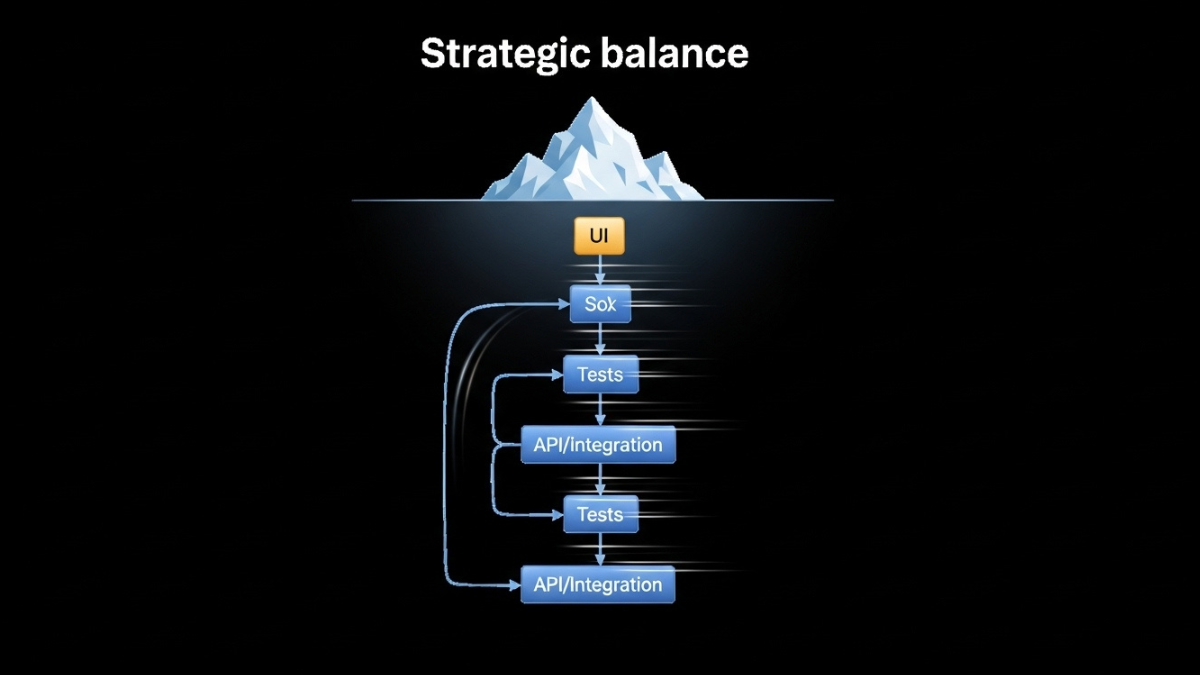
Introduction: UI Automation Hit Its Limits
For years, UI automation was treated as the gold standard of test automation. If the test clicked buttons, filled forms, and mimicked real users, it was considered “end-to-end” and therefore valuable.
In 2026, that assumption no longer holds.
Modern software systems are faster, more distributed, and more complex than UI-heavy automation can reliably handle. As teams push for continuous delivery and faster feedback, UI-centric test suites are increasingly becoming a bottleneck rather than a safeguard.
This is why API-first automation is rapidly replacing UI-heavy testing as the backbone of modern quality strategies.
The Core Problem With UI-Heavy Automation
UI automation is not inherently bad. It’s just been overused and misapplied.
The common issues are well known:
- Tests are slow
- Tests are brittle
- Minor UI changes break large test suites
- Debugging failures is time-consuming
- Pipelines become unstable
As applications adopt microservices, headless frontends, and dynamic UI frameworks, UI tests become increasingly fragile.
The result? Teams spend more time maintaining tests than validating quality.
Modern Applications Are API-Driven by Design
Most modern applications follow this architecture:
- UI is a thin layer
- Business logic lives in APIs
- Data flows through services
In many systems, 90% of application behavior is driven by APIs, not the UI.
Testing only at the UI layer means:
- You test logic indirectly
- Failures are harder to diagnose
- Coverage is shallow despite many tests
API-first automation aligns testing with where real logic lives.
What API-First Automation Actually Means
API-first automation does not mean “no UI tests.”
It means:
- APIs are tested first and most thoroughly
- UI tests are reduced to critical user flows
- Business logic is validated directly
- UI tests become confirmation layers, not primary defenses
This approach creates faster, more reliable, and more meaningful test coverage.
Why API Tests Are Faster and More Stable
1. Fewer Moving Parts
API tests don’t depend on:
- Browsers
- Rendering engines
- Animations
- Frontend timing issues
They run faster and fail for real reasons, not cosmetic ones.
2. Clearer Failure Signals
When an API test fails, you know:
- Which service failed
- Which endpoint
- Which payload
- Which validation broke
UI failures often require digging through logs, screenshots, and recordings just to understand what happened.
API-First Automation reduce diagnostic noise.
3. Earlier Feedback in the Pipeline
API tests can run:
- On every commit
- In parallel
- Without heavy infrastructure
This enables true shift-left testing, catching defects before they reach the UI layer.
UI Automation Is Still Needed: Just Less of It
API-First Automation does not mean UI-free.
UI tests still matter for:
- Critical user journeys
- Visual regressions
- Accessibility validation
- Smoke testing production readiness
But instead of hundreds of UI tests, modern teams maintain:
- A small, high-value UI suite
- Focused on user confidence, not coverage numbers
This dramatically reduces flakiness and maintenance overhead.
The CI/CD Reality: Speed Beats Exhaustiveness
In continuous delivery environments, feedback speed matters more than exhaustive UI coverage.
API-first automation enables:
- Faster pipelines
- Predictable execution times
- Reliable gating of releases
UI-heavy pipelines often become:
- Slow
- Unstable
- Frequently bypassed
Once teams stop trusting pipelines, automation loses its value.
API-First Testing Fits QAOps and DevOps Models
As QA evolves into QAOps, automation is expected to:
- Live inside CI/CD
- Support observability
- Enable rapid releases
API-First Automation testing fits naturally into this model:
- APIs are stable integration points
- Tests can be owned by teams
- Automation aligns with service ownership
UI-heavy automation often sits outside these workflows, creating friction.
Contract Testing Strengthens API-First Strategies
Modern API-first approaches often include:
- Contract testing
- Schema validation
- Consumer-driven tests
This ensures:
- Services don’t break downstream consumers
- Changes are validated before deployment
- Teams can move independently
UI tests cannot provide this level of service-to-service confidence.
Cost Is Becoming Impossible to Ignore
UI automation is expensive:
- Infrastructure costs
- Maintenance time
- Debugging effort
API tests are cheaper to:
- Write
- Run
- Maintain
In an environment where automation ROI is scrutinized, API-first testing consistently delivers better cost-to-confidence ratios.
Why Teams Are Actively Reducing UI Test Suites
Across industries, teams are:
- Deleting redundant UI tests
- Migrating logic validation to APIs
- Keeping only high-impact UI coverage
This is not a trend—it’s a correction.
Teams learned that:
More UI tests ≠ better quality
Better test design does.
Common Mistakes When Adopting API-First Automation
1. Treating APIs as Implementation Details
API tests should validate behavior and contracts, not internal logic.
Over-coupled tests create fragility.
2. Ignoring Data Management
API tests require:
- Controlled test data
- Isolated environments
- Predictable states
Without this, API tests become flaky too.
3. Eliminating UI Tests Completely
Removing all UI tests creates blind spots.
Balance matters.
How to Transition From UI-Heavy to API-First
A practical approach:
- Identify business-critical flows
- Move logic validation to API tests
- Reduce UI tests to core journeys
- Introduce contract testing
- Measure pipeline stability and speed
The goal is confidence, not coverage metrics.
What This Means for Automation Engineers
The role is changing.
Automation engineers now need:
- Strong API testing skills
- Understanding of system architecture
- CI/CD integration experience
- Data and environment management expertise
Click-based automation alone is no longer enough.
Final Thoughts: Quality Lives Below the UI
UI automation made sense when applications were monoliths. Modern systems are not.
In 2026, quality is built:
- At the service layer
- At integration points
- Inside pipelines
API-first automation reflects how software is actually built and deployed today.
UI testing still plays a role but it’s no longer the foundation.
The teams that succeed are those that stop testing appearances and start testing behavior. For More Details Contact Us
Similar Posts
Software Testing & QA
Advanced Threat Modeling Strategies for Stronger Security Testing in 2026
For years, threat modeling was treated as a separate security exercise typically conducted at the beginning of a…
Software Testing & QA
QAOps: How Continuous Testing Is Rewriting Quality Assurance in 2026
Introduction: Quality Assurance Is No Longer a Phase It’s a System For years, Quality Assurance lived at the…