



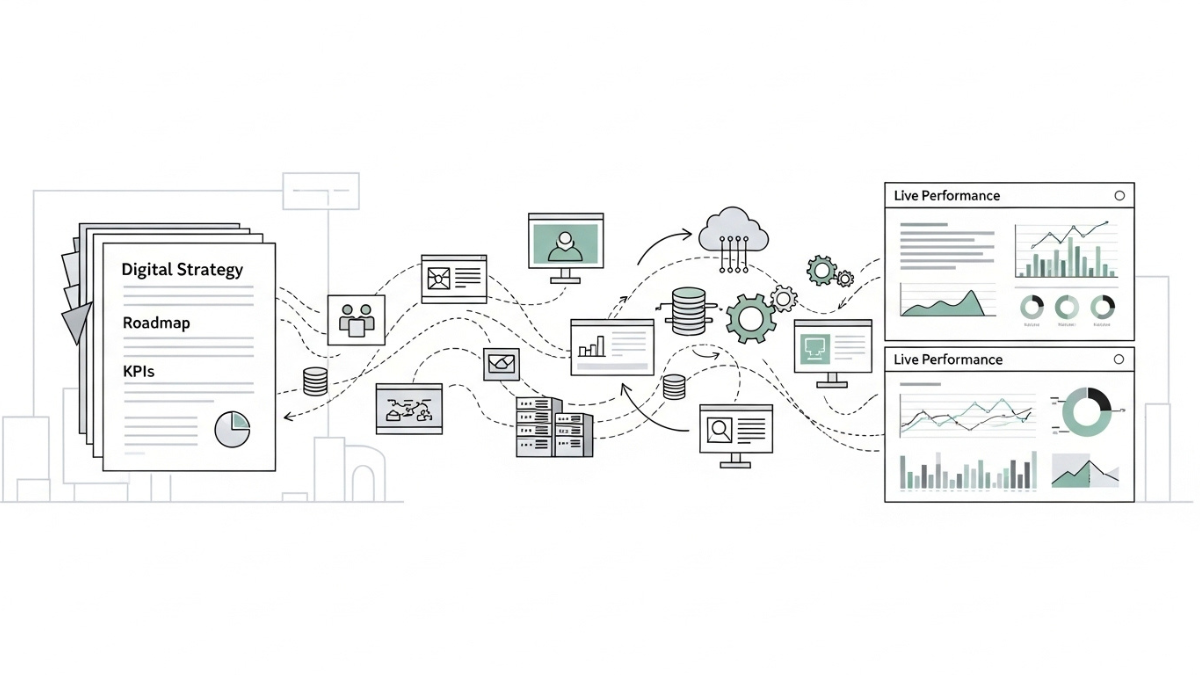
In today’s competitive environment, technology decisions influence nearly every aspect of business performance from operational efficiency and customer experience to revenue growth and market expansion. Organizations are investing heavily in cloud infrastructure, automation platforms, data analytics, cybersecurity frameworks, and custom software development.
Yet many of these investments fail to deliver expected returns. The issue is the absence of a clearly defined digital strategy.
Without structured direction, digital initiatives become fragmented, reactive, and disconnected from business objectives. A well-designed digital strategy transforms technology from a cost center into a long-term growth accelerator.
Digital Strategy Is More Than Technology Planning
A digital strategy is not simply an IT upgrade plan. It is a business growth framework powered by technology.
It defines:
- How digital capabilities will create competitive advantage
- How systems will scale as the company grows
- How operational processes will be optimized through automation
- How data will drive smarter decisions
- How risk and compliance will be proactively managed
In short, digital strategy aligns business ambition with technical execution.
Why Digital Initiatives Fail Without Strategic Alignment
Many companies begin transformation efforts by implementing tools before defining outcomes. This often results in:
- Technology silos across departments
- Integration challenges between platforms
- Redundant investments
- Budget overruns
- Low adoption among internal teams
When systems are implemented without a unified roadmap, complexity increases instead of efficiency.
Digital maturity requires structured governance, prioritized implementation phases, and executive-level oversight.
The Strategic Role of Leadership in Digital Direction
One of the most overlooked components of digital strategy is executive alignment.
Successful organizations ensure that:
- C-level leadership defines measurable digital objectives
- IT leaders translate business priorities into architecture plans
- Department heads align operational workflows with system capabilities
- KPIs are monitored continuously
It cannot be delegated solely to technical teams. It requires cross-functional leadership to ensure technology investments deliver real business value.
A Phased Approach to Digital Strategy Development
An effective digital strategy typically follows a structured progression:
Phase 1: Current State Assessment
Evaluate infrastructure, software ecosystem, data capabilities, security posture, and process inefficiencies.
Phase 2: Gap Analysis
Identify disconnects between current digital capability and future business goals.
Phase 3: Architecture Blueprint
Design scalable systems, integration models, security frameworks, and cloud environments.
Phase 4: Prioritized Roadmap
Develop a step-by-step execution plan based on business impact and technical feasibility.
Phase 5: Continuous Optimization
Monitor performance, measure ROI, and refine systems as the organization evolves.
Digital strategy is not static. It adapts as markets, technologies, and business models change.
The Financial Impact of a Strong Digital Strategy
A well-implemented digital strategy delivers measurable results, including:
- Reduced operational costs through automation
- Faster product or service delivery cycles
- Increased customer retention through improved user experience
- Stronger cybersecurity posture
- Higher revenue through scalable infrastructure
Most importantly, it reduces uncertainty. Organizations with structured digital direction make confident decisions about investments, hiring, and expansion.
Digital Strategy in a Rapidly Evolving Technology Landscape
The pace of innovation continues to accelerate. Artificial intelligence, cloud-native applications, advanced analytics, and automation are reshaping industries at unprecedented speed.
Without strategic planning, companies risk:
- Falling behind competitors
- Over-investing in trends without clear ROI
- Building systems that quickly become obsolete
A modern digital strategy anticipates change rather than reacting to it. It emphasizes flexibility, modular architecture, and long-term scalability.
How Nautics Technologies Supports Digital Strategy Execution
At Nautics Technologies OU, digital strategy consulting combines business analysis with technical execution expertise. The approach focuses on:
- Translating executive vision into practical IT roadmaps
- Designing scalable enterprise architectures
- Integrating automation and data-driven processes
- Strengthening cybersecurity foundations
- Supporting implementation with full-stack engineering capabilities
The goal is not to create theoretical documents, but to build systems that perform under real-world conditions.
The Competitive Advantage of Clarity
In markets defined by disruption and digital acceleration, clarity becomes a strategic asset.
Organizations with a defined digital strategy:
- Move faster with less risk
- Scale operations efficiently
- Adapt to technological change
- Outperform competitors who operate reactively
Digital success is not determined by how many tools a company adopts.
It is determined by how intentionally those tools are integrated into a unified growth framework. For details Contact Us
Similar Posts

Business & Consulting
How Startup Funding Is Unlocking New Opportunities Across Europe
For more than a decade, European tech funding has been dominated by a handful of major hubs cities…

Business & Consulting
Why Digital Transformation Is About Execution, Not Vision in 2026
Introduction: The Vision Era Is Over For years, digital transformation was sold as a vision problem. Companies hired…