



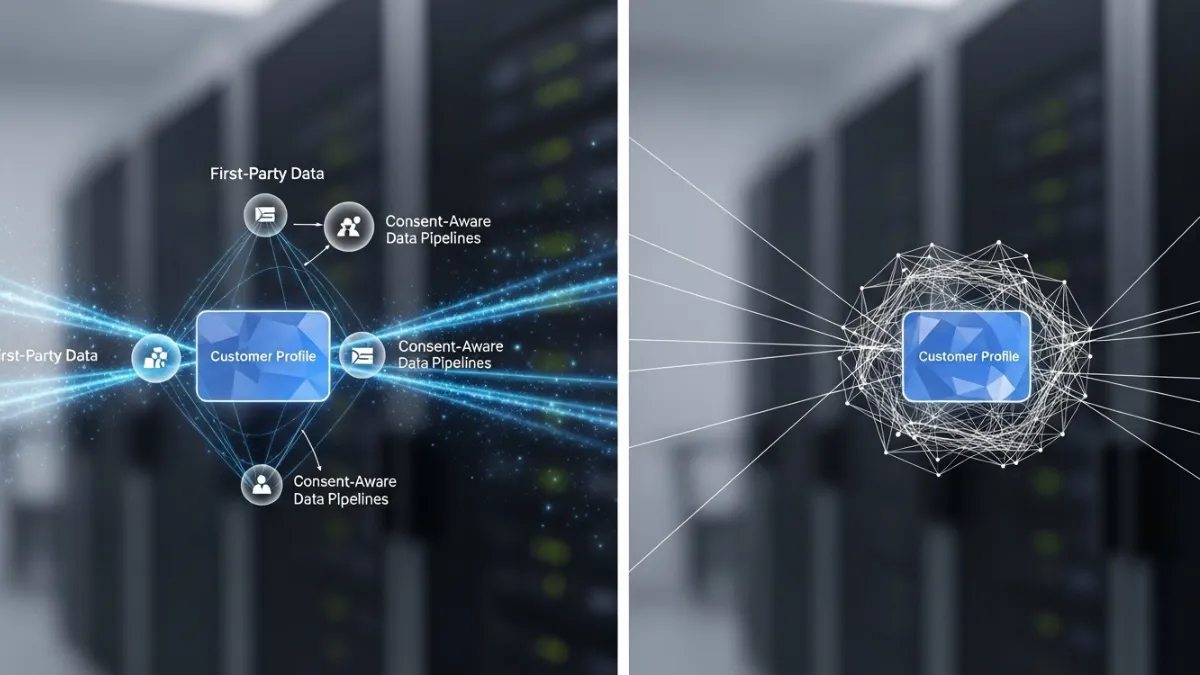
Introduction: First-Party Data Is No Longer Optional
For years, marketing platforms differentiated themselves through features: automation, AI, dashboards, and channel integrations. In 2026, that differentiation has collapsed.
Most platforms now look similar on the surface.
What actually separates winners from laggards today is first-party data readiness the ability to collect, process, activate, and govern customer data without relying on third-party tracking.
With cookies disappearing, attribution weakening, and privacy enforcement tightening, marketing teams are being forced to rethink their platforms from a data ownership perspective. The question is no longer which tool has more features, but:
Which platform gives us control over our data and lets us use it safely and effectively?
This blog breaks down how modern marketing platforms compare when evaluated through that lens.
What “First-Party Data Readiness” Really Means
Before comparing platforms, it’s important to define the criteria. First-party data readiness is not a single feature it’s a capability stack.
A first-party-ready marketing platform must support:
- Direct data collection from owned channels
- Consent-aware data handling
- Centralized customer profiles
- Activation across paid, owned, and earned channels
- Server-side and privacy-safe tracking
- Clear data ownership and portability
Many platforms claim readiness. Few deliver it end-to-end.
Why First-Party Data Is the New Performance Foundation
The shift toward first-party data isn’t philosophical it’s forced by reality.
Key drivers include:
- Loss of third-party cookies
- Platform-level tracking restrictions
- Modeled and delayed attribution
- Regulatory scrutiny (GDPR, AI usage, consent UX)
Performance marketing now depends on how well platforms handle what you own, not what they can infer.
As a result, marketing platform comparisons have fundamentally changed.
Category 1: All-in-One Marketing Platforms (CRM-Centric)
Strengths
All-in-one platforms typically combine:
- CRM
- Marketing automation
- Email and messaging
- Lead tracking
- Basic analytics
First-party data advantage:
These platforms naturally excel at data collection and ownership. They ingest data directly from:
- Forms
- Emails
- Landing pages
- CRM interactions
They offer:
- Persistent customer profiles
- Built-in consent handling
- Strong identity resolution
Weaknesses
- Limited flexibility for advanced data modeling
- Paid media activation often depends on external connectors
- Less control over raw event data
Best for
- SMBs and mid-market teams
- B2B marketing
- Organizations prioritizing ownership over experimentation
Verdict:
Strong first-party foundations, but limited customization at scale.
Category 2: Customer Data Platforms (CDPs)
Strengths
CDPs are built specifically for first-party data.
They excel at:
- Centralizing data from multiple sources
- Identity resolution across devices and channels
- Consent-aware data processing
- Feeding clean data into downstream tools
They provide:
- High data transparency
- Strong governance controls
- Advanced segmentation
Weaknesses
- Not execution tools on their own
- Require integration with ad platforms, CRMs, and marketing tools
- Can be expensive and complex
Best for
- Data-mature organizations
- Multi-channel marketing teams
- Enterprises with fragmented data stacks
Verdict:
Best-in-class for data control, but only valuable if activation is well integrated.
Category 3: Performance Marketing Platforms
Strengths
Traditionally optimized for:
- Paid media execution
- Attribution modeling
- Campaign optimization
Some platforms are evolving to support:
- Server-side tracking
- First-party signal ingestion
- CRM integrations
Weaknesses
- Often depend heavily on platform APIs
- Limited control over how data is stored or reused
- First-party data is frequently treated as an input not an asset
Best for
- Paid-media-heavy teams
- Short-term optimization focus
Verdict:
Improving, but still secondary players in first-party data strategy.
Category 4: Analytics-First Platforms
Strengths
Analytics platforms have become central to first-party strategies.
They provide:
- Event-level data capture
- Server-side tracking support
- Flexible data schemas
- Integration with warehouses
These platforms shine at:
- Data accuracy
- Transparency
- Custom analysis
Weaknesses
- Limited native activation
- Require technical setup
- Not marketer-friendly out of the box
Best for
- Product-led companies
- Data-driven growth teams
- Organizations with engineering support
Verdict:
Excellent for data collection and insight activation still requires additional tooling.
Category 5: AI-Driven Marketing Platforms
Strengths
AI-first platforms promise:
- Automated personalization
- Predictive segmentation
- AI-driven recommendations
Some support:
- First-party data ingestion
- Behavior-based modeling
Weaknesses
- Often opaque about how data is processed
- Risk of training on customer data without clarity
- Weak consent and governance tooling
Best for
- Experimentation-focused teams
- Use cases with low compliance risk
Verdict:
Powerful but risky if data governance is unclear.
Key Comparison Criteria That Matter in 2026
1. Data Ownership
Ask:
- Can you export raw data easily?
- Is data stored in a vendor-controlled format?
- What happens if you leave the platform?
Ownership is non-negotiable.
2. Consent & Privacy Controls
Modern platforms must:
- Respect consent across channels
- Allow granular control
- Support regional compliance
If privacy is bolted on, it will fail under scrutiny.
3. Server-Side & Event-Based Tracking
Client-side tracking is unreliable.
Platforms must support:
- Server-side event ingestion
- Custom events
- Durable identifiers
Without this, first-party data remains fragile.
4. Activation Without Lock-In
First-party data is useless if it can’t be activated flexibly.
Look for:
- Clean integrations
- API access
- Multi-channel activation
Avoid platforms that trap data inside proprietary workflows.
Why Many Tool Comparisons Miss the Point
Most comparison blogs focus on:
- Feature lists
- Pricing tiers
- UI screenshots
In 2026, these factors matter far less than data posture.
Two platforms may look identical on the surface, but:
- One gives you long-term control
- The other creates hidden dependency
That difference determines future scalability.
The Strategic Trade-Off: Simplicity vs Control
There is no universal “best” platform.
Instead, there is a trade-off:
- Simplicity: All-in-one tools, faster setup, less flexibility
- Control: CDPs + analytics + activation stack, more complexity
Smart organizations choose based on:
- Data maturity
- Compliance exposure
- Internal capabilities
The wrong choice isn’t complexity or simplicity it’s misalignment.
What Smart Buyers Are Doing Differently
In 2026, experienced buyers:
- Audit data flows before choosing tools
- Map consent and ownership explicitly
- Prioritize portability over convenience
- Reduce platform dependency
They treat marketing platforms as infrastructure decisions, not feature purchases.
Final Thoughts: First-Party Readiness Is the New Differentiator
Marketing platforms are converging in features but diverging in data philosophy.
The platforms that win in the next decade will be those that:
- Respect data ownership
- Enable privacy-by-design
- Support flexible activation
- Integrate cleanly into broader ecosystems
Choosing a platform without evaluating first-party data readiness is no longer a tactical mistake it’s a strategic risk.
In 2026, marketing performance is built on what you own, not what you borrow. For more details Contact Us
Similar Posts
Marketing
9 Proven Benefits of AI Search Integration for Better Content Discovery
AI search integration is transforming how content is discovered, summarized, and ranked in modern search engines. In 2026,…

Marketing
Autonomous Orchestration: 5 Powerful Strategies Transforming Marketing Workflows
Marketing automation has moved far beyond scheduled email sequences and rule-based drip campaigns. Today, we are witnessing the…