



Category
Share on
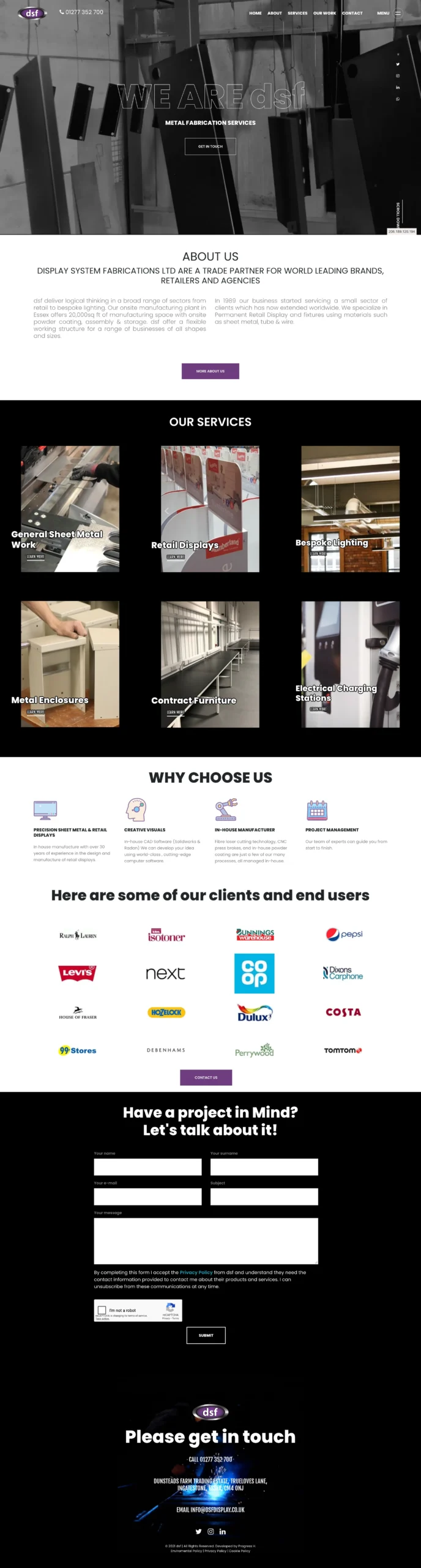
The DSF Display project was delivered through a strategic collaboration between Progress Hacker and Nautics Technologies, where Nautics Technologies served as the core development partner responsible for the technical architecture and implementation.
The end client, DSF Display, is a long-established industrial manufacturing brand with deep expertise in metal refurbishing, precision fabrication, and large-scale industrial production. Over the years, DSF Display has supported globally recognized brands across multiple industries, including consumer electronics, beverages, retail, and industrial infrastructure. Their operations span complex manufacturing processes, custom-built industrial solutions, and high-capacity production facilities designed to meet demanding commercial and operational standards.
Despite this scale, experience, and industry trust, DSF Display’s digital presence failed to reflect the reality of the business.
The existing website had been built decades earlier and had seen only minimal updates since its initial launch. It relied on outdated design patterns, legacy layouts, and an inflexible structure that made both content updates and technical improvements increasingly difficult. From a user perspective, the site did not communicate the company’s manufacturing capabilities, production capacity, or technical credibility. From a business perspective, it did little to support brand positioning, partnerships, or future growth.
Key shortcomings of the legacy website included:
An outdated visual identity that did not align with DSF’s industrial scale or modern facilities
Limited ability to showcase partnerships, past projects, and long-term client relationships
Poor content hierarchy, making it difficult for visitors to understand DSF’s services and expertise
A technical foundation that restricted performance, security, and scalability
As DSF Display continued to work with globally recognized brands and expand its industrial capabilities, the gap between the company’s real-world operations and its digital representation became increasingly difficult to justify. What was needed was not a superficial redesign, but a fundamental modernization of the website one that could accurately represent DSF Display as a serious, capable, and future-focused industrial manufacturing partner.
This project set out to close that gap by rebuilding DSF Display’s digital presence from the ground up, aligning the website’s structure, performance, and visual language with the scale and credibility of the brand behind it.
The client’s requirements were precise and intentionally constrained.
DSF Display wasn’t technically complex it was strategically sensitive.
For established brands, the biggest risk is overdesigning.
Too much animation, too many pages, or aggressive marketing language would:
Restraint was critical.
DSF had:
Trying to include everything would have resulted in noise.
The challenge was what to leave out, not what to add.
The development timeline depended on:
Back-and-forth on assets directly affected delivery speed.
We treated DSF Display as a brand alignment project, not a feature build.
We started with a basic UI concept, focused on:
This initial UI was used to:
Once approved, we moved forward.
We designed a five-page structure that balanced simplicity and authority:
No blog.
No clutter.
No unnecessary pages.
The website of DSF Display was developed using PHP with the Laravel framework.
Why Laravel:
This ensured the website:
Once final assets were delivered, we integrated:
We intentionally limited the number of logos shown to avoid:
This preserved premium positioning.
The total delivery timeline was 10 days, including:
The timeline was driven not by development complexity, but by asset coordination and approvals.
If you want a solution like this, Contact Us.