


Category
Share on
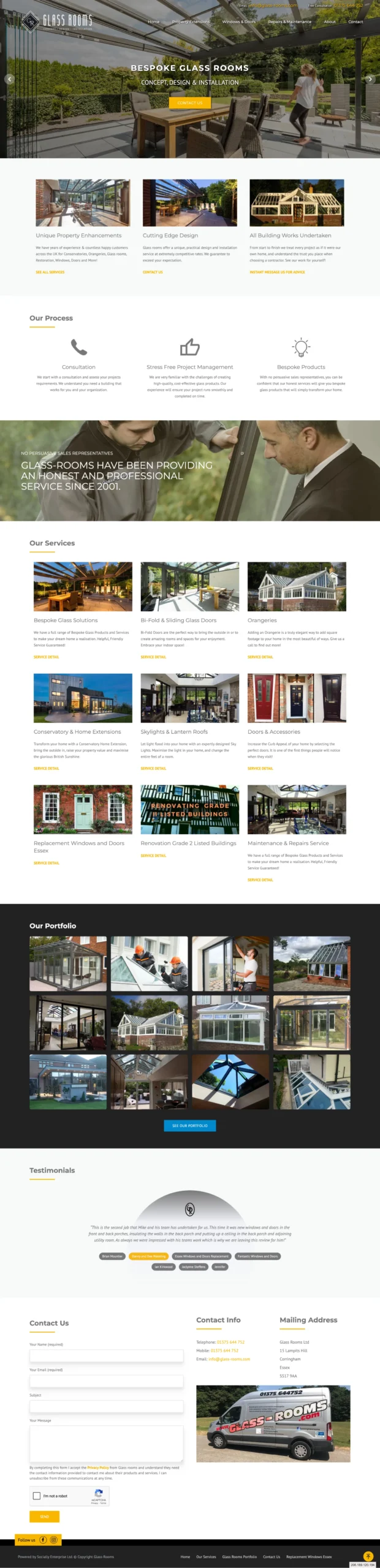
Glass Rooms project was delivered through a white-label collaboration with Progress Hacker, where we acted as the development partner under an outreach and white-label model.
The end client was an industrial glass company, specializing in glass installation, glass reforming, and material-based glass solutions. Their website was a critical business tool for:
However, their existing website: built by a freelancer had become a liability rather than an asset.
The client did not want innovation.
Glass Rooms wanted stability, security, and speed.
And they wanted it fast.
In addition, the website needed to support the client’s day-to-day operations without introducing complexity or risk. Downtime, security vulnerabilities, and performance issues were directly affecting trust and lead flow, making a fast and reliable rebuild a business necessity rather than a technical upgrade. The goal was not to introduce new features or experimental design elements, but to restore confidence in the platform by ensuring that every core function worked flawlessly under real-world usage.
Our role focused on delivering a clean, secure, and maintainable WordPress infrastructure that could support the client’s existing workflows while eliminating the technical debt left by the previous implementation. This included reinforcing security standards, improving page load performance, and restructuring the backend to allow future updates without disruption. The result needed to be a website that the client could rely on daily one that functioned as a stable operational asset rather than a source of ongoing technical risk.
Glass Rooms client’s requirements were practical and non-negotiable.
Glass Rooms wasn’t complex it was damaged.
The existing WordPress site used by Glass Rooms suffered from multiple structural issues
As a result, the Glass Rooms website became increasingly unstable:
Before recommending a rebuild, we attempted to fix the existing website:
After two to three repair cycles, it became clear:
Maintenance costs were exceeding the cost of rebuilding.
Continuing would have been irresponsible.
The client could not afford:
The solution had to be:
The problem of Glass Rooms was a strategic reset, not a technical experiment.
We made a clear recommendation:
“Stop fixing a broken foundation. Rebuild it properly.”
This saved the client money in the long run and eliminated ongoing risk.
Despite past issues, WordPress was still the right choice when implemented correctly.
Why:
The problem wasn’t WordPress.
The problem was how it was built.
We built a completely new WordPress website, not a patch job.
Key actions:
No legacy baggage was carried over.
Security was not an add-on it was built in.
We implemented:
This eliminated the repeated hacking issue at its root.
We configured the site to support:
Everything was designed so the client’s internal team could operate independently.
The entire rebuild was completed in one week.
This included:
No extended timelines.
No hidden phases.
If you want such powerful solutions, please Contact us