

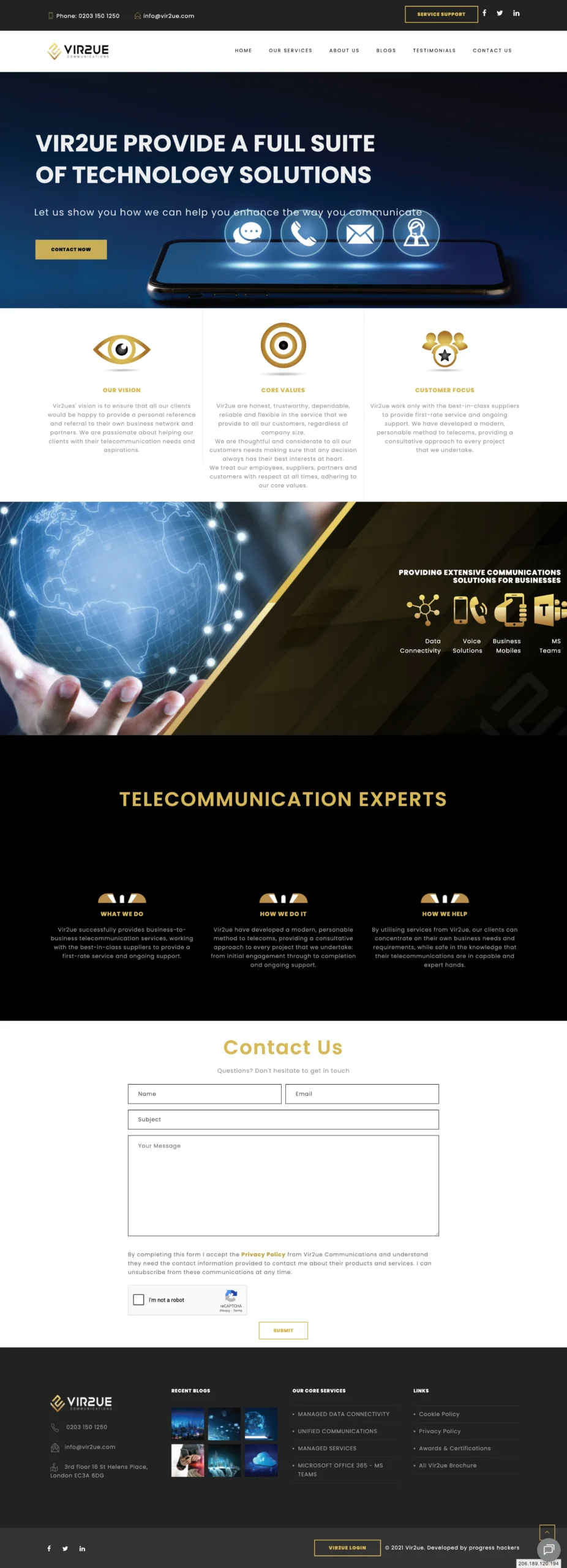
Overview: VIR2UE

VIR2UE was delivered through our partnership with Progress Hacker, a UK-registered IT company. Together, we were engaged by one of their enterprise clients a large UK-based telecom and data services provider offering telephone, connectivity, and business communication solutions.

At the time of engagement, VIR2UE was undergoing a major business transformation. Their legacy VDSL-focused model was being replaced by a modern, virtualized service offering. This shift required more than a visual refresh. it demanded a complete digital reset.

The existing brand, website, and infrastructure no longer reflected:

  • Their updated services
  • Their enterprise positioning
  • Their long-term growth strategy

The objective was clear: rebuild the brand and digital platform from the ground up, while ensuring deep integration with internal systems and future marketing tools.

This was not a marketing website.
This was an enterprise operational platform.

Show More

Requirements

Once discovery began, the scope became clearly enterprise-level.

Core Requirements

  1. Complete Website Rebuild
    • Modern, sharp, enterprise-grade design
    • Multiple high-conversion landing pages
    • Clear service segmentation
  2. Design-to-Code Accuracy
    • Client had an in-house design team
    • Designs delivered in Figma
    • Pixel-accurate implementation required
  3. CRM Integration
    • Website must connect directly to their UK-based custom CRM
    • Lead data flow without manual intervention
    • Backend-controlled content management
  4. Internal Content Control
    • Ability to manage landing pages internally
    • Blog publishing via CRM/backend
    • No dependency on developers for updates
  5. Chat Support
    • Real-time customer communication
    • Integrated into backend workflows
  6. Marketing Scalability
    • Marketing-ready architecture
    • Future automation support

CRM + marketing tool interoperability

Challenges

VIR2UE had multiple layers of complexity.

1. Business Model Transformation

VIR2UE was not just changing a website, they were:

  • Shifting from VDSL to virtual services
  • Repositioning their market offering
  • Updating internal workflows

The website had to support change, not block it.

2. Enterprise Design Precision

With an internal design team involved, tolerance for mismatch was zero.
The challenge was to translate Figma designs into production-ready code without compromise.

3. CRM Dependency

Unlike marketing sites that use external forms, this platform had to:

  • Integrate directly with a proprietary UK CRM
  • Respect internal data structures
  • Maintain security and performance

4. Long-Term Scalability

This was not a “launch and forget” project.
The architecture needed to support:

  • Continuous landing page creation
  • Content updates
  • Marketing integrations
  • Future system expansions

Solution

We approached VIR2UE as a system rebuild, not a website build.

Step 1: Design Alignment & Technical Planning

We began by aligning with:

  • Progress Hacker’s technical team
  • The client’s in-house designers

Using Figma, we reviewed:

  • Page structures
  • Component logic
  • Design consistency
  • Reusability requirements

This step eliminated downstream friction.

Step 2: Design-to-Code Conversion

The approved Figma designs were first converted into a clean PHP implementation, ensuring:

  • Accurate layout rendering
  • Responsive behavior
  • Performance optimization

This intermediate step allowed validation before full framework migration.

Step 3: Migration to Laravel

Once validated, VIR2UE website was migrated to the latest version of Laravel.

Why Laravel:

  • Enterprise-grade security
  • Clean MVC architecture
  • Long-term maintainability
  • Custom backend flexibility

This formed the core of the platform.

Step 4: Custom Backend & CRM Integration

We developed a custom backend system that:

  • Connected directly to the client’s UK-based CRM
  • Allowed internal teams to:
    • Create landing pages
    • Publish blogs
    • Manage content independently

This eliminated reliance on third-party CMS tools and gave the client full ownership.

Step 5: Chat Support & Lead Flow

A chat support system was integrated and connected to backend workflows, enabling:

  • Real-time customer interaction
  • Structured lead capture
  • CRM-aligned data flow

This ensured no communication was lost or fragmented.

Step 6: Marketing Automation Integration

After the initial launch and stabilization phase, we integrated HubSpot to support:

  • Marketing automation
  • Lead nurturing
  • Campaign tracking
  • Sales alignment

The architecture had been designed for this from day one—no refactoring needed.

If you want such a powerful solutions, please Contact us

Technologies Used