



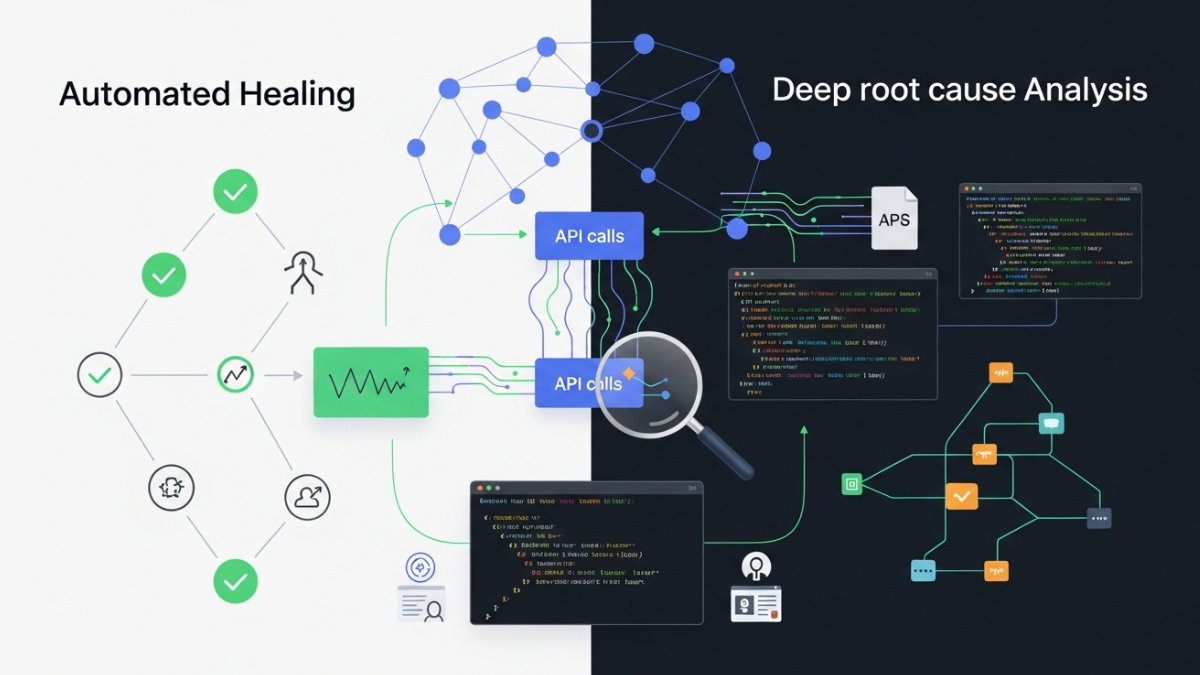
Introduction: Stability Isn’t the Same as Confidence
Over the last few years, self-healing tests have been marketed as the answer to flaky automation. Broken locators? Healed. Timing issues? Retried. UI changes? Adapted automatically.
At first, the results looked impressive. Pipelines got greener. Test failures dropped. Teams felt relief.
Then something uncomfortable happened: production bugs still escaped.
In 2026, many engineering teams are realizing a hard truth self-healing tests improve test stability, but they do not improve system understanding. And without understanding why failures happen, quality remains fragile.
This is where root-cause intelligence enters the picture.
What Self-Healing Tests Actually Do (and Don’t)
Self-healing tests are designed to adapt when something changes unexpectedly. They typically:
- Auto-update UI locators
- Retry failed steps
- Adjust waits and timeouts
- Mask transient failures
Their purpose is clear: reduce noise in automation pipelines.
And they succeed at that.
What they don’t do:
- Explain why a test failed
- Identify system instability
- Detect architectural regressions
- Surface hidden risk
Self-healing is reactive. It fixes symptoms, not causes.
Why Self-Healing Became Popular
The rise of self-healing tests wasn’t accidental.
They addressed real pain:
- UI tests breaking on minor changes
- Flaky pipelines blocking releases
- High maintenance costs
- QA teams overwhelmed by false failures
In fast-moving environments, self-healing felt like progress and in some ways, it was.
But over time, teams began confusing silence with reliability.
The Hidden Risk: Quietly Broken Signals
The biggest danger of self-healing tests is not what they break it’s what they hide.
When tests auto-heal:
- Instability is masked
- Regression signals are weakened
- Failure patterns disappear
- Engineers lose feedback loops
The pipeline stays green, but confidence erodes.
This creates what many teams now call “silent flakiness” systems that are unstable, but no longer visible through tests.
Root-Cause Intelligence: A Different Philosophy
Root-cause intelligence focuses on understanding, not suppression.
Instead of asking:
“How do we stop this test from failing?”
It asks:
“Why did this failure happen, and what does it tell us about the system?”
Root-cause intelligence uses:
- Failure pattern analysis
- Correlation across services
- Change-impact detection
- Signal classification (infra vs app vs test)
Its goal is not greener pipelines it’s better decisions.
Why Root-Cause Intelligence Matters More in 2026
Modern systems are:
- Distributed
- API-driven
- Highly integrated
- Continuously deployed
Failures rarely come from a single UI element. They come from:
- Contract changes
- Data inconsistencies
- Environment drift
- Dependency latency
- Race conditions
Self-healing tests struggle in these environments because they operate too close to the surface.
Root-cause intelligence operates at the system level.
Self-Healing vs Root-Cause Intelligence: The Core Differences
Self-Healing Tests
- Reactive
- UI-focused
- Symptom-oriented
- Optimized for pipeline stability
- Reduces visible failures
Root-Cause Intelligence
- Proactive
- System-focused
- Cause-oriented
- Optimized for confidence and learning
- Reduces real defects
One keeps tests running.
The other keeps systems healthy.
Where Self-Healing Still Makes Sense
Self-healing is not useless. It just needs boundaries.
It works best when:
- Used on low-risk UI paths
- Applied to cosmetic or locator changes
- Combined with strict reporting
- Treated as noise reduction, not quality validation
Self-healing should buy time, not replace investigation.
Why Teams Are Shifting Toward Root-Cause Intelligence
Leading QA and platform teams are changing priorities because:
- Green pipelines no longer equal safe releases
- Flaky behavior reappears in production
- Engineers distrust “auto-fixed” tests
- AI-generated tests amplify noise without insight
Root-cause intelligence restores trust by making failures actionable.
How AI Changes This Equation
AI has made both sides stronger and more dangerous.
AI can:
- Generate self-healing logic faster
- Mask failures at scale
- Create thousands of tests instantly
But AI can also:
- Cluster failures
- Detect anomalies
- Trace change impact
- Identify systemic risk
The difference is intent.
Using AI only for self-healing increases verification debt.
Using AI for root-cause intelligence increases organizational learning.
What Root-Cause-Driven Testing Looks Like in Practice
Teams adopting this approach focus on:
- API and contract testing as the primary signal
- Failure classification (test issue vs product issue)
- Linking failures to recent code changes
- Observability integration (logs, metrics, traces)
- Reducing tests that don’t add signal
Tests are treated as sensors, not gatekeepers.
The Role Shift for Automation Engineers
This shift is changing roles dramatically.
Modern automation engineers are expected to:
- Understand system architecture
- Analyze failure patterns
- Work closely with DevOps and SRE
- Design signal-rich tests
- Reduce test volume while increasing confidence
Click-level automation skills alone are no longer enough.
A Dangerous Middle Ground: Self-Healing Without Intelligence
The most risky setup today is:
- Heavy self-healing
- No failure analysis
- No observability correlation
- No test pruning
This creates the illusion of quality while increasing long-term risk.
Teams think they are stable until a major incident proves otherwise.
How to Balance Both Approaches
The right approach is not choosing one over the other it’s hierarchy.
A mature strategy looks like this:
- Root-cause intelligence as the foundation
- API and contract tests as primary signals
- Self-healing applied selectively to UI noise
- Human review for AI-generated changes
- Continuous pruning of low-value tests
Stability serves intelligence not the other way around.
Final Thoughts: Green Pipelines Are Not the Goal
Self-healing tests solve a visible problem.
Root-cause intelligence solves the real one.
In 2026, quality is no longer about how many tests pass it’s about how well failures teach you something.
Teams that chase silent stability will keep shipping surprises.
Teams that invest in understanding will ship with confidence.
Self-healing makes pipelines quieter.
Root-cause intelligence makes teams smarter.
And in modern software delivery, smart beats silent every time. For details Contact Us
Similar Posts
Marketing
9 Proven Benefits of AI Search Integration for Better Content Discovery
AI search integration is transforming how content is discovered, summarized, and ranked in modern search engines. In 2026,…
AI
Data Quality Scoring Is Becoming Standard, Not Optional
In the early days of machine learning and analytics, teams often rushed toward model training with one assumption:…