



In the early days of digital advertising, performance marketing felt simple. Businesses could launch a campaign, track clicks, measure conversions, and calculate return on investment with relative ease. Marketers relied heavily on dashboards that showed where users came from, what they clicked, and how much revenue each campaign generated.
But in 2026, the world of performance marketing looks completely different.
Modern customer journeys are fragmented across dozens of platforms, devices, and channels. Privacy regulations are tightening globally. Third-party cookies are disappearing. AI-driven advertising systems are changing how campaigns are optimized. Consumers are interacting with brands in more unpredictable ways than ever before.
As a result, attribution and measurement have become some of the biggest challenges in modern marketing.
Today, even large companies with massive advertising budgets struggle to answer basic questions like:
- Which marketing channel actually drove the conversion?
- Which platform deserves the credit?
- Which campaigns are truly profitable?
- What is the real customer acquisition cost?
- Which touchpoints influenced customer decisions?
This growing uncertainty is forcing businesses to completely rethink how they approach performance marketing, analytics, and growth strategy.
Understanding Attribution in Performance Marketing
Attribution refers to the process of identifying which marketing efforts contributed to a customer conversion.
In simple terms, attribution attempts to answer:
“What caused the sale?”
For example:
- Did the customer convert because of a Google Search ad?
- Was it influenced by an Instagram Reel?
- Did an email campaign play a role?
- Did a YouTube review create trust earlier in the journey?
Attribution helps businesses:
- allocate budgets
- optimize campaigns
- understand customer behavior
- improve marketing ROI
- scale profitable channels
Without reliable attribution, businesses operate blindly.
However, modern customer behavior has made attribution dramatically more difficult.
The Customer Journey Is No Longer Linear
Years ago, customer journeys were relatively straightforward.
A user might:
- Search on Google
- Click an ad
- Visit the website
- Purchase a product
Today, the process is far more complicated.
A single customer may:
- discover a brand on TikTok
- watch YouTube reviews
- see retargeting ads on Instagram
- receive email campaigns
- search the brand on Google
- visit the website multiple times
- compare competitors
- read Reddit discussions
- interact with creators or influencers
- finally convert weeks later
This creates a multi-touch customer journey with many overlapping interactions.
Each platform attempts to claim credit for the conversion.
As a result:
- reporting becomes inconsistent
- conversion paths become unclear
- attribution models conflict
- marketers struggle to identify what truly works
The rise of omnichannel marketing has fundamentally changed measurement systems.
The Decline of Third-Party Cookies
One of the biggest reasons attribution is becoming harder is the decline of third-party cookies.
Third-party cookies have historically allowed advertisers to:
- track users across websites
- retarget visitors
- measure ad effectiveness
- build detailed user profiles
- attribute conversions across channels
However, growing concerns around privacy and data protection have changed the digital advertising ecosystem.
Governments and technology companies are implementing stricter privacy regulations such as:
- GDPR
- CCPA
- global consent policies
- browser privacy protections
Major browsers including:
- Safari
- Firefox
- Google Chrome
have introduced restrictions that limit cross-site tracking capabilities.
This creates serious challenges for performance marketers because:
- tracking becomes incomplete
- customer journeys appear fragmented
- attribution accuracy declines
- retargeting effectiveness weakens
- conversion visibility decreases
Many marketers are now operating with partial data rather than full customer visibility.
Data Fragmentation Across Advertising Platforms
Modern businesses advertise across multiple platforms simultaneously.
A single brand may run campaigns on:
- Google Ads
- Meta Ads
- TikTok
- YouTube
- X (Twitter)
- email automation systems
- influencer campaigns
- affiliate networks
- connected TV platforms
The problem is that every platform uses different attribution logic.
For example:
- Meta may claim the sale came from Facebook
- Google may claim it came from Search
- LinkedIn may attribute it to sponsored content
- Email software may report it as an email conversion
This creates overlapping and conflicting reporting.
Marketing teams often face:
- duplicated conversions
- inflated ROAS metrics
- inconsistent reporting windows
- disconnected analytics systems
- unreliable dashboards
As advertising budgets increase, these inaccuracies become extremely costly.
Businesses may accidentally:
- overfund weak channels
- underfund profitable campaigns
- scale the wrong strategies
- miscalculate customer acquisition costs
AI Is Transforming Performance Marketing
Artificial intelligence is rapidly changing how advertising platforms operate.
AI systems now control:
- bidding strategies
- audience targeting
- campaign optimization
- creative testing
- conversion predictions
- automated budget allocation
Platforms like:
- Google Performance Max
- Meta Advantage+
- TikTok Smart Performance Campaigns
rely heavily on machine learning systems.
AI offers powerful advantages:
- faster optimization
- predictive analytics
- automated testing
- improved scalability
- dynamic personalization
However, AI also creates new attribution challenges.
Many marketers do not fully understand:
- how algorithms distribute credit
- what signals AI prioritizes
- why certain audiences are targeted
- how optimization decisions are made
This creates a “black box” problem where businesses rely on automated systems without full transparency.
As AI-driven advertising grows, marketers must balance:
- automation
- human analysis
- strategic oversight
- data interpretation
The future of attribution will increasingly involve AI-assisted measurement systems.
Why Traditional Attribution Models Are Failing
Traditional attribution models were designed for simpler customer journeys.
Common models include:
- First-click attribution
- Last-click attribution
- Linear attribution
- Time-decay attribution
These models often fail to capture the complexity of modern buying behavior.
For example:
- A TikTok video may create awareness
- A YouTube review may build trust
- An email campaign may nurture interest
- A Google Search may trigger the final purchase
Last-click attribution only credits the final touchpoint.
This creates distorted reporting where:
- awareness campaigns appear ineffective
- content marketing gets undervalued
- creator campaigns seem unprofitable
- bottom-funnel channels receive excessive credit
Businesses that rely only on last-click attribution often make poor strategic decisions.
The Rise of First-Party Data
Because external tracking is becoming weaker, businesses are investing heavily in first-party data systems.
First-party data includes:
- customer emails
- CRM records
- website behavior
- purchase history
- loyalty program interactions
- app activity
- direct customer engagement
First-party data is valuable because:
- it is privacy compliant
- businesses control the information
- it improves personalization
- it strengthens long-term analytics
- it reduces dependency on third-party platforms
Companies are now building:
- CRM ecosystems
- customer data platforms (CDPs)
- server-side tracking systems
- marketing automation infrastructure
Businesses with strong first-party data systems have a significant competitive advantage in modern performance marketing.
Server-Side Tracking Is Becoming Essential
Traditional browser-based tracking is becoming less reliable.
To solve this issue, companies are adopting server-side tracking solutions.
Server-side tracking improves:
- data accuracy
- attribution reliability
- privacy compliance
- event tracking consistency
Popular solutions include:
- Meta Conversions API
- Google Enhanced Conversions
- server-side Google Tag Manager
- custom backend event systems
Server-side tracking allows businesses to maintain better visibility even in privacy-restricted environments.
This infrastructure is becoming a critical part of modern marketing systems.
Incrementality Testing Is Growing Rapidly
One of the biggest changes in attribution strategy is the rise of incrementality testing.
Traditional attribution asks:
“Which click caused the sale?”
Incrementality testing asks:
“Would this sale have happened anyway?”
This approach focuses on measuring actual business impact rather than simply tracking clicks.
Incrementality testing helps businesses determine:
- true campaign effectiveness
- real revenue lift
- organic vs paid influence
- advertising efficiency
Methods include:
- geo-testing
- holdout experiments
- conversion lift studies
- controlled audience testing
Large brands increasingly rely on incrementality because traditional attribution systems are becoming less trustworthy.
Media Mix Modeling (MMM) Is Returning
Media Mix Modeling, commonly called MMM, is making a major comeback.
MMM analyzes:
- marketing spend
- sales performance
- seasonality
- economic conditions
- channel effectiveness
- offline and online influence
Unlike user-level attribution, MMM focuses on overall business outcomes.
This makes MMM valuable in privacy-first environments where user tracking is limited.
Benefits of MMM include:
- better budget planning
- improved forecasting
- long-term performance analysis
- reduced dependency on cookies
Enterprise brands are investing heavily in MMM because it provides broader strategic insights than traditional attribution systems.
Creator Marketing Complicates Attribution Further
Influencer and creator marketing are now major parts of performance marketing strategies.
However, creator-driven customer journeys are difficult to track accurately.
A user may:
- watch a creator review
- remember the product
- search for the brand days later
- convert through another platform
Traditional attribution systems often fail to recognize the creator’s influence.
This creates undervaluation of:
- influencer marketing
- video content
- podcasts
- organic social media
- community-building campaigns
As creator economies continue growing, attribution systems must evolve to measure indirect influence more effectively.
Connected TV (CTV) Creates New Measurement Problems
Connected TV advertising is growing rapidly across:
- YouTube TV
- streaming platforms
- smart TVs
- sports streaming services
CTV combines branding and performance marketing.
However, measuring conversions from TV-based ads is difficult because users often:
- watch ads on TV
- later search on mobile
- convert on desktop
Cross-device attribution remains one of the industry’s biggest technical challenges.
Marketers increasingly rely on:
- probabilistic modeling
- household-level tracking
- AI-powered measurement
- blended attribution systems
to improve visibility across devices.
Why Attribution Problems Hurt Businesses
Poor attribution creates serious operational and financial problems.
Without accurate measurement:
- budgets become inefficient
- scaling becomes risky
- profitable channels remain unclear
- decision-making slows down
- forecasting becomes unreliable
Businesses may:
- increase spending on low-performing campaigns
- ignore profitable awareness channels
- misunderstand customer behavior
- miscalculate ROI
Attribution problems directly impact growth and profitability.
This is why measurement has become one of the most important discussions in modern marketing.
Privacy-First Marketing Is The Future
The advertising industry is moving toward privacy-first marketing ecosystems.
Future strategies will focus on:
- consent-based data collection
- first-party customer relationships
- ethical tracking systems
- privacy-compliant analytics
- contextual targeting
Businesses that fail to adapt will struggle to compete.
The future belongs to companies that can balance:
- personalization
- data accuracy
- customer trust
- privacy compliance
while still maintaining effective marketing performance.
The Future of Attribution & Measurement
Perfect attribution may never exist again.
Instead, the future of measurement will rely on combining:
- AI analytics
- first-party data
- incrementality testing
- media mix modeling
- server-side infrastructure
- probabilistic attribution
Successful businesses will move away from obsessing over:
“perfect tracking”
and focus more on:
“understanding overall business impact.”
Marketing measurement is evolving from a purely technical function into a strategic growth discipline.
Final Thoughts
Attribution and measurement are becoming one of the biggest challenges in performance marketing because the digital ecosystem itself is changing rapidly.
Customer journeys are more complex.
Privacy restrictions are stronger.
AI systems are more automated.
Advertising platforms are more fragmented.
Traditional attribution models are no longer sufficient for modern marketing environments.
Businesses that continue relying on outdated tracking methods risk:
- wasting advertising budgets
- scaling inefficiently
- making poor strategic decisions
- losing competitive advantage
The companies that succeed in 2026 and beyond will be the ones that build:
- strong first-party data ecosystems
- advanced analytics infrastructure
- privacy-compliant tracking systems
- AI-assisted attribution models
- long-term measurement strategies
Performance marketing is no longer just about clicks and conversions.
It is now about understanding the full customer journey, measuring real business impact, and building smarter growth systems for the future.
For more Contact Us
Similar Posts
Marketing
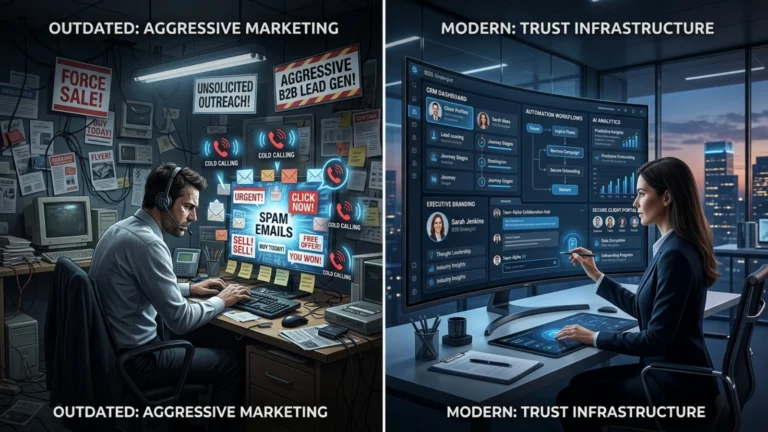
B2B Brands Are Focusing More on Trust Infrastructure in 2026
Why Trust Has Become the Most Important Growth Asset in 2026 The B2B business environment has changed dramatically…

Marketing
7 Powerful Ways AI Is Becoming Every Marketer’s Ultimate Copilot
Introduction Marketing has entered a new era where artificial intelligence is no longer just a supporting technology to…