


Introduction: The Evolution of Software Performance
In the modern digital economy, performance is directly tied to business success. A slow-loading application, a crashing API, or a delayed transaction can cost companies millions in lost revenue and damaged reputation. As user expectations continue to rise, organizations are realizing that traditional performance testing methods are no longer enough.
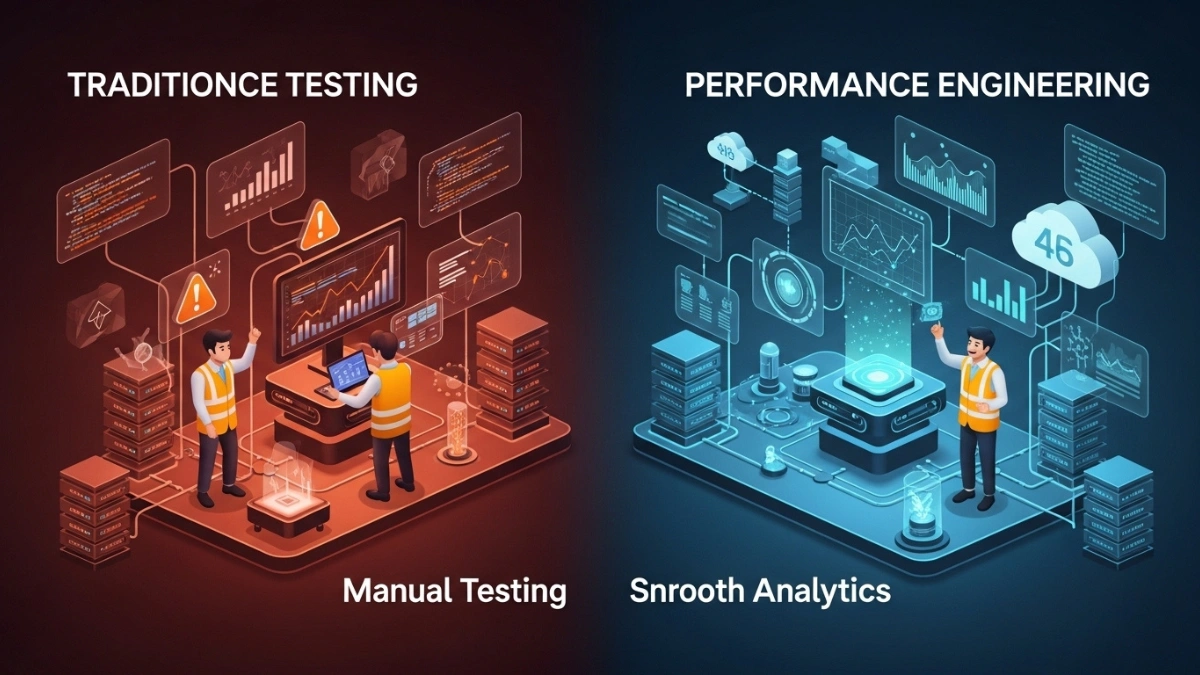
This realization has sparked a major transformation: Performance Engineering is replacing Traditional Testing as the dominant approach to ensuring system reliability, scalability, and speed.
Tech leaders like Netflix, Amazon Web Services, and Google are not just testing performance they are engineering it from the ground up.
Understanding Traditional Performance Testing
Traditional performance testing has long been a critical part of software quality assurance. It typically occurs near the end of the development lifecycle and aims to evaluate how a system behaves under certain conditions.
Common Types of Traditional Testing:
- Load Testing → Simulating expected user traffic
- Stress Testing → Pushing systems beyond limits
- Spike Testing → Handling sudden traffic surges
- Endurance Testing → Checking long-term stability
Limitations of Traditional Testing:
- Late Detection of Issues → Problems are found after development
- High Cost of Fixes → Late-stage fixes require rework
- Limited Coverage → Focused only on predefined scenarios
- No Real-Time Insight → Doesn’t reflect live user behavior
This reactive approach worked in slower development cycles, but in today’s fast-paced environments, it creates bottlenecks and risks.
What Is Performance Engineering?
Performance engineering is a holistic, proactive, and continuous approach to ensuring optimal system performance throughout the software lifecycle.
It integrates performance into:
- System architecture
- Development practices
- Testing pipelines
- Production monitoring
Instead of being a single phase, performance becomes a continuous discipline.
Core Philosophy:
“Build systems that are designed to perform, not just tested for performance.”
Key Differences Between Traditional Testing and Performance Engineering
1. Reactive vs Proactive
- Traditional Testing → Finds issues after they occur
- Performance Engineering → Prevents issues before they happen
2. Isolated vs Continuous
- Testing is a one-time activity
- Engineering is integrated into CI/CD pipelines
Tools like Jenkins and GitHub Actions automate performance checks with every deployment.
3. Scenario-Based vs Real-World Analysis
- Traditional testing uses predefined scenarios
- Performance engineering uses real user data and behavior
4. Testing Focus vs System Optimization
- Testing validates performance
- Engineering improves performance at every level
Why Performance Engineering Is Becoming Essential
1. Explosion of Microservices Architecture
Modern applications rely on distributed systems and APIs. A single bottleneck in one microservice can impact the entire system.
Performance engineering ensures:
- Seamless communication between services
- Load balancing across systems
- Efficient resource utilization
2. Increasing User Expectations
Users expect:
- Instant page loads
- Real-time responses
- Zero downtime
Even a 1-second delay can significantly impact user engagement and conversions.
3. DevOps and Agile Transformation
With rapid release cycles, waiting until the end to test performance is impractical.
Performance engineering supports:
- Continuous integration
- Continuous delivery
- Faster, safer deployments
4. Cloud and Scalability Demands
Cloud-native systems must handle:
- Dynamic traffic spikes
- Global user bases
- Auto-scaling infrastructure
Performance engineering ensures systems scale efficiently without failures.
Core Pillars of Performance Engineering
1. Continuous Performance Testing
Performance tests are executed at every stage:
- During development
- During integration
- Before deployment
2. Real User Monitoring (RUM)
RUM captures actual user interactions, providing insights into:
- Load times
- Device performance
- Geographic variations
3. Observability and Monitoring
Modern systems use advanced observability tools to track:
- System metrics
- Logs
- Distributed traces
Tools like Grafana help visualize performance data in real time.
4. Capacity Planning
Predicts how systems will perform under future loads, ensuring readiness for:
- Business growth
- Seasonal spikes
- Unexpected demand
5. Automation and AI Integration
AI-driven tools can:
- Predict bottlenecks
- Suggest optimizations
- Automate performance tuning
Popular Tools Driving Performance Engineering
Load & Testing Tools
- Apache JMeter → widely used for load simulation
- k6 → modern, developer-focused testing
Monitoring & Observability Tools
- Grafana → dashboards and visualization
- Prometheus → metrics monitoring
CI/CD Integration Tools
- Jenkins
- GitHub Actions
These tools enable a seamless, automated performance pipeline.
Real-World Case Study: High-Scale Performance
Netflix
Netflix is a prime example of performance engineering in action.
Their Approach:
- Continuous performance monitoring
- Chaos engineering (intentionally breaking systems)
- Real-time user analytics
Result:
- Seamless streaming for millions of users
- Minimal downtime
- Highly scalable architecture
Benefits of Performance Engineering
Enhanced User Experience
Faster and smoother applications improve customer satisfaction.
Reduced Downtime
Proactive monitoring prevents failures before they impact users.
Cost Optimization
Early detection reduces expensive late-stage fixes.
Better Scalability
Systems are designed to handle growth effortlessly.
Competitive Advantage
High-performing applications attract and retain users.
Challenges in Adoption
Despite its advantages, organizations face several hurdles:
1. Cultural Shift
Teams must move from a testing mindset to an engineering mindset.
2. Skill Gap
Requires expertise in:
- System design
- Monitoring tools
- Performance optimization
3. Tool Integration
Integrating multiple tools into a unified pipeline can be complex.
4. Initial Investment
Setup costs can be high, but ROI is significant over time.
Future Trends in Performance Engineering
1. AI-Powered Performance Optimization
AI will predict and fix issues before they occur.
2. Self-Healing Systems
Applications will automatically recover from failures.
3. Edge and 5G Performance Testing
Performance testing will extend to edge computing environments.
4. Sustainability in Performance
Organizations will optimize systems for:
- Energy efficiency
- Reduced carbon footprint
Final Thoughts
Performance engineering is not just a trend it is a necessary evolution in how software is built and maintained. Traditional performance testing, while still valuable, is no longer sufficient on its own.
By embedding performance into every stage of development, organizations can build systems that are:
- Faster
- More reliable
- Highly scalable
Companies that adopt performance engineering today will be the ones that lead tomorrow’s digital landscape.
Conclusion
The shift from traditional testing to performance engineering marks a turning point in software development. It transforms performance from a checkpoint into a continuous commitment.
In a world where milliseconds matter, performance engineering ensures that applications are always ready no matter the load, scale, or complexity.
For more Contact Us
Similar Posts

Software Testing & QA
7 Essential Cloud-Native Load Testing Strategies for Global Scale
As businesses continue their digital transformation journeys, cloud-native applications have become the backbone of modern software development. Organizations…

Software Testing & QA
AI Testing Is the Fastest-Growing Trend in 2026
The world of software testing is undergoing one of the biggest transformations in its history. For years, automation…