


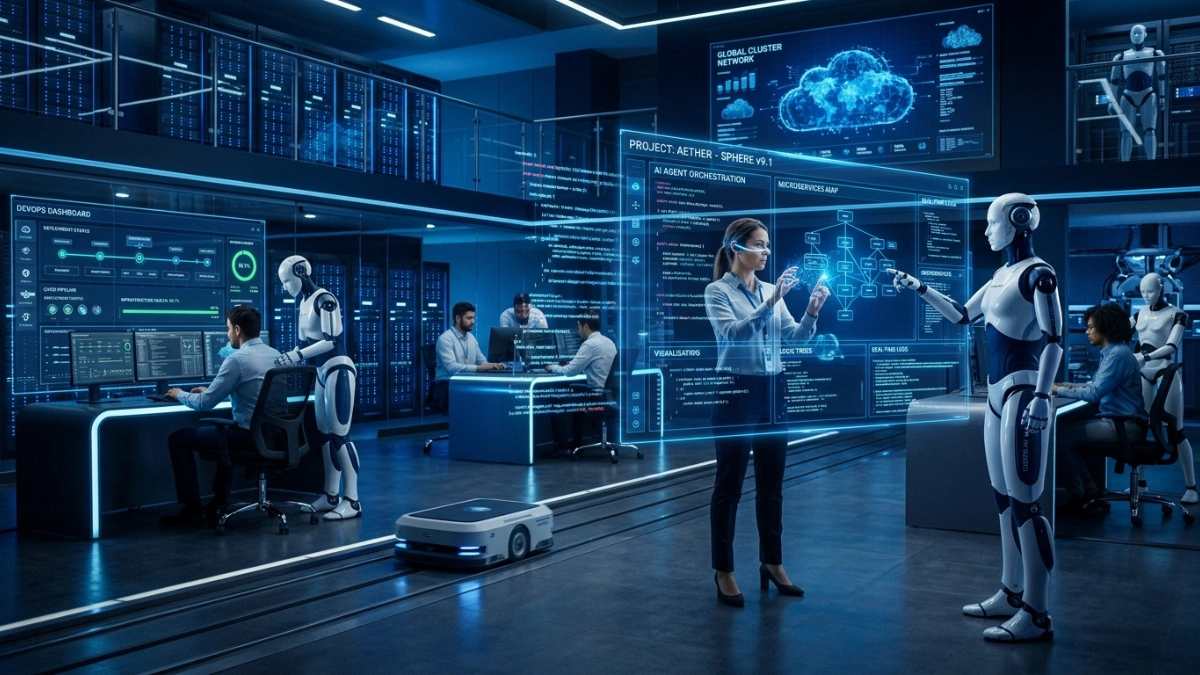
Artificial Intelligence is transforming nearly every industry, but one of the most significant changes is happening inside software development itself. For decades, developers have relied on manual coding, repetitive workflows, extensive testing cycles, and human-managed deployment systems. However, that model is rapidly evolving.
In 2026, UiPath introduced a major innovation that reflects the next phase of enterprise automation:
AI Coding Agent Automation.
This announcement is far more important than a standard product release. It signals a major industry transition from traditional robotic automation toward intelligent autonomous engineering systems capable of participating directly in software development workflows.
The software industry is now entering an era where AI systems are not only helping developers write code they are increasingly capable of managing development pipelines, automating engineering tasks, optimizing operations, and orchestrating enterprise software environments with minimal human intervention.
This evolution is reshaping:
- software engineering
- DevOps
- cloud infrastructure
- quality assurance
- enterprise automation
- operational scalability
The future of enterprise technology is becoming deeply connected to AI-powered engineering ecosystems.
Understanding the Rise of AI Coding Agents
Traditional AI coding assistants have existed for several years. Tools like:
- GitHub Copilot
- Cursor AI
- OpenAI Codex
- Claude Code
have already helped developers:
- generate code snippets
- autocomplete functions
- explain documentation
- debug errors
However, AI Coding Agent Automation goes far beyond simple code suggestions.
AI coding agents are designed to:
- understand development goals
- perform multi-step engineering tasks
- interact with external systems
- coordinate workflows
- automate operational processes
- continuously optimize software environments
Instead of acting as passive assistants, these systems behave more like autonomous digital engineering collaborators.
This is part of the broader movement known as:
Agentic AI
Agentic AI refers to intelligent systems capable of reasoning, decision-making, workflow execution, and adaptive problem-solving across multiple environments.
Why UiPath’s Expansion Into AI Coding Matters
UiPath has historically been one of the biggest names in robotic process automation (RPA). The company built its reputation by helping organizations automate repetitive business tasks such as:
- invoice processing
- HR operations
- document handling
- customer workflows
- enterprise data entry
- compliance reporting
Now the company is applying automation principles directly to software engineering itself.
This is important because modern software development has become incredibly complex.
Today’s enterprises manage:
- distributed cloud systems
- microservices architectures
- CI/CD pipelines
- cybersecurity frameworks
- container orchestration
- multi-platform applications
- AI infrastructure
- large-scale DevOps operations
Managing these environments manually is expensive, slow, and operationally difficult.
AI coding agents aim to reduce that complexity.
The Evolution of Software Development
Software engineering has evolved through several major eras.
1. Manual Development Era
Early software development required:
- entirely manual coding
- manual deployments
- manual testing
- manual infrastructure management
Development cycles were slow and resource-intensive.
2. Agile & DevOps Era
The introduction of:
- Agile methodologies
- DevOps pipelines
- cloud computing
- containerization
dramatically improved software delivery speed.
Automation became a core part of engineering culture.
3. AI-Assisted Development Era
AI coding tools began helping developers:
- write code faster
- automate repetitive tasks
- improve productivity
This marked the beginning of intelligent development assistance.
4. Autonomous Engineering Era
Now, the industry is moving toward:
AI-driven autonomous software operations.
This is the stage UiPath is helping accelerate.
In this environment:
- AI agents participate in engineering workflows
- systems self-optimize
- testing becomes continuous
- deployments become increasingly autonomous
- operational bottlenecks are minimized
Key Features of UiPath AI Coding Agent Automation
UiPath’s AI coding ecosystem focuses heavily on enterprise-scale operational automation.
The platform introduces several important capabilities.
1. Intelligent Code Generation
AI coding agents can:
- generate application logic
- create APIs
- automate scripting
- build reusable templates
- assist with infrastructure code
Developers no longer need to manually handle repetitive implementation tasks.
This significantly improves:
- development speed
- engineering productivity
- workflow efficiency
It also allows teams to focus more on:
- architecture
- innovation
- system design
- strategic engineering decisions
2. AI-Powered Software Testing
Testing has traditionally been one of the biggest bottlenecks in software development.
Manual QA processes often create:
- delayed releases
- inconsistent validation
- expensive operational overhead
UiPath’s automation tools can:
- generate test cases automatically
- execute regression tests
- monitor software behavior
- identify performance issues
- detect anomalies
- validate outputs continuously
This supports:
Continuous Testing Infrastructure.
As businesses move toward faster release cycles, automated testing becomes increasingly critical.
3. Workflow Orchestration Across Development Pipelines
Modern software delivery involves multiple interconnected systems.
AI coding agents can coordinate:
- Git repositories
- CI/CD pipelines
- deployment approvals
- cloud infrastructure
- issue tracking systems
- testing environments
- monitoring platforms
This creates unified development automation ecosystems capable of operating with significantly less manual coordination.
4. AI-Driven DevOps Automation
DevOps teams manage many repetitive operational tasks daily, including:
- deployments
- monitoring
- scaling infrastructure
- patch management
- configuration updates
- incident responses
UiPath’s AI automation helps streamline these processes through intelligent orchestration and autonomous workflow management.
This reduces operational fatigue and allows DevOps engineers to focus on:
- infrastructure reliability
- performance optimization
- scalability planning
5. Enterprise Governance & Compliance
One of the biggest concerns with AI-generated code is security.
Large organizations must ensure:
- governance controls
- auditability
- compliance tracking
- access management
- security validation
UiPath is positioning its platform as:
enterprise-safe AI automation.
This includes:
- workflow visibility
- approval systems
- role-based permissions
- compliance monitoring
- operational governance frameworks
This is especially important for industries such as:
- finance
- banking
- healthcare
- insurance
- legal technology
- government systems
where regulatory requirements are extremely strict.
Why Businesses Are Rapidly Adopting AI Automation
Enterprise technology teams face enormous pressure today.
Organizations are expected to:
- launch products faster
- reduce operational costs
- improve reliability
- maintain cybersecurity
- support global scalability
- handle increasing software complexity
At the same time, the industry faces:
- engineering talent shortages
- rising infrastructure costs
- increasing operational workloads
AI automation helps businesses solve many of these challenges.
Benefits of AI Coding Agent Automation
1. Faster Software Development
AI systems can automate repetitive engineering tasks, allowing developers to ship products faster.
This shortens:
- development cycles
- release timelines
- deployment schedules
2. Improved Productivity
Developers spend less time on repetitive operational work and more time solving meaningful problems.
This increases overall engineering efficiency.
3. Reduced Operational Costs
Automation reduces:
- manual QA costs
- infrastructure management expenses
- repetitive engineering workloads
Large enterprises can save significant operational resources.
4. Continuous Operations
AI agents can monitor systems:
- 24/7
- without fatigue
- across global environments
This improves reliability and incident response speed.
5. Scalability
As software systems grow larger, AI automation helps organizations scale operations more efficiently.
The Rise of AI-Native Engineering Organizations
One of the most important industry trends emerging in 2026 is:
AI-native engineering teams.
In these environments:
- AI agents become part of daily operations
- workflows become semi-autonomous
- software delivery becomes highly optimized
- engineering collaboration evolves dramatically
Human developers still remain essential.
However, their responsibilities are shifting toward:
- supervising AI systems
- designing architectures
- validating outputs
- managing automation strategies
- solving high-level engineering problems
The role of developers is evolving from:
“manual implementers”
to:
“AI-enabled system architects.”
How AI Coding Agents Could Change Developer Roles
There is growing discussion around whether AI will replace software engineers.
The reality is more nuanced.
AI automation will likely:
- eliminate repetitive engineering tasks
- reduce manual operational work
- automate simple development functions
But it will also create demand for:
- AI workflow engineers
- automation architects
- prompt engineers
- AI operations specialists
- governance analysts
- infrastructure strategists
The software industry is not disappearing.
It is transforming.
Challenges Facing AI Coding Automation
Despite the excitement, several challenges still exist.
1. Security Risks
AI-generated code can introduce:
- vulnerabilities
- insecure dependencies
- compliance violations
Human oversight remains critical.
2. Reliability Concerns
AI systems can sometimes:
- generate incorrect logic
- misunderstand requirements
- produce inefficient implementations
Senior engineering review is still necessary.
3. Governance Complexity
As AI systems become more autonomous, organizations need strong governance frameworks to maintain control.
4. Ethical Concerns
There are concerns around:
- workforce displacement
- junior developer opportunities
- AI dependency
Companies must balance automation with workforce development.
The Bigger Industry Competition
UiPath is part of a much larger AI automation race.
Major players competing in this space include:
The competition is shifting toward:
enterprise AI ecosystems.
Companies no longer want isolated AI tools.
They want:
- integrated AI workflows
- operational automation
- autonomous infrastructure
- enterprise-wide AI orchestration
The Future of AI Automation
Over the next several years, AI coding agents are expected to become standard across enterprise software environments.
Future AI systems may eventually:
- self-heal infrastructure
- optimize cloud costs automatically
- detect vulnerabilities proactively
- generate production-ready applications
- coordinate engineering operations independently
This could fundamentally reshape:
- software engineering
- enterprise IT
- DevOps
- SaaS operations
- digital transformation
AI automation may become as important to future businesses as cloud computing became in the last decade.
Final Thoughts
UiPath’s launch of AI Coding Agent Automation represents a major milestone in the evolution of enterprise software development.
The industry is rapidly moving toward:
intelligent operational ecosystems powered by autonomous AI agents.
Businesses are no longer looking for simple automation tools.
They want:
- scalable AI infrastructure
- autonomous workflows
- continuous optimization
- operational efficiency
- intelligent engineering systems
Organizations that successfully combine:
- human expertise
- AI-driven automation
- strong governance
- scalable infrastructure
will likely dominate the next generation of digital business.
The future of software development is no longer just about writing code manually.
It is about building intelligent systems capable of managing, optimizing, and evolving software operations themselves.
For more Contact Us
Similar Posts

AI
Cybersecurity Insurance Market Experiences Rapid Growth
As cyber threats continue to evolve in complexity and scale, businesses around the world are facing unprecedented digital…

AI
Sports Analytics Trends Powered by Machine Learning in 2026
The world of sports is undergoing one of the biggest technological transformations in history. For decades, sports success…