
QAOps: How Continuous Testing Is Rewriting Quality Assurance in 2026

Introduction: Quality Assurance Is No Longer a Phase It’s a System

For years, Quality Assurance lived at the end of the software lifecycle. Code was written, features were “done,” and then QA stepped in to validate what already existed. That model is officially broken.

In 2026, speed is non-negotiable. Releases happen daily, sometimes hourly. In this environment, traditional Quality Assurance simply cannot keep up. The result is a fundamental shift: QAOps the integration of quality assurance directly into DevOps pipelines through continuous testing, automation, and real-time feedback.

QAOps isn’t a trend. It’s a survival mechanism.

What Is QAOps Really?

QAOps is not just “more automation” or “testing earlier.” It’s a systemic change in how quality is owned, measured, and delivered.

At its core, QAOps means:

  • Testing is continuous, not scheduled
  • Quality is everyone’s responsibility, not just QA’s
  • Feedback loops are automated and immediate
  • Testing lives inside CI/CD pipelines
  • Production behavior informs future tests

In short, QAOps treats quality as an operational capability, not a checkpoint.

Why Traditional QA Failed at Scale

1. Testing Happens Too Late

When Quality Assurance is a final gate, defects are discovered after:

  • Architectural decisions are locked
  • Timelines are compressed
  • Fixes are expensive

Late testing increases risk instead of reducing it.

2. Manual Bottlenecks Don’t Scale

Manual regression cycles can’t keep pace with:

  • Microservices architectures
  • Frequent releases
  • Multi-platform applications

Teams either skip testing or accept lower confidence.

3. QA Is Isolated From Delivery

When Quality Assurance works separately from DevOps:

  • Test environments drift
  • Failures lack context
  • Feedback arrives too late

This isolation turns Quality Assurance into a blocker instead of an enabler.

QAOps exists because this model no longer works.

Continuous Testing: The Backbone of QAOps

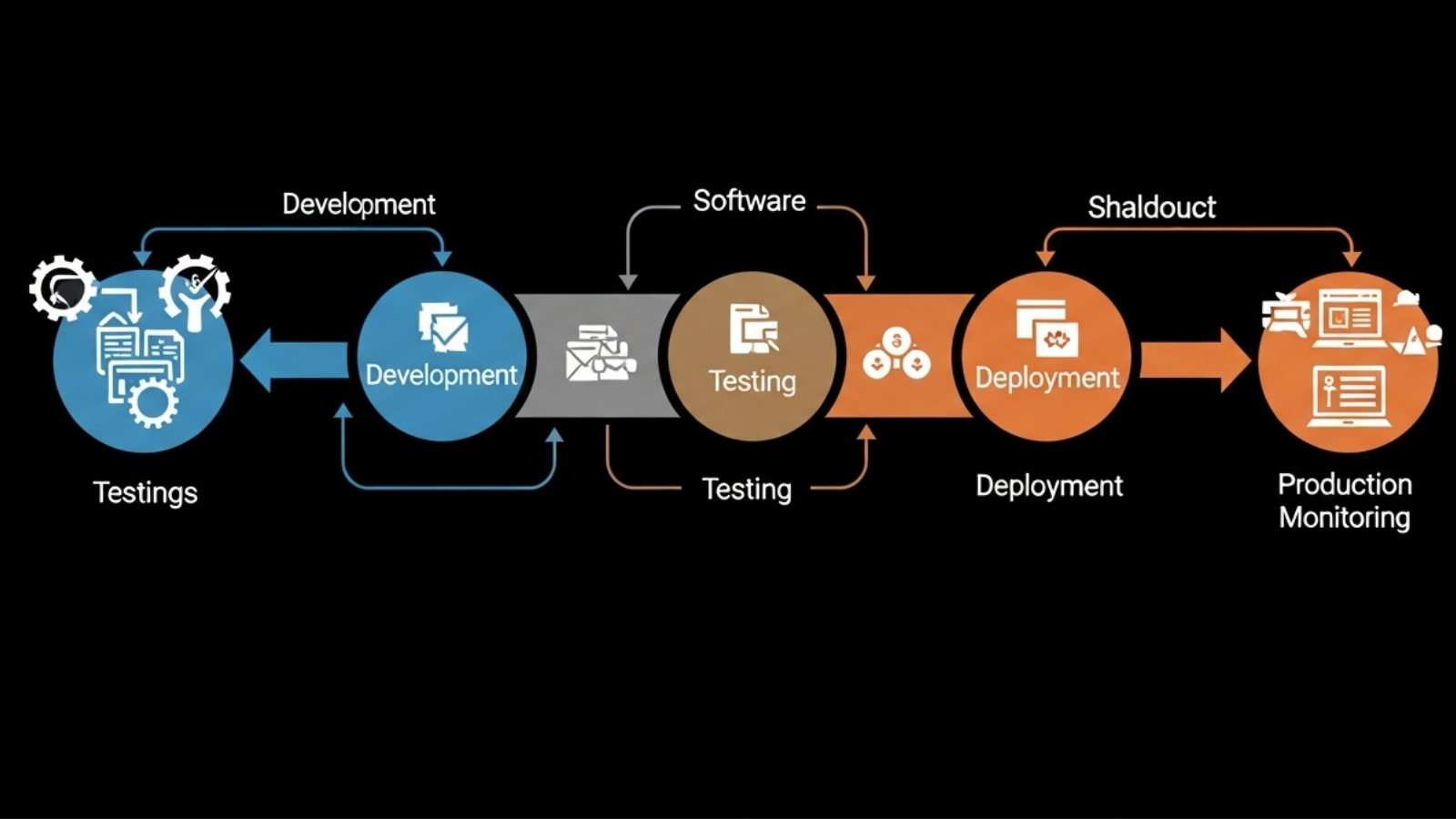
Continuous testing is the engine that powers QAOps. It ensures that every change is validated automatically, across the lifecycle.

Continuous testing includes:

  • Unit tests triggered on every commit
  • API and integration tests in pipelines
  • UI tests on critical paths
  • Performance and security checks
  • Monitoring and validation in production

The goal isn’t “100% automation.”
The goal is continuous confidence.

Shift-Left + Shift-Right: QAOps in Practice

QAOps combines two powerful approaches:

Shift-Left Testing

Testing moves earlier into:

  • Requirements
  • Design
  • Development

This reduces defect cost and improves clarity.

Shift-Right Testing

Quality doesn’t stop at release. QAOps validates:

  • Real user behavior
  • Performance under load
  • Error rates and anomalies

Production becomes a quality signal, not a blind spot.

Together, these approaches close the feedback loop.

The Role of Automation in QAOps

Automation is necessary but not sufficient.

In QAOps, automation must be:

  • Stable: Self-healing where possible
  • Relevant: Focused on business-critical paths
  • Fast: Optimized for pipeline execution
  • Observable: Failures provide actionable insight

Bad automation creates noise.
Good automation creates trust.

QAOps teams invest more in maintaining test value than in increasing test count.

AI Is Accelerating QAOps Adoption

AI is a major catalyst for QAOps in 2026.

Used correctly, AI helps with:

  • Test case generation
  • Test maintenance and self-healing
  • Risk-based test prioritization
  • Failure analysis and root cause detection

But here’s the hard truth:
AI doesn’t replace QA thinking. It amplifies it.

Teams that rely blindly on AI-generated tests accumulate verification debt. QAOps requires human oversight plus intelligent automation.

QAOps Changes Team Structure and Culture

QAOps is as much cultural as it is technical.

Successful teams:

  • Embed Quality Assurance engineers into product squads
  • Involve Quality Assurance in sprint planning and design
  • Share ownership of test failures
  • Treat broken pipelines as production incidents

In QAOps, quality failures are team failures, not QA failures.

Metrics That Matter in QAOps

Traditional Quality Assurance metrics (number of test cases, defects found) are insufficient.

QAOps focuses on:

  • Deployment frequency
  • Change failure rate
  • Mean time to detect (MTTD)
  • Mean time to recover (MTTR)
  • Escaped defects

These metrics tie quality directly to business impact.

Common Mistakes When Adopting QAOps

Many organizations struggle with QAOps because they:

  • Automate bad tests
  • Overload pipelines with slow UI tests
  • Ignore test data management
  • Treat QAOps as a tooling problem
  • Skip change management

QAOps fails when it’s implemented mechanically instead of strategically.

How to Start with QAOps (Practically)

If you’re transitioning toward QAOps, start here:

  1. Stabilize your CI/CD pipeline
  2. Automate critical paths first
  3. Integrate Quality Assurance early into delivery planning
  4. Introduce observability and production feedback
  5. Measure outcomes, not activity

QAOps is built incrementally not overnight.

What QAOps Means for the Future of QA

Quality Assurance is not disappearing. It’s becoming more powerful.

In 2026, top QA professionals are:

  • Quality strategists
  • Automation architects
  • Risk analysts
  • Delivery enablers

QAOps elevates QA from execution to engineering leadership.

Final Thoughts: QAOps Is the New Default

Continuous delivery demands continuous quality. QAOps provides the structure to make that possible without slowing teams down.

Organizations that adopt QAOps:

  • Release faster
  • Fail safer
  • Recover quicker
  • Build trust with users

Those that don’t will continue firefighting defects they could have prevented.

Quality hasn’t lost importance.
It has finally gained operational relevance.

If your organization is modernizing its QA strategy and moving toward QAOps and continuous testing, explore software testing and quality consulting at Contact Us


Why Enterprises Are Killing Tool Sprawl in 2026

Introduction: More Tools Didn’t Make Enterprises Safer or Faster

For over a decade, enterprises responded to every new problem by buying another tool. A new security risk? Add a security product. A new analytics need? Add a dashboard. A productivity issue? Add a SaaS subscription.

By 2026, the result is clear: tool sprawl has become a liability.

Organizations now manage dozens sometimes hundreds of overlapping tools across IT, security, development, marketing, and operations. Instead of increasing efficiency, this sprawl has driven up costs, increased risk, slowed decision-making, and burned out teams. Enterprises are finally doing what should have happened years ago: cutting back aggressively.

What Tool Sprawl Really Looks Like Inside Enterprises

Tool sprawl isn’t just “too many apps.” It’s systemic fragmentation.

Typical symptoms include:

  • Multiple tools solving the same problem in slightly different ways
  • Data scattered across disconnected platforms
  • Conflicting dashboards and reports
  • Security blind spots caused by poor integration
  • Rising SaaS costs with unclear ROI

In many organizations, no one can answer a simple question like:
Which tools are mission-critical, and which are just noise?

That uncertainty is now unacceptable.

The Cost Problem Enterprises Can No Longer Ignore

In 2026, enterprise CFOs are scrutinizing software spend harder than ever. Tool sprawl hides massive waste:

  • Licenses paid for unused features
  • Duplicate subscriptions across departments
  • Expensive platforms used by a handful of users

When budgets tighten, the first question becomes:

Why are we paying for five tools that all claim to do the same thing?

The answer is rarely good.

Tool consolidation is no longer a technical decision it’s a financial mandate.

Security and Compliance Are Breaking Under Tool Sprawl

One of the biggest drivers behind tool reduction is security risk.

Every additional tool introduces:

  • Another attack surface
  • Another integration point
  • Another place data can leak
  • Another vendor risk assessment

Security teams are overwhelmed managing alerts from dozens of platforms that don’t talk to each other. Compliance teams struggle to prove consistent controls across fragmented systems.

In regulated environments, tool sprawl directly undermines:

  • Audit readiness
  • Incident response
  • Governance and accountability

In 2026, enterprises are choosing fewer, better-integrated tools over sprawling stacks that look impressive but fail under scrutiny.

AI Changed the Economics of Software Tools

AI has quietly accelerated the death of tool sprawl.

Why? Because AI can replace entire layers of functionality that previously required separate tools:

  • Reporting and analysis
  • Workflow automation
  • Monitoring and alerting
  • Content and data processing

Instead of buying another niche platform, enterprises can:

  • Centralize workflows
  • Use AI to orchestrate tasks
  • Reduce manual handoffs between systems

This shifts the question from:

Which tool should we add?
to
Which tools can we eliminate?

Integration Fatigue Is Real

IT teams are exhausted not from lack of tools, but from too many of them.

Every new product requires:

  • Integration work
  • API maintenance
  • User training
  • Ongoing support

As tool counts grow, integration becomes the real bottleneck. Systems become fragile. Changes ripple unpredictably. Innovation slows.

In 2026, enterprises are prioritizing platforms that reduce integration complexity, not add to it.

Executives Want Outcomes, Not Dashboards

Another reason tool sprawl is dying: leadership is done with vanity metrics.

Executives don’t want:

  • Ten dashboards saying different things
  • Weekly reports generated manually
  • Conflicting versions of the truth

They want:

  • Clear outcomes
  • Measurable impact
  • Real-time visibility

Tool sprawl obscures insight. Consolidation clarifies it.

The New Enterprise IT Strategy: Fewer Tools, Deeper Capability

Enterprises aren’t anti-tools they’re anti-chaos.

The winning strategy in 2026 looks like this:

  • Fewer core platforms
  • Strong native integrations
  • Centralized data and identity
  • AI-driven orchestration
  • Clear ownership and governance

Instead of assembling fragile stacks of point solutions, organizations are investing in cohesive ecosystems.

What Gets Cut First and Why

When enterprises rationalize their stacks, the same types of tools are usually first to go:

  • Overlapping analytics tools
  • Redundant monitoring platforms
  • Standalone productivity SaaS
  • Niche tools used by single teams

Tools survive only if they deliver unique, provable value that cannot be replicated or absorbed elsewhere.

What This Means for Vendors and Consultants

For software vendors, the message is brutal but clear:

If your product doesn’t integrate deeply or deliver unique value, it’s on the chopping block.

For consultants and IT partners, the opportunity is massive:

  • Tool rationalization assessments
  • Stack consolidation roadmaps
  • Integration and automation strategy
  • AI-driven platform design

Enterprises need guidance to simplify without breaking critical workflows.

How Enterprises Should Approach Tool Reduction

Successful tool reduction isn’t about ripping systems out blindly. It requires:

  1. A full inventory of tools and usage
  2. Clear mapping to business outcomes
  3. Identification of redundancy and risk
  4. A phased consolidation plan
  5. Strong change management

When done right, consolidation improves:

  • Security posture
  • Cost efficiency
  • Operational speed
  • Team morale

Final Thoughts: Tool Sprawl Is a Symptom, Not the Disease

Tool sprawl happened because enterprises optimized locally instead of strategically. Each team solved its own problem, and no one owned the whole system.

In 2026, that mindset is over.

The most successful enterprises are not those with the most tools but those with the clearest, simplest, and most controlled technology foundations.

Killing tool sprawl isn’t about austerity.
It’s about focus, resilience, and scale.

If your organization is looking to rationalize its IT stack, reduce tool sprawl, and design a future-ready platform strategy, explore technology consulting at Contact Us

Anthropic’s 3 Major AI Challenges Forcing a Software Rethink

Introduction: This Isn’t Just Another AI Product Launch

For years, software tools evolved in predictable ways: better UX, incremental features, tighter integrations. That model is now breaking.

With its latest wave of AI product releases, Anthropic isn’t just adding features it’s challenging the foundations of how software tools are built, priced, and differentiated. The implications go far beyond AI assistants or productivity boosts. This shift forces every SaaS and enterprise software provider to ask an uncomfortable question:

What happens when AI can replicate core product value faster than roadmaps can keep up?

What Anthropic Actually Launched and Why It Matters

Anthropic’s recent product moves center around agentic AI tools systems that don’t just respond to prompts but actively perform tasks, collaborate with users, and operate across files, workflows, and applications.

Key characteristics of these tools include:

  • Persistent context across tasks
  • File and system interaction
  • Multi-step execution without constant user input
  • Rapid development cycles some tools reportedly built largely by AI itself

This isn’t AI bolted onto software. This is AI acting like software.

The Real Disruption: Features Are Becoming Commodities

Traditionally, SaaS differentiation came from:

  • Feature depth
  • Workflow optimization
  • Proprietary interfaces

Anthropic’s approach threatens that model. When AI agents can:

  • Draft documents
  • Analyze data
  • Manage workflows
  • Generate code
  • Coordinate tasks

then entire product categories risk being flattened.

A CRM feature, a project management workflow, or a reporting dashboard is no longer defensible if an AI agent can replicate 80% of its value on demand.

From Tools to Capabilities: A Strategic Shift

The old question for product teams was:

What features should we build next?

The new question is:

What capabilities must we own that AI cannot easily abstract away?

This marks a shift from feature-based competition to capability-based strategy.

Winning tools in this new era will focus on:

  • Deep domain specialization
  • Trusted data ownership
  • Workflow authority
  • Compliance, governance, and security
  • Ecosystem integration

AI can generate outputs but it cannot easily replace contextual authority.

Why Traditional SaaS Roadmaps Are at Risk

Anthropic’s rapid iteration exposes a structural weakness in traditional product development:

  • Human-built roadmaps move slowly
  • AI-generated capabilities move fast
  • Feature parity can be reached in weeks, not years

This creates a dangerous gap. By the time a SaaS company ships a planned feature, an AI agent may already be doing it without requiring users to adopt a new tool.

The result? Feature velocity no longer guarantees relevance.

The Pricing Model Problem

AI-driven tools also challenge SaaS pricing assumptions.

If AI can:

  • Replace multiple tools
  • Collapse workflows
  • Reduce user effort

then per-seat, per-feature pricing starts to feel outdated.

Anthropic’s trajectory suggests a future where:

  • Value is tied to outcomes, not licenses
  • Pricing aligns with usage or results
  • Bundled AI capabilities replace fragmented subscriptions

SaaS companies that fail to rethink pricing risk being undercut by AI-native alternatives.

Security, Compliance, and Trust Become Differentiators

One area where AI tools face real friction is trust.

As AI agents gain more autonomy, enterprises worry about:

  • Data exposure
  • Unintended actions
  • Compliance violations
  • Auditability

This creates opportunity for established tools that can offer:

  • Strong governance
  • Clear access controls
  • Transparent audit trails
  • Regulatory alignment

In this sense, Anthropic’s disruption doesn’t eliminate traditional software it raises the bar for trust and accountability.

What Product Leaders Should Be Doing Right Now

1. Audit Your Product’s Defensibility

Ask honestly:

  • Which features could an AI agent replicate?
  • What value depends on proprietary data or domain expertise?
  • Where do customers trust us beyond convenience?

If the answers are unclear, that’s a warning sign.

2. Shift From “AI Features” to “AI Strategy”

Adding AI buttons isn’t enough.

Product teams need to define:

  • How AI reshapes workflows
  • Where human oversight remains essential
  • How AI enhances not replaces core value

This requires cross-functional alignment between product, engineering, legal, and security.

3. Redesign the User Relationship

As AI agents take over tasks, users interact less with interfaces and more with outcomes.

This means:

  • Fewer clicks
  • More automation
  • Higher expectations

Products must evolve from tools users operate to systems users trust.

The Competitive Landscape Is Shifting

Anthropic’s moves highlight a broader industry reality: competition is no longer limited to direct rivals.

A SaaS product now competes with:

  • AI platforms
  • Agentic workflows
  • Custom AI setups
  • User-built automations

This makes strategic positioning more important than ever. Survival depends on clarity of purpose, not feature breadth.

Final Thoughts: This Is a Strategy Reset, Not a Trend

Anthropic’s new AI products are not just impressive they’re destabilizing. They force a rethink of:

  • What software is
  • How value is delivered
  • Why users choose tools

For software companies, the takeaway is clear:

AI will not replace all tools but it will expose weak ones.

The winners will be those who understand where AI fits—and where it doesn’t—inside their product strategy.

If your organization is reassessing its software, product, or AI strategy in this new landscape, explore technology and product consulting at Contact Us

Spain’s AI Powerhouse: 5 Powerful Reasons Founders Can’t Miss EU-Startups Summit 2026

Introduction: An Event That Reflects a Bigger Shift

The EU-Startups Summit 2026 isn’t just another networking event. It’s a signal.

When Europe’s most influential startup summit takes place in Spain, it confirms what many founders and investors already know: Spain is no longer an emerging ecosystem it’s a leading one. Over the past five years, Spain has quietly transformed into one of Europe’s most attractive destinations for AI startups, scaleups, and international founders.

This article connects the dots between the EU-Startups Summit 2026 and the deeper reason it matters: Spain’s rise as a core innovation hub in Europe.

What Is the EU-Startups Summit and Why It Matters

The EU-Startups Summit is one of Europe’s most respected startup-focused conferences, bringing together:

  • High-growth startups and scaleups
  • Venture capital firms and angel investors
  • Corporate innovation leaders
  • Accelerators, policymakers, and ecosystem builders

Unlike generic tech expos, this summit is built around funding, scaling, and cross-border growth. The focus is not hype it’s execution.

By 2026, the summit has evolved into a barometer of where European innovation is heading.

Why Founders Should Attend or Closely Watch EU-Startups Summit 2026

1. Investor Access Without the Noise

One of the summit’s biggest strengths is signal quality. Investors attending are:

  • Actively deploying capital
  • Focused on EU-based growth
  • Interested in AI, SaaS, climate tech, fintech, and deep tech

For founders, this means fewer vanity meetings and more real conversations about traction, scalability, and funding readiness.

2. Europe-First, Global-Ready Perspective

Unlike US-centric conferences, EU-Startups Summit focuses on:

  • European regulation realities
  • Cross-border scaling challenges
  • Multi-market go-to-market strategies

This is critical for founders building in Europe but aiming globally.

3. AI and Deep Tech Are No Longer Side Tracks

By 2026, AI is no longer treated as a niche. It’s embedded across:

  • SaaS products
  • Marketing platforms
  • Health and finance
  • GovTech and smart infrastructure

The summit reflects this shift, positioning AI as foundational infrastructure, not a buzzword.

4. Policy Meets Practice

A unique strength of the summit is the presence of:

  • EU innovation programs
  • Public-private funding initiatives
  • Regulatory stakeholders

For founders navigating grants, compliance, or scaleup funding, this context is invaluable.

Why Spain Is the Right Place for This Summit

The bigger story isn’t the event. It’s why Spain makes sense as its host.

By 2025, This country had firmly established itself as one of Europe’s most dynamic startup ecosystems especially in AI, digital services, and platform-based businesses.

How Spain Became a Top European AI & Startup Hub by 2025

1. Strong Public Funding and EU Alignment

Spain has been highly effective in channeling:

  • EU innovation funds
  • Digital transformation grants
  • AI and deep-tech initiatives

Rather than spreading funds thin, Spain focused on:

  • Scalable startups
  • Research-to-market pathways
  • AI-driven innovation

This created a fertile environment for serious founders not grant chasers.

2. Cities That Specialize, Not Compete

Spain’s ecosystem strength comes from distributed specialization, not one dominant city.

  • Barcelona: Deep tech, AI, health tech, design-led SaaS
  • Madrid: Fintech, enterprise SaaS, corporate innovation
  • Málaga: Emerging AI, cybersecurity, and international hubs

This creates multiple entry points for founders, investors, and talent.

3. International Founder Magnet

Spain offers something rare in Europe:

  • Competitive cost of living
  • High quality of life
  • Access to EU markets
  • Strong talent pipelines

As a result, Spain attracted:

  • Remote-first founders
  • International startup teams
  • Scaleups relocating operations

This diversity accelerated ecosystem maturity.

4. AI Adoption Beyond Research

Spain didn’t stop at AI research it pushed AI adoption into real businesses:

  • Marketing automation
  • Smart cities
  • E-commerce personalization
  • Financial risk analysis

This practical focus created demand for AI-first startups that solve real problems.

5. A Growing Scaleup Culture

By 2025, Spain moved past early-stage obsession. The ecosystem matured to support:

  • Series A–C funding rounds
  • International expansion
  • Operational scaling

This is exactly why the EU-Startups Summit fits so well it targets companies ready to grow, not just ideate.

What This Means for Founders in 2026

The convergence of:

  • EU-Startups Summit 2026
  • Spain’s mature startup ecosystem
  • AI as a core business driver

creates a powerful opportunity.

Founders who engage with this ecosystem gain:

  • Better funding access
  • Stronger cross-border networks
  • Exposure to EU-aligned growth strategies

Whether you attend in person or track insights remotely, this summit is a strategic checkpoint.

Why Startup Consultants and Investors Should Pay Attention

For consultants, accelerators, and investors, Spain’s rise signals:

  • Where talent is concentrating
  • Where capital is flowing
  • Where policy and innovation align

Ignoring Spain in 2026 means missing one of Europe’s most balanced startup environments.

Final Thoughts: Event as Evidence, Not Exception

The EU-Startups Summit 2026 isn’t making Spain a startup hub it’s confirming it.

Spain’s ecosystem strength, AI adoption, and scaleup maturity made it a natural host. For founders, this is a reminder that Europe’s innovation map has evolved.

The smart move isn’t just to attend events it’s to understand why they’re happening where they are.

If you’re a founder, investor, or organization looking to enter or scale within the European startup ecosystem—especially in Spain—explore startup consulting and technology advisory services at Contact Us

UK Cyber Action Plan: A Critical Guide for Private Sector Teams in 2026

Introduction: The UK Cyber Action Plan Just Admitted the Risk Is “Critically High”

When a government publicly states that its cyber risk is critically high, it’s not posturing it’s a warning.

In early 2026, the UK Government announced a £210 million National Cyber Action Plan, acknowledging that despite years of investment, cyber threats are accelerating faster than defenses. The plan is designed to strengthen national resilience, modernize public sector systems, and enforce stronger security controls.

But here’s the uncomfortable truth: private sector organizations are not insulated from this plan they are directly affected by it.

If you operate in or with the UK market, this initiative should immediately change how you think about security, compliance, and operational risk.

What Is the UK Cyber Action Plan?

The Cyber Action Plan is a government-wide initiative aimed at:

  • Strengthening national cyber defenses
  • Reducing systemic vulnerabilities
  • Improving response coordination
  • Enforcing consistent security standards across public bodies

Key elements include:

  • Creation of a centralized Government Cyber Unit
  • Mandatory baseline security controls
  • Increased funding for incident response and monitoring
  • Accelerated modernization of legacy systems

This is not just a public sector cleanup. It sets expectations that will ripple into the private sector.

Why the Private Sector Should Pay Attention

Government cyber policy doesn’t stay confined to government networks. It almost always becomes:

  • Procurement requirements
  • Regulatory expectations
  • Contractual obligations

Private companies that provide:

  • IT services
  • Cloud infrastructure
  • Software platforms
  • Data processing
  • Managed services

will increasingly be expected to match government-grade security standards.

Ignoring this shift now will cost you later either in lost contracts or emergency compliance spending.

The Real Message Behind the Plan

Strip away the headlines, and the message is clear:

Reactive cybersecurity is no longer acceptable.

The UK government is moving toward:

  • Continuous risk assessment
  • Proactive threat management
  • Enforced accountability

Private organizations still relying on annual audits and static policies are already behind.

Key Areas That Will Impact Private Organizations

1. Mandatory Baseline Security Controls

The Cyber Action plan emphasizes standardized controls across systems. This typically translates into:

  • Stronger identity and access management
  • Mandatory multi-factor authentication
  • Asset visibility and inventory
  • Patch and vulnerability management

Private sector teams should expect these controls to appear in:

  • Supplier security questionnaires
  • Vendor audits
  • Contract clauses

If your controls aren’t documented and enforced, you’ll fail before technical discussions even start.

2. Supply Chain Security Comes Under Scrutiny

One of the biggest drivers behind the plan is supply chain risk.

Government systems are only as secure as the weakest vendor connected to them. Expect:

  • More rigorous third-party risk assessments
  • Evidence-based security validation
  • Continuous monitoring expectations

Private companies can no longer rely on self-attestations. Proof is becoming mandatory.

3. Incident Response Expectations Will Rise

The Cyber Action Plan prioritizes faster detection and coordinated response.

For private organizations, this means:

  • Clearly defined incident response plans
  • Tested response procedures
  • Breach notification readiness
  • Cross-team coordination (IT, legal, leadership)

“Having a plan” is not enough. It must be tested, documented, and executable.

4. Legacy Systems Are Now a Liability

A major admission in the Cyber Action plan is that outdated systems are a primary risk factor.

Private sector takeaway:

  • Legacy platforms increase compliance risk
  • Unsupported software weakens trust
  • Security exceptions will be harder to justify

Modernization is no longer a roadmap item it’s a risk mitigation requirement.

The Compliance Shift: From Paper to Proof

One of the most important implications of the Cyber Action Plan is how compliance is evolving.

Traditional compliance focused on:

  • Policies
  • Annual audits
  • Checkbox frameworks

The new direction demands:

  • Continuous evidence
  • Operational security metrics
  • Real-time visibility

Private organizations should prepare for compliance that looks more like ongoing security operations than documentation exercises.

What Private Sector Teams Should Do Now

1. Assess Your Current Security Posture

Ask hard questions:

  • Can we prove our controls are active?
  • Do we know our asset inventory?
  • Can we detect incidents quickly?

If the answer is unclear, that’s your starting point.

2. Align Security With Business Risk

Security teams must connect controls to:

  • Business continuity
  • Customer trust
  • Contract eligibility

This alignment is essential as boards and regulators demand clearer justification for security investments.

3. Prepare for Increased Vendor Scrutiny

If you sell into regulated markets:

  • Document your controls
  • Standardize security reporting
  • Prepare evidence, not statements

Security maturity is becoming a competitive differentiator.

4. Invest in Continuous Security Practices

This includes:

  • Continuous monitoring
  • Threat exposure management
  • Regular testing and validation

Static security models will not survive this regulatory direction.

What This Means Long Term

The UK Cyber Action Plan is not a one-off initiative. It’s part of a broader global trend:

  • Governments raising security expectations
  • Regulators demanding operational proof
  • Markets rewarding resilient organizations

Private companies that adapt early will:

  • Reduce breach impact
  • Win trust faster
  • Qualify for high-value contracts

Those who delay will pay in rushed remediation, reputational damage, and lost opportunities.

Final Thoughts

The UK government’s cyber admission should be taken seriously. Cybersecurity is no longer framed as a technical problem it’s a national risk issue.

For private sector teams, the message is simple:

Get proactive, get visible, or get left behind.

Security maturity is no longer optional. It’s becoming the cost of doing business.

If your organization needs help aligning security, compliance, and operational resilience with modern regulatory expectations, explore security and technology consulting at Contact Us

Machine Learning 2026: Powerful Real-Time ML Tooling for Production-Ready Systems That Scale

Introduction: Why Traditional Machine Learning Batch Processing Is No Longer Enough

For years, machine learning lived comfortably in batch pipelines. Predictions were generated overnight. Models were updated weekly. Latency didn’t matter.

That world is gone.

In 2026, ML systems are expected to respond in milliseconds, adapt continuously, and operate reliably at scale. This demand has triggered a major evolution in real-time Machine Learning tooling and it’s reshaping how systems are designed.

Why Real-Time ML Is So Hard

Real-time ML isn’t just “faster batch processing.” It introduces entirely new challenges:

  • Low-latency inference
  • Streaming data ingestion
  • Model drift detection
  • Continuous monitoring
  • High availability under load

Most early ML stacks were never designed for this.

What’s New in Real-Time ML Tooling

Recent tooling advances focus on end-to-end real-time Machine Learning systems, not isolated components.

1. Streaming-First Data Pipelines

Modern ML platforms now support:

  • Native event streams
  • Online feature stores
  • Low-latency feature computation

This allows models to react to live user behavior instead of stale snapshots.

2. Real-Time Inference Engines

Inference tooling has improved dramatically:

  • Sub-10ms response times
  • Auto-scaling under burst traffic
  • Hardware-aware optimization

This makes ML viable for use cases like fraud detection, recommendations, pricing, and personalization.

3. ML Observability and Monitoring

One of the biggest breakthroughs is ML observability:

  • Drift detection
  • Feature distribution monitoring
  • Prediction confidence tracking
  • Performance regression alerts

Teams can now see when models degrade before customers notice.

4. Continuous Deployment for Models

Real-time ML tooling supports:

  • Safe model rollouts
  • Shadow deployments
  • Canary testing
  • Automated rollback

This brings DevOps discipline into ML workflows often called MLOps 2.0.

Why This Matters for Revenue

Real-time ML directly impacts business outcomes:

  • Fraud prevention reduces losses instantly
  • Recommendations increase conversion rates
  • Dynamic pricing improves margins
  • Personalization boosts retention

Latency is no longer technical it’s financial.

Architecture Shift: From Pipelines to Systems

Successful real-time ML requires a mindset shift:

  • From training pipelines → always-on systems
  • From offline evaluation → continuous validation
  • From static models → adaptive services

This demands closer collaboration between ML, backend, and infrastructure teams.

Common Mistakes Teams Still Make

Despite better tooling, many teams fail because they:

  • Ignore data freshness
  • Underinvest in monitoring
  • Treat models as static assets
  • Optimize accuracy while ignoring latency

Real-time ML punishes shortcuts.

What Teams Should Do in 2026

To succeed with real-time ML:

  1. Design for observability first
  2. Invest in feature stores and streaming data
  3. Treat models as production services
  4. Align ML and engineering teams

The tools exist. The discipline must follow.

Final Thoughts

Real-time ML is no longer a competitive advantage it’s becoming a baseline expectation. Organizations that master it will deliver smarter, faster, and more responsive products. Those that don’t will feel slow, irrelevant, and expensive.

If you’re building real-time systems and need help with architecture, tooling, or deployment, explore machine learning consulting at Contact Us

Next-Gen Transformer Model Breakthrough 2026: 4 Powerful Impacts on Machine Learning

Introduction: Why Traditional Machine Learning Batch Processing Is No Longer Enough

Transformer architectures have been the foundation of modern AI, but the next-gen transformer model breakthrough in 2026 marks a major turning point for Machine Learning. These advances go beyond incremental performance gains, introducing new ways to improve efficiency, scalability, and contextual understanding across complex tasks.

The Machine Learning world sees “breakthrough” announcements almost every week. Most of them quietly disappear. But the latest generation of transformer models is different not because they’re bigger, but because they’re smarter, more efficient, and more deployable.

This new wave of transformer research focuses on solving the problems enterprises actually face: cost, latency, adaptability, and real-world performance. In short, transformers are finally growing up.

Why Traditional Transformers Hit a Wall

Classic transformer models delivered massive gains in language understanding, vision, and multimodal tasks but they came with serious drawbacks:

  • Exploding compute costs
  • High memory consumption
  • Poor efficiency in low-data scenarios
  • Difficult deployment outside large cloud environments

For many companies, transformers were impressive but impractical. Training was expensive, inference was slow, and fine-tuning required significant infrastructure investment.

The next generation is attacking these limitations directly.

What’s New in Next-Gen Transformer Architectures

Recent transformer breakthroughs focus on efficiency over scale. Instead of simply increasing parameter counts, researchers are redesigning how transformers process information.

Key improvements include:

1. Smarter Attention Mechanisms

New attention variants reduce quadratic complexity, allowing models to:

  • Handle longer contexts efficiently
  • Scale without proportional cost increases
  • Perform better in real-time applications

This makes transformers viable for streaming data, logs, and real-time signals.

2. Improved Few-Shot and Low-Data Learning

Next-gen transformers show dramatic gains in:

  • Few-shot learning
  • Domain adaptation
  • Rapid fine-tuning

This is critical for enterprises where labeled data is scarce or expensive. Models can now adapt faster with less retraining.

3. Modular and Composable Design

Instead of monolithic architectures, newer transformers support:

  • Modular layers
  • Task-specific adapters
  • Dynamic routing

This allows teams to reuse core models while customizing behavior per use case reducing retraining costs and deployment friction.

4. Better Hardware Alignment

New designs are optimized for modern accelerators:

This tight alignment between model architecture and hardware drastically improves performance-per-watt and inference speed.

Why This Is a Big Deal for Production ML

The biggest shift isn’t research accuracy it’s deployability.

Next-gen transformers enable:

  • Lower inference costs
  • Faster response times
  • Smaller infrastructure footprints
  • Edge and hybrid deployments

This changes who can use transformers. They’re no longer reserved for hyperscalers.

Business Impact: From Research to Revenue

For businesses, this breakthrough translates directly into value:

  • Faster product iteration through easier fine-tuning
  • Lower operational costs via efficient inference
  • New use cases in real-time decision systems
  • Improved personalization without massive retraining

Transformers are moving from experimental tools to core business infrastructure.

What Machine Learning Teams Should Do Now

To prepare for this shift, The teams should:

  1. Audit current transformer workloads for inefficiency
  2. Explore modular fine-tuning approaches
  3. Re-evaluate inference pipelines
  4. Align model choices with hardware strategy

The competitive advantage won’t come from the biggest model but from the most efficiently deployed one.

Final Thoughts

The next generation of transformers marks a turning point. It is moving away from brute-force scale and toward architectural intelligence. Teams that adapt early will build faster, cheaper, and more resilient systems.

If your organization wants to modernize its Machine Learning stack and deploy next-gen models in production, explore AI and machine learning solutions at Contact Us

GitHub Reinvents Itself for the AI Era: 3 Game-Changing Moves Developers Must Know

Introduction: GitHub Is No Longer Just a Repository

For years, GitHub was the backbone of modern software development a place to store code, collaborate, and ship. But in the AI era, that’s no longer enough.

Under the direction of Microsoft, GitHub is transforming itself from a passive platform into an active AI-driven development environment.

This shift isn’t cosmetic. Github fundamentally changes how developers write, review, and maintain software.

Why GitHub Had to Change

The rise of AI-native coding tools exposed a weakness in traditional platforms:

  • Repositories store code
  • AI tools create code

If Tools didn’t adapt, it risked becoming irrelevant reduced to storage while intelligence moved elsewhere.

Competitors offering AI-first development environments forced tools to evolve or lose influence over the developer workflow.

GitHub’s New Role in the AI Stack

This tool is moving from: Code host → Intelligent development platform

Key changes include:

  • Deep AI integration across workflows
  • AI-assisted code generation and review
  • Smarter pull requests and issue handling
  • Context-aware development suggestions

This positions GitHub as the control plane for AI-assisted software engineering.

AI Becomes a First-Class Contributor

In the new GitHub model:

  • AI doesn’t just suggest code
  • It participates in reviews
  • It flags potential issues
  • It assists with refactoring

This changes the dynamics of teams. Developers now collaborate not just with humans, but with AI agents embedded in their tools.

The Rise of “Agentic” Development

GitHub’s direction aligns with a broader trend: agentic AI systems that can:

  • Understand tasks
  • Break them into steps
  • Execute across repositories

This Tool reduces manual overhead but introduces new risks:

  • Reduced code comprehension
  • Over-reliance on automation
  • Weaker architectural thinking

Without strong governance, teams risk building systems they no longer fully control.

What This Means for Developers

Developers must adapt in three critical ways:

1. From Coders to Reviewers

AI will write more code. Humans must:

  • Review behavior
  • Validate intent
  • Protect architecture

2. Stronger Fundamentals Matter More

AI amplifies skill gaps. Developers without solid foundations will struggle to catch errors AI introduces.

3. Tool Literacy Becomes a Core Skill

Understanding how AI tools work limits, biases, failure modes is now part of being a professional engineer.

What This Means for Organizations

For companies, This tool’s evolution brings opportunity and responsibility:

  • Faster delivery
  • Lower development friction
  • Higher risk if governance is weak

Organizations must define:

  • AI usage policies
  • Review standards
  • Security controls

AI-driven platforms reward discipline. Chaos will be punished.

The Future of GitHub

GitHub is positioning itself as:

  • The orchestrator of AI-assisted development
  • The source of truth for human AI collaboration
  • A platform where code, context, and intelligence converge

This makes tools more powerful and more dangerous depending on how it’s used.

Final Thoughts

GitHub’s reinvention signals a clear future: software development will be AI-accelerated, not AI-replaced. Developers who adapt will become more effective. Those who surrender judgment to automation will lose relevance.

Tools are changing. The responsibility is not.

If your organization needs help navigating AI-driven development platforms, governance, and scalable engineering practices, explore technology consulting at Contact Us

Verification Debt in AI-Generated Code: The Hidden Risk Developers Can’t Ignore in 2026

Verification Debt in AI-Generated Code: The Hidden Risk Developers Can’t Ignore

AI-assisted coding is no longer optional. From autocomplete to full function generation, AI tools now sit at the center of modern development workflows. Teams are shipping faster than ever but beneath this speed lies a growing, dangerous problem: verification debt.

Verification debt happens when AI-generated code is accepted, merged, and deployed without sufficient human review. Unlike technical debt, it doesn’t show up immediately. It hides quietly until it explodes in production, security incidents, or unmaintainable systems.

Developers who ignore this problem are not moving faster. They’re just postponing failure.

What Is Verification Debt?

Verification debt is the accumulated risk created when developers trust AI-generated code without validating:

  • Correctness
  • Security
  • Performance
  • Maintainability

AI tools generate plausible code, not guaranteed correct code. They optimize for probability, not truth. When teams treat AI output like peer-reviewed code, they introduce silent errors that compound over time.

This debt grows invisibly until systems become fragile, unpredictable, and expensive to fix.

Why Developers Are Skipping Code Verification

Let’s be honest. Verification debt exists because:

  • Reviewing AI code takes time
  • AI outputs look confident and clean
  • Teams are under pressure to ship faster
  • “It works” passes as “It’s correct”

Many developers now spend more time prompting than reviewing. That’s backwards. AI should reduce boilerplate, not eliminate responsibility.

Speed without scrutiny is not productivity it’s gambling.

Where AI-Generated Code Fails Most Often

AI-generated code usually breaks in subtle, high-risk areas:

1. Edge Cases

AI often handles the “happy path” well and fails silently on:

  • Null conditions
  • Concurrency issues
  • Race conditions
  • Unexpected inputs

2. Security

AI frequently:

  • Misses authorization checks
  • Introduces insecure defaults
  • Misuses cryptography
  • Copies unsafe patterns from public code

3. Architecture & Design

AI doesn’t understand your system context. It may:

  • Duplicate logic
  • Violate design patterns
  • Create tight coupling
  • Increase long-term maintenance cost

These issues rarely appear in unit tests but surface months later.

The Illusion of Productivity

Teams often celebrate AI-assisted speed without measuring downstream cost:

  • Debugging time
  • Incident response
  • Refactoring cycles
  • Security audits

The truth is brutal:

Unverified AI code shifts effort from development to firefighting.

Verification debt is not saving time it’s relocating it to the most expensive phase of software delivery.

Why This Problem Will Get Worse in 2026

AI coding tools are evolving fast:

  • More autonomy
  • Multi-file generation
  • Agent-based development

As AI takes on larger responsibilities, verification becomes harder not easier. When AI writes entire modules, human oversight must shift from line-level review to system-level validation.

Teams that don’t adapt will lose control of their own codebases.

How Teams Can Manage Verification Debt

Ignoring AI is not the answer. Controlling it is.

1. Redefine “Done”

AI-generated code is not complete until:

  • Logic is reviewed
  • Security is validated
  • Tests are extended, not assumed

2. Strengthen Code Review Culture

Code reviews must evolve from:

  • Syntax checks
    to
  • Behavioral and architectural reviews

3. Invest in Automated Testing

AI-generated code demands stronger:

  • Unit tests
  • Integration tests
  • Security scanning

Automation is your safety net.

4. Treat AI as a Junior Developer

AI is fast, helpful, and inconsistent.
Trust it like a junior engineer never blindly.

Final Thoughts

Verification debt is the hidden cost of AI-driven development. Teams that acknowledge it will build faster and safer. Teams that ignore it will spend the next few years untangling systems they no longer understand.

AI doesn’t remove responsibility. It raises the bar for engineering discipline.

If your team is adopting AI-assisted development and needs help building safe, scalable engineering practices, explore consulting and development services at Contact Us

Brand’s Social Listening Strategy 2026: How Unilever & TikTok Are Powerfully Rewriting Brand Playbooks

Introduction

Unilever’s recent success on TikTok didn’t come from a traditional campaign. It came from listening, not broadcasting. In 2026, this approach reflects a broader shift toward a social listening strategy 2026 that prioritizes real-time insights over pre-planned messaging.

Instead of pushing pre-planned ads, Unilever leveraged real-time social listening to spot organic trends and then amplified them. This approach signals a major shift in modern marketing: brands reacting to culture instead of trying to control it.

What Is Social Listening in 2026?

Social listening today goes far beyond tracking mentions or hashtags.

It includes:

  • Real-time trend detection
  • Sentiment analysis at scale
  • Behavioral pattern recognition

On platforms like TikTok, this data reveals what audiences actually care about, often before brands even notice.

How Unilever Used TikTok Differently

Unilever observed how users were already engaging with its products organically. Instead of forcing new creative ideas, the brand:

  • Amplified existing creator narratives
  • Shifted ad spend toward proven trends
  • Let creators lead the storytelling

This resulted in content that felt native, timely, and authentic—exactly what TikTok’s algorithm rewards.

Why This Strategy Works

Traditional marketing plans are slow. Social platforms move fast.

Social listening allows brands to:

  • Respond within hours, not weeks
  • Reduce creative risk
  • Invest budget where momentum already exists

This turns marketing from a guessing game into an adaptive system.

The Role of AI in Social Listening

AI makes this approach scalable.

Modern tools analyze:

  • Video engagement patterns
  • Comment sentiment
  • Trend velocity

This enables brands to spot opportunities early and act before competitors even realize a trend exists.

What Marketers Should Learn from Unilever

The key lesson is simple but uncomfortable:

The audience is already creating the best ideas.

Brands must stop over-planning and start observing.

Winning marketers in 2026:

  • Build systems for listening
  • Empower teams to act quickly
  • Let data guide creativity, not restrict it

Final Thoughts

Unilever’s TikTok success proves that modern marketing isn’t louder—it’s smarter. Social listening transforms platforms from advertising channels into real-time insight engines.

To build data-driven, adaptive marketing strategies for your business, explore marketing and consulting services at Contact Us