

Powerful Reasons Machine Learning Is the Foundation Behind AI

Introduction

Artificial Intelligence dominates today’s technology conversations whether it’s generative AI, autonomous agents, or intelligent automation. These advancements often give the impression that AI itself is the primary driver of innovation.

But beneath all this progress lies a deeper reality:

Machine Learning is still the foundation behind AI.

In 2026, despite the rise of advanced AI systems, machine learning continues to power the core capabilities that make these systems effective prediction, pattern recognition, decision-making, and continuous improvement.

Understanding this foundation is critical for anyone looking to build, adopt, or scale AI-driven systems.

The Relationship Between AI and ML

Artificial Intelligence is a broad field that aims to create systems capable of performing tasks that typically require human intelligence.

ML, on the other hand, is a subset of AI that focuses on enabling systems to learn from data and improve over time without explicit programming.

Simple Breakdown:

  • AI: The overall goal (intelligent systems)
  • ML: The engine that powers those systems

Without machine learning, most modern AI systems would not function effectively.

Why Machine Learning Remains the Core of AI

1. AI Systems Depend on Data-Driven Learning

At the heart of AI lies the ability to learn from data.

ML enables:

  • Pattern detection
  • Predictive modeling
  • Decision-making

Without ML, AI systems would rely solely on static rules limiting their adaptability and effectiveness.

2. Every Major AI Application Uses ML

Whether it’s:

  • Recommendation systems
  • Fraud detection
  • Natural language processing
  • Image recognition

Machine learning plays a central role in enabling these capabilities.

Even advanced AI systems rely heavily on ML models to process and interpret data.

3. ML Enables Continuous Improvement

Unlike traditional software, machine learning systems improve over time.

They:

  • Learn from new data
  • Adapt to changing conditions
  • Refine their predictions

This makes ML essential for building systems that evolve with real-world usage.

4. AI Without ML Is Limited

Rule-based systems can perform basic tasks, but they:

  • Lack adaptability
  • Cannot learn from experience
  • Struggle with complex scenarios

ML overcomes these limitations by enabling systems to:

  • Generalize from data
  • Handle uncertainty
  • Improve performance continuously

How Machine Learning Powers Modern AI Systems

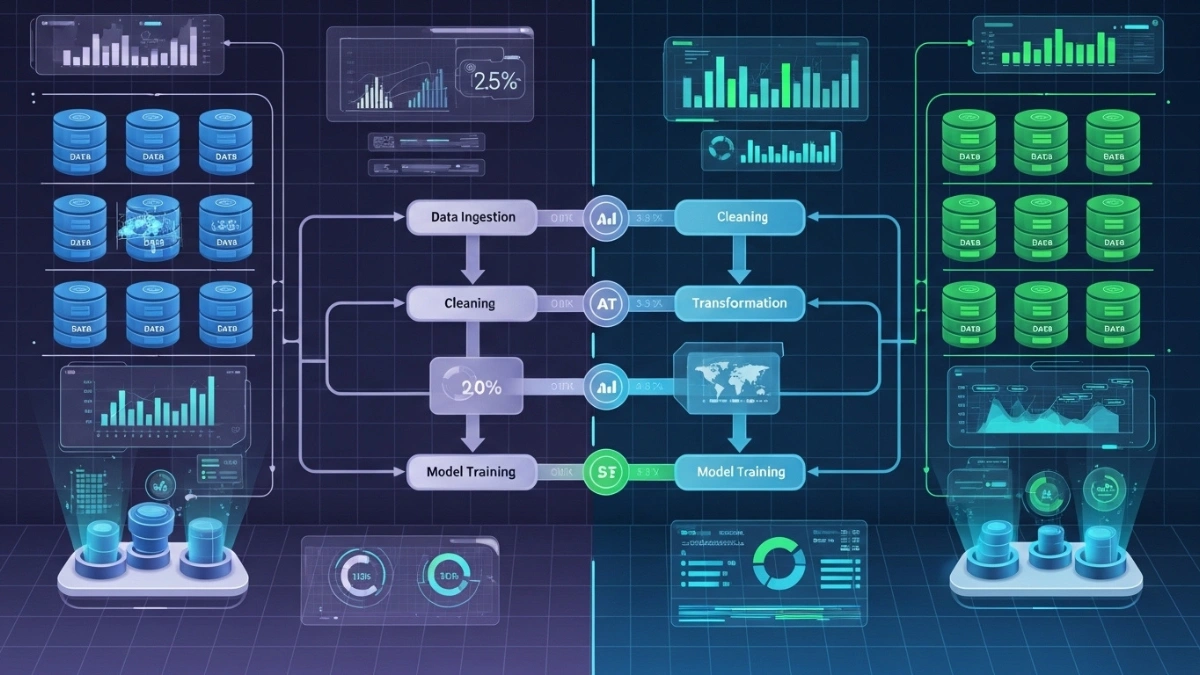
Data Collection

AI systems gather large volumes of structured and unstructured data.

Data Processing

Machine learning algorithms analyze and clean the data.

Model Training

ML models learn patterns and relationships within the data.

Prediction & Decision-Making

The trained models generate insights and predictions.

Feedback Loop

Continuous data input improves model performance over time.

This lifecycle is the backbone of most AI systems.

The Evolution of Machine Learning in the AI Era

Machine learning itself has evolved significantly:

Early ML

  • Basic algorithms
  • Limited data
  • Narrow applications

Modern ML

  • Large-scale data processing
  • Advanced models (deep learning, neural networks)
  • Integration with AI systems

Current Shift (2026)

  • ML integrated with generative AI
  • Real-time learning systems
  • AI agents powered by ML models

Despite these advancements, the core principle remains the same:
Learning from data to make better decisions

Real-World Applications Where ML Drives AI

1. E-Commerce Platforms

Machine learning powers:

  • Product recommendations
  • Customer behavior analysis
  • Demand forecasting

2. Financial Services

ML enables:

  • Fraud detection
  • Risk assessment
  • Algorithmic trading

3. Healthcare

Machine learning supports:

  • Disease prediction
  • Medical imaging analysis
  • Personalized treatment plans

4. Cybersecurity

ML systems:

  • Detect anomalies
  • Identify threats
  • Prevent attacks

5. Transportation & Logistics

Machine learning optimizes:

  • Route planning
  • Supply chain efficiency
  • Autonomous systems

Why Understanding ML Basics Is More Important Than Ever

As AI becomes more widespread, understanding machine learning fundamentals is essential:

1. Better Decision-Making

Organizations can make informed choices about AI adoption.

2. Improved System Design

Developers can build more effective AI solutions.

3. Reduced Dependency on Black-Box Systems

Understanding ML helps interpret AI outputs and avoid blind reliance.

4. Career Growth

ML skills are increasingly in demand across industries.

The Shift in Machine Learning Basics

In 2026, the fundamentals of ML are evolving:

Old Approach:

  • Focus on algorithms and math
  • Build models from scratch

New Approach:

  • Focus on data understanding
  • Use pre-trained models
  • Emphasize real-world applications

This shift makes ML more accessible while maintaining its importance.

Challenges in Leveraging Machine Learning

Data Quality Issues

Poor data leads to inaccurate models.

Model Bias

ML systems can inherit biases from training data.

Complexity

Understanding and tuning models requires expertise.

Integration Challenges

Implementing ML in real-world systems can be difficult.

The Future: Machine Learning as Invisible Infrastructure

Machine learning is becoming:

  • Embedded in every application
  • Invisible to end users
  • Essential to system functionality

In the future:

  • Users will interact with AI
  • But ML will silently power the experience

Strategic Insight

Many organizations focus heavily on AI interfaces chatbots, automation tools, and user-facing features.

However, the real value lies in:

  • The quality of machine learning models
  • The accuracy of predictions
  • The effectiveness of data-driven decisions

Companies that invest in ML foundations will outperform those that focus only on surface-level AI.

Conclusion

Machine Learning remains the foundation behind AI, even as technology evolves rapidly.

It enables systems to:

  • Learn from data
  • Make intelligent decisions
  • Improve continuously

While AI may be the visible layer, machine learning is the engine that drives it.

Understanding this foundation is not just important it is essential for building the future of intelligent systems.

For more Contact Us

AI Is Becoming the Core Engine of Software Testing: The New Intelligence Layer for Quality Engineering in 2026

Introduction

Software is no longer released in predictable cycles it is deployed continuously, updated frequently, and consumed globally in real time. In this environment, quality is not just a technical requirement; it is a business-critical differentiator.

Yet traditional software testing approaches manual execution, static automation scripts, and late-stage validation cannot keep up with modern development speed and complexity.

In 2026, Artificial Intelligence is redefining the rules.

AI is not simply enhancing software testing it is becoming the core engine that powers how quality is built, validated, and optimized across the entire software lifecycle. This shift transforms testing from a reactive checkpoint into an intelligent, autonomous, and continuously learning system.

Why Software Testing Needed a Transformation

Modern software systems are fundamentally different from those of the past:

  • Built using microservices and APIs
  • Deployed across multi-cloud environments
  • Updated continuously via CI/CD pipelines
  • Used by millions of users across diverse devices

This complexity creates new challenges:

1. Exponential Test Scenarios

The number of possible interactions and edge cases has grown dramatically.

2. Faster Release Cycles

Teams cannot afford long testing phases before deployment.

3. Dynamic System Behavior

Applications evolve constantly, making static test scripts obsolete.

4. Increased Risk

Performance issues or bugs can directly impact revenue and user trust.

Traditional testing simply cannot scale to meet these demands AI fills this gap.

From Automation to Intelligence: The Real Shift

Automation improved speed, but it introduced its own limitations:

  • Scripts required constant maintenance
  • Tests were limited to predefined scenarios
  • Adaptability was minimal

AI introduces something fundamentally different:

Intelligence + Adaptability

AI systems learn from data, adapt to changes, and improve over time.

Decision-Making Capability

AI can decide:

  • What to test
  • When to test
  • How to test

Continuous Optimization

Testing becomes a self-improving system rather than a static process.

This is the transition from test automation → intelligent quality systems.

The Core Capabilities of AI-Driven Testing Engines

1. Autonomous Test Generation

AI analyzes:

  • Code changes
  • User behavior
  • Historical defects

…and generates test cases dynamically.

Result:

  • Higher coverage
  • Reduced manual effort
  • Faster test design cycles

2. Self-Healing Test Automation

One of the biggest pain points in automation is broken scripts.

AI solves this by:

  • Detecting UI or code changes
  • Automatically updating test scripts
  • Reducing flaky tests

Impact:

  • 60–80% reduction in maintenance effort (industry trend estimates)

3. Intelligent Test Prioritization

Instead of running all tests equally, AI:

  • Identifies high-risk areas
  • Prioritizes business-critical functions
  • Optimizes test execution

Outcome:

  • Faster feedback
  • Better use of resources

4. Predictive Defect Detection

AI uses historical data and patterns to:

  • Predict where bugs are likely to occur
  • Identify performance bottlenecks
  • Recommend preventive actions

Shift:

  • From finding bugs → preventing bugs

5. Continuous Learning Systems

AI systems improve with every test cycle:

  • Learn from failures
  • Adapt to system changes
  • Refine testing strategies

Result:
Testing becomes smarter over time not repetitive.

AI Across the End-to-End Testing Lifecycle

1. Requirement Analysis

AI interprets requirements and identifies potential risks early.

🔹 2. Test Design

Generates relevant and high-value test scenarios automatically.

3. Test Execution

Runs tests across environments, scaling effortlessly.

4. Defect Analysis

Classifies defects, identifies root causes, and suggests fixes.

5. Production Monitoring

Continuously monitors performance and user behavior.

6. Feedback Loop

Feeds insights back into development for continuous improvement.

The Rise of “Testing as an Intelligent System”

AI is turning testing into a system of intelligence, not just a process.

Traditional Testing:

  • Linear
  • Manual or scripted
  • Periodic

AI-Driven Testing:

  • Continuous
  • Adaptive
  • Predictive
  • Autonomous

Testing becomes an always-on capability embedded in the system.

Real-World Enterprise Use Cases

1. E-Commerce Platforms

  • Simulate peak traffic scenarios
  • Ensure smooth checkout experiences
  • Optimize page load performance

2. SaaS Applications

  • Continuously validate feature updates
  • Detect regressions instantly
  • Maintain uptime and performance

3. Banking & Fintech

  • Validate transaction accuracy
  • Detect anomalies and fraud patterns
  • Ensure compliance and reliability

4. Healthcare Systems

  • Ensure system stability
  • Validate critical workflows
  • Maintain data integrity

5. Media & Streaming

  • Test high-load content delivery
  • Optimize streaming performance
  • Prevent downtime during peak usage

Business Impact: Beyond Testing

AI-driven software testing is not just improving QA it is transforming business outcomes:

1. Faster Time-to-Market

Reduced testing cycles accelerate product releases.

2. Higher Product Quality

Continuous validation ensures reliability.

3. Cost Efficiency

Reduced manual effort and maintenance costs.

4. Better User Experience

Applications perform consistently under real-world conditions.

5. Increased Competitive Advantage

Organizations can innovate faster without compromising quality.

The New Role of QA Professionals

AI is not replacing testers it is elevating them.

From:

  • Manual testers
  • Script writers

To:

  • Quality engineers
  • AI orchestrators
  • Risk analysts

New Responsibilities of Software Testing:

  • Designing software testing strategies
  • Managing AI systems
  • Interpreting insights
  • Ensuring governance and compliance

Challenges in Adopting Software Testing AI

1. Data Quality

AI depends on accurate and comprehensive data.

2. Integration Complexity

Integrating AI with existing systems can be challenging.

3. Skill Gaps

Teams need expertise in AI, testing, and DevOps.

4. Trust and Explainability

Organizations must understand AI-driven decisions.

5. Over-Reliance on Automation

Balancing human oversight with AI autonomy is critical.

Implementation Framework for Enterprises

Step 1: Identify High-Impact Areas

Focus on critical workflows and systems.

Step 2: Build Data Infrastructure

Ensure access to reliable and real-time data.

Step 3: Introduce AI Gradually

Start with test generation and prioritization.

Step 4: Enable Continuous Software Testing

Integrate AI into CI/CD pipelines.

Step 5: Scale Across Systems

Expand AI-driven testing across applications.

Step 6: Establish Governance

Define rules, controls, and monitoring mechanisms.

The Future: Autonomous Quality Engineering

The next phase of AI in testing will involve:

  • Fully autonomous testing systems
  • AI agents collaborating across workflows
  • Real-time optimization of performance
  • Self-healing applications

Organizations will move toward self-optimizing software ecosystems where quality is continuously ensured without manual intervention.

Strategic Insight

Most companies today:

  • Use AI for limited automation
  • Rely on traditional QA practices
  • Treat testing as a separate phase

But leading organizations:

  • Embed AI into the entire testing lifecycle
  • Use predictive and risk-based testing
  • Build intelligent quality systems

This shift is becoming a key competitive differentiator.

Conclusion

AI is fundamentally transforming software testing by becoming its core engine.

It is enabling organizations to:

  • Move faster without sacrificing quality
  • Detect and prevent issues proactively
  • Build resilient, scalable systems
  • Deliver exceptional user experiences

In a world where Software Testing defines success, AI-driven testing is not optional it is the foundation of modern quality engineering.

For more Contact US

AI Infrastructure Is Transforming the Future of Digital Systems

For much of the past decade, artificial intelligence was viewed as a powerful digital tool. Organizations adopted AI to automate customer support, analyze data, recommend products, or detect fraud. These systems were often implemented as isolated solutions designed to solve specific business problems.

But the role of AI is now evolving beyond individual tools.

In 2026 and beyond, artificial intelligence is rapidly becoming core digital infrastructure embedded deeply within software platforms, operating systems, cloud environments, and enterprise workflows. Rather than simply supporting applications, AI is increasingly becoming the intelligence layer that powers them.

This transformation represents a fundamental shift in how technology systems are designed and how businesses operate. AI is no longer just improving digital systems; it is becoming a structural component of the digital economy itself.

From Specialized AI Tools to Integrated Systems

The earliest wave of commercial AI adoption focused on specialized applications. Businesses implemented AI in narrow areas where automation and predictive capabilities could deliver clear benefits.

Common examples included:

  • recommendation engines for e-commerce
  • fraud detection in financial services
  • predictive analytics in marketing
  • chatbots for customer support
  • image recognition systems in security

These tools delivered measurable value, but they typically operated within defined boundaries. AI models were integrated into particular features rather than embedded across entire platforms.

As technology advanced, however, organizations began to recognize that AI could do much more than automate isolated tasks.

The true potential of AI lies in system-level intelligence where AI continuously analyzes information, learns from data, and optimizes digital processes across entire infrastructures.

The Drivers Behind AI’s Infrastructure Transformation

Several technological and economic trends are accelerating the shift from AI tools to AI infrastructure.

Explosion of Data

Modern digital environments generate vast amounts of data from customer interactions, connected devices, operational systems, and online platforms.

Organizations now rely on AI to process this data and transform it into actionable insights. Without AI-driven analytics, the sheer volume of information would be impossible to interpret effectively.

AI infrastructure enables companies to convert data into strategic intelligence continuously.

Advances in Cloud Computing

Cloud platforms provide the computational power required to train and deploy large-scale AI models. These platforms allow businesses to integrate AI services into applications without building infrastructure from scratch.

Major cloud providers now offer AI capabilities as built-in services, including:

  • machine learning platforms
  • natural language processing engines
  • computer vision systems
  • predictive analytics tools

This integration means that AI is no longer an optional add-on it is becoming a default component of digital platforms.

The Rise of Large Language Models

Recent breakthroughs in large language models and generative AI systems have dramatically expanded what AI can accomplish.

These systems can:

  • write and summarize documents
  • generate code
  • analyze complex data
  • interact conversationally with users
  • assist with research and decision-making

Because of these capabilities, AI is now being embedded directly into productivity tools, development platforms, and enterprise software.

In many cases, AI is becoming the primary interface between users and technology.

AI Across the Modern Technology Stack

The transition from AI tools to AI infrastructure is happening across multiple layers of the digital ecosystem.

User Experience Layer

At the top of the technology stack, AI enhances user experiences by making applications more intuitive and personalized.

Examples include:

  • conversational interfaces that allow users to interact with software using natural language
  • personalized product recommendations
  • AI-assisted search that understands user intent
  • automated content generation

These capabilities allow users to interact with digital systems more naturally and efficiently.

Application Layer

Within business applications, AI is transforming how software processes information and makes decisions.

AI-powered applications can now:

  • forecast market trends
  • optimize logistics operations
  • analyze financial risks
  • personalize healthcare treatment recommendations
  • automate customer engagement

These systems allow organizations to operate more intelligently and adapt more quickly to changing conditions.

Platform Layer

At the platform level, AI is increasingly used to manage digital operations and optimize workflows.

AI-powered platforms can monitor system performance, detect anomalies, and recommend improvements automatically.

For example, AI can help:

  • optimize cloud resource allocation
  • predict system failures before they occur
  • analyze cybersecurity threats in real time
  • automate large-scale data processing

In these environments, AI acts as a control layer that continuously improves system efficiency.

Infrastructure Layer

Perhaps the most profound shift is occurring at the infrastructure level.

AI is now being embedded directly into infrastructure systems that manage computing resources, networks, and data environments.

Examples include:

  • AI-driven cloud orchestration systems
  • intelligent network traffic management
  • automated cybersecurity defense systems
  • predictive infrastructure maintenance

In these systems, AI does not simply assist operators it actively manages digital environments.

AI as the Intelligence Layer of the Digital Economy

Many technology leaders now describe AI as the intelligence layer of modern infrastructure.

Just as electricity powers physical infrastructure and the internet connects digital networks, AI provides the cognitive capabilities that allow systems to learn, adapt, and optimize.

In the near future, AI may become so deeply integrated that users no longer perceive it as a separate technology.

Instead, AI will simply be part of how digital systems operate.

Implications for Businesses

The transition toward AI infrastructure has profound implications for organizations across industries.

Strategic Competitive Advantage

Companies that integrate AI deeply into their infrastructure gain significant advantages in efficiency, innovation, and decision-making.

AI-powered systems can identify opportunities, predict risks, and automate complex workflows faster than traditional software systems.

Organizations that fail to adopt AI infrastructure may struggle to compete with AI-driven competitors.

Changes in Workforce Skills

As AI becomes embedded within digital infrastructure, demand for AI-related skills will increase.

Key capabilities will include:

  • machine learning engineering
  • data engineering
  • AI governance and ethics
  • AI product design
  • AI systems integration

Businesses will need professionals who understand both technology and the strategic implications of AI.

New Governance and Ethical Challenges

Embedding AI deeply into infrastructure raises important governance questions.

Organizations must address issues such as:

  • algorithmic bias
  • transparency in automated decisions
  • data privacy protection
  • accountability for AI-driven actions

Responsible AI governance will become a critical aspect of future technology systems.

The Rise of AI-Native Organizations

One of the most important consequences of AI infrastructure is the emergence of AI-native organizations.

AI-native companies design their systems, workflows, and strategies around AI from the start rather than adding AI later.

These organizations integrate AI into areas such as:

  • product development
  • customer support
  • operations management
  • financial forecasting
  • market analysis

By embedding AI into their core operations, these companies operate with greater agility and intelligence.

AI Infrastructure and Global Innovation

AI infrastructure is also shaping innovation at a global scale.

Countries and technology ecosystems that invest heavily in AI research, computing infrastructure, and data ecosystems are likely to gain long-term economic advantages.

Governments around the world are now supporting initiatives to develop AI infrastructure, including:

  • national AI research programs
  • high-performance computing centers
  • public AI data platforms
  • AI startup ecosystems

These investments reflect the growing recognition that AI infrastructure will play a central role in the future global economy.

The Next Phase of AI Infrastructure

The evolution of AI infrastructure is still in its early stages. Several emerging developments will shape the next phase of this transformation.

Autonomous AI Systems

Future AI systems may manage digital environments autonomously, optimizing operations and solving problems with minimal human intervention.

AI Agents and Automation

AI agents capable of performing multi-step tasks will increasingly automate complex workflows across industries.

These agents could coordinate activities such as software development, data analysis, and operational management.

Distributed AI Networks

Edge computing and decentralized AI systems will allow AI capabilities to operate closer to devices and users, improving speed and reducing reliance on centralized systems.

Conclusion

Artificial intelligence is undergoing a profound transformation. What once functioned as a set of specialized tools is rapidly evolving into the foundational infrastructure that powers modern digital systems.

As AI becomes embedded across applications, platforms, and infrastructure layers, it will reshape how organizations operate, how technology systems are built, and how decisions are made.

The most successful organizations of the next decade will not simply adopt AI tools they will design their systems with AI as a core infrastructure component.

In the future of technology, AI will not just enhance digital systems.
It will define them.

For more Contact US

9 Proven Benefits of AI Search Integration for Better Content Discovery

AI search integration is transforming how content is discovered, summarized, and ranked in modern search engines. In 2026, search is no longer limited to keyword matching and blue links. Artificial intelligence now interprets intent, generates structured summaries, and reshapes how users interact with information online.

Instead of simply ranking pages, AI search systems analyze semantic relationships, contextual depth, and content structure before presenting answers directly within search interfaces. This shift is fundamentally changing content strategy and SEO practices.

This marks a major shift in content strategy. SEO is no longer only about visibility it is about participation in AI-driven discovery systems.

From Blue Links to Intelligent Answers

Traditional search results relied on ranking web pages as clickable blue links. Users would:

  1. Enter a query
  2. Browse results
  3. Click a page
  4. Extract information

Today, AI models summarize multiple sources and present direct answers within the search interface itself.

This transformation includes:

  • AI-generated summaries
  • Conversational search results
  • Multi-step guided answers
  • Follow-up question prompts
  • Context-aware recommendations

Content is now competing not just for rankings, but for inclusion in AI-generated responses.

How AI Search Integration Changes SEO Strategy

AI-driven search systems evaluate content differently. Instead of scanning for keyword frequency alone, they prioritize:

  • Conceptual depth
  • Entity relationships
  • Author credibility
  • Structured clarity
  • Context completeness

Content that is thin, repetitive, or surface-level is less likely to be surfaced in AI summaries.

In contrast, content that demonstrates clarity, expertise, and logical structure has higher chances of being referenced.

The Rise of Structured and Extractable Content

AI models rely heavily on structured data patterns. This means that content optimized for AI discovery typically includes:

  • Clear H2 and H3 headings
  • Bullet points
  • Numbered steps
  • FAQs
  • Definitions and explanations
  • Logical topic progression

Unstructured long paragraphs are harder for AI systems to parse and summarize accurately.

Content structure now directly influences discoverability.

Multimodal Discovery Is Expanding

Search is no longer purely text-based. AI integration supports:

  • Image interpretation
  • Video summarization
  • Voice queries
  • Conversational responses
  • Cross-platform search experiences

Content creators must consider multiple formats when designing assets.

For example:

  • A blog post may appear as a summarized snippet
  • An infographic may be extracted into a featured answer
  • A video transcript may inform conversational AI responses

Content discovery is now multi-layered.

The Impact on Click-Through Behavior

One of the most significant changes in AI-integrated search is its effect on traffic patterns.

Because AI answers often provide summaries directly in search results, users may not always click through to the original source.

This introduces new strategic questions:

  • How do brands maintain visibility if clicks decrease?
  • How should content provide value beyond summaries?
  • What motivates users to visit the full page?

The answer lies in depth and differentiation.

Surface-level answers may be summarized, but original insights, case studies, frameworks, and expert analysis still drive engagement.

As AI search integration evolves, content must be structured for extractability and semantic clarity rather than keyword repetition.

Authority Signals Matter More Than Ever

AI systems prioritize trustworthy sources. Signals that influence AI inclusion include:

  • Author expertise
  • Brand authority
  • Backlink credibility
  • Consistent publishing
  • Topical depth

Content ecosystems built around topic clusters perform better than isolated posts.

For example, rather than publishing a single article on SEO, organizations now build:

  • Core pillar content
  • Supporting subtopics
  • Case studies
  • Technical breakdowns
  • Expert commentary

AI favors comprehensive topical authority.

Organizations that understand AI search integration will outperform competitors still relying on traditional ranking tactics.

Topic Clusters Over Keywords

The integration of AI into search accelerates the shift from keyword-based SEO to intent-based SEO.

Instead of targeting individual search terms, successful strategies focus on:

  • Topic coverage
  • User journey alignment
  • Related question mapping
  • Contextual completeness

AI models connect ideas rather than matching isolated phrases.

Content strategy must reflect that evolution.

First-Party Engagement Signals Are Increasingly Important

With AI search integration reducing some click-through behavior, engagement quality becomes more critical.

Search engines now consider:

  • Time on page
  • Scroll depth
  • Repeat visits
  • Content interaction
  • Bounce rate

User satisfaction signals influence long-term ranking and visibility in AI systems.

SEO now overlaps more closely with UX and content experience design.

The Role of AI in Content Creation

AI is not only transforming search it is also influencing content production.

Content teams now use AI tools for:

  • Topic ideation
  • Outline structuring
  • Keyword clustering
  • Content optimization suggestions
  • Performance forecasting

However, AI-generated content alone is insufficient.

AI integration in search systems favors originality, expertise, and differentiated insight not generic summaries.

Human-driven strategic thinking remains essential.

Challenges of AI Search Integration

Despite its benefits, AI-driven search introduces challenges:

1. Reduced Traffic Transparency

Summarized results may obscure referral patterns.

2. Attribution Complexity

AI-generated answers may aggregate multiple sources without clear credit.

3. Increased Competition for Authority

Brands must compete not only for ranking but for inclusion in summary models.

Organizations must adapt measurement frameworks to account for new discovery dynamics.

Strategic Recommendations for 2026

To succeed in AI-integrated search environments, organizations should:

  1. Build topic clusters, not isolated articles
  2. Structure content clearly for extractability
  3. Demonstrate expertise through case studies and data
  4. Use schema markup where appropriate
  5. Optimize for user intent rather than keyword density
  6. Focus on engagement depth beyond surface answers

The goal is not just ranking it is inclusion, authority, and sustained trust.

Conclusion

AI integration is reshaping content discovery at a structural level. Search engines are evolving from index-and-rank systems into interpret-and-answer systems.

This shift changes how content is evaluated, displayed, and consumed. Visibility now depends on semantic depth, structural clarity, and authority signals.

Organizations that adapt to AI-driven discovery models will maintain influence in the evolving search landscape. Those that rely solely on traditional SEO tactics risk declining visibility.

In the age of AI Search Integration, content strategy must be intelligent, structured, and authoritative.

Search is no longer about links. It is about understanding.

AI search integration is not a temporary shift it represents a permanent transformation in how digital content is evaluated and delivered.
For more Contact Us

Data Quality Scoring Is Becoming Standard, Not Optional

In the early days of machine learning and analytics, teams often rushed toward model training with one assumption: more data equals better results. Data pipelines were built quickly, datasets were collected from multiple sources, and models were trained with minimal inspection of data integrity.

That approach no longer works.

In 2026, data quality scoring is becoming a standard requirement before any model training or analytics deployment begins. Organizations are recognizing that poor data quality is one of the primary causes of model failure, inaccurate insights, and operational risk.

The shift is clear: data quality is no longer an afterthought it is a measurable prerequisite.

Why Data Quality Was Historically Overlooked

For years, data engineering focused primarily on:

  • Data ingestion speed
  • Storage scalability
  • Model accuracy metrics
  • Feature engineering optimization

Data quality checks were often limited to:

  • Missing value detection
  • Basic format validation
  • Schema matching

These checks were reactive and superficial. They did not measure whether the data was reliable, unbiased, consistent, or representative.

As machine learning systems became more integrated into real-world decision-making healthcare diagnostics, credit scoring, fraud detection, supply chain forecasting the cost of low-quality data became significantly higher.

What Is Data Quality Scoring?

Data quality scoring is a structured process that assigns measurable ratings to datasets before they are used for training or inference.

Rather than simply asking, “Is the data complete?”, modern scoring systems evaluate:

  • Completeness – Are critical fields missing?
  • Consistency – Are formats and values uniform across sources?
  • Accuracy – Does the data reflect real-world conditions?
  • Timeliness – Is the dataset up to date?
  • Distribution Stability – Has the data drifted from historical patterns?
  • Bias Detection – Does the dataset overrepresent certain groups?

Each dimension contributes to an overall quality score that determines whether the dataset is safe to use.

Why Data Quality Scoring Is Becoming Mandatory

1. Model Performance Depends on Input Integrity

Even the most advanced algorithms cannot compensate for flawed data. Low-quality inputs lead to:

  • Inconsistent predictions
  • Overfitting to noisy signals
  • Increased false positives or negatives
  • Model instability in production

By scoring data quality early, organizations prevent expensive rework.

2. Regulatory and Compliance Pressure

Industries such as finance, healthcare, and insurance face increasing scrutiny regarding algorithmic decisions.

Regulators now expect companies to demonstrate:

  • Data lineage
  • Bias mitigation practices
  • Validation frameworks
  • Audit trails

Data quality scoring provides documentation and defensibility.

3. AI Responsibility and Fairness Standards

Responsible AI practices now require dataset evaluation beyond performance metrics.

If a model is trained on biased or incomplete data, it can produce discriminatory outcomes. Data quality scoring incorporates fairness checks, ensuring datasets meet ethical and legal standards.

4. Cost Efficiency in ML Pipelines

Poor data often leads to:

  • Repeated training cycles
  • Increased debugging time
  • Deployment rollbacks
  • Production outages

Scoring datasets before model training reduces operational waste.

Key Components of Modern Data Quality Scoring Systems

Modern platforms integrate automated checks directly into data pipelines.

Automated Schema Validation

Ensures structure matches expected definitions.

Missing Value Impact Analysis

Measures how missing data affects model performance.

Distribution Shift Detection

Compares new data with historical baselines to detect drift.

Feature Reliability Index

Scores each feature based on stability and predictive contribution.

Bias and Fairness Screening

Identifies disproportionate representation across sensitive attributes.

These tools generate dashboards that allow data teams to approve or reject datasets before use.

Data Quality Scoring in Real-Time Systems

With the rise of real-time machine learning systems, static validation is insufficient.

Organizations are implementing:

  • Continuous data monitoring
  • Real-time anomaly detection
  • Streaming quality validation
  • Drift alerts before model degradation

Quality scoring is now ongoing not one-time.

The Cultural Shift: From Data Volume to Data Integrity

In the past, success was often measured by the size of a dataset.

Today, quality matters more than quantity.

High-integrity datasets enable:

  • Better generalization
  • Faster model convergence
  • More explainable predictions
  • Increased stakeholder trust

Data integrity has become a strategic asset.

Challenges in Implementing Data Quality Scoring

Despite its benefits, organizations face challenges:

1. Standardization Across Teams

Different teams may define “quality” differently.

2. Tool Integration

Integrating scoring tools into existing pipelines requires architectural planning.

3. False Confidence

A high data quality score does not guarantee perfect predictions. Human oversight remains essential.

However, the long-term gains outweigh these obstacles.

The Future of Data Quality Management

Looking forward, data quality scoring will evolve into:

  • AI-assisted quality diagnostics
  • Predictive quality degradation alerts
  • Self-healing data pipelines
  • Integrated governance dashboards

Eventually, data quality scoring will become as fundamental as version control in software development.

It will not be optional it will be embedded.

Conclusion

Data quality scoring is becoming standard because the cost of ignoring it is too high. As machine learning systems become more embedded in business-critical decisions, organizations must ensure that the foundation their data is reliable, fair, and consistent.

By implementing structured data quality scoring frameworks, companies reduce risk, improve model performance, and strengthen trust in AI-driven outcomes.

In modern machine learning, success begins before training starts. It begins with data integrity.

For more information Connect with us

AI-Driven CI/CD: Powerful Features Transforming DevOps in 2026

The world of DevOps is evolving rapidly, and one of the most powerful accelerators behind this transformation is Artificial Intelligence (AI). In 2026, AI-driven CI/CD tools are no longer experimental they are becoming essential components of modern software delivery pipelines.

From predictive build analysis to automated rollback strategies, AI is redefining how teams build, test, deploy, and secure applications. In this blog, we explore the major AI-driven CI/CD tool features shaping the future of DevOps.

Why AI in CI/CD Matters Now

Traditional CI/CD pipelines rely heavily on predefined rules and manual optimizations. While effective, they often struggle with:

  • Flaky test failures
  • Slow build times
  • Infrastructure drift
  • Pipeline inefficiencies
  • Reactive troubleshooting

AI introduces data-driven intelligence into the pipeline, allowing systems to learn from historical runs and improve continuously.

Platforms like GitHub, GitLab, and CircleCI are embedding AI-driven CI/CD ecosystems.

1. Automated Test Impact Analysis (Smart Test Selection)

One of the biggest pain points in CI/CD is running unnecessary tests.

AI-driven CI/CD tools now analyze:

  • Code changes
  • Dependency graphs
  • Historical test coverage
  • Failure patterns

Using machine learning, these systems determine which tests are actually impacted by a commit. Instead of running 5,000 tests, your pipeline might run only 300 relevant ones.

Benefits:

  • 40–70% faster build times
  • Reduced compute costs
  • Lower developer wait time
  • Faster feedback loops

This feature is becoming standard in enterprise pipelines with large microservices architectures.

2. Predictive Build Failure Detection

Modern AI-driven pipelines can now predict whether a build is likely to fail before it finishes.

By analyzing:

  • Previous commit history
  • Branch patterns
  • Test flakiness data
  • Developer behavior patterns

AI models flag risky builds early.

Instead of waiting 20 minutes for failure, teams get real-time warnings like:

“This commit has a 75% probability of failing due to dependency mismatch.”

Impact:

  • Reduced wasted compute time
  • Faster issue triage
  • Higher developer productivity

3. Flaky Test Detection & Auto-Healing

Flaky tests are a nightmare in CI/CD. They:

  • Create false negatives
  • Block deployments
  • Reduce trust in pipelines

AI models now identify flakiness patterns by tracking:

  • Intermittent failures
  • Timing inconsistencies
  • Infrastructure variability

Advanced systems can even:

  • Auto-retry unstable tests intelligently
  • Quarantine flaky test suites
  • Suggest fixes based on similar historical patterns

This dramatically improves pipeline stability.

4. Intelligent Deployment Rollbacks

Rollback decisions used to rely on manual monitoring and reactive action.

Now, AI enhanced pipelines:

  • Monitor deployment health metrics
  • Detect anomalies in latency, error rates, and CPU usage
  • Compare behavior against historical baselines

If anomalies exceed safe thresholds, the system can:

  • Automatically initiate rollback
  • Recommend safe deployment versions
  • Trigger rollback workflows without human intervention

This is especially valuable in Kubernetes-based deployments.

AI + Kubernetes = Smarter Releases

With orchestration platforms like Kubernetes, AI-driven CI/CD tools are now integrating:

  • Intelligent canary analysis
  • Progressive delivery decisions
  • Resource usage prediction

AI determines whether a rollout should continue, pause, or revert.

This reduces downtime and protects revenue for high-traffic platforms.

5. AI-Based Security & Vulnerability Prioritization

DevSecOps has become a mandatory standard. However, security tools often overwhelm teams with alerts.

AI-driven CI/CD platforms now:

  • Prioritize vulnerabilities based on exploit likelihood
  • Analyze dependency risk patterns
  • Suggest patch versions intelligently

Rather than showing 200 vulnerabilities, the system highlights:

“These 3 vulnerabilities are high-risk and actively exploited.”

This improves remediation speed and reduces alert fatigue.

6. Pipeline Optimization & Cost Intelligence

AI systems analyze historical pipeline runs to optimize:

  • Job parallelization
  • Resource allocation
  • Cache strategies
  • Runner usage

For example:

  • Suggest optimal CPU/memory allocation
  • Reduce idle runner costs
  • Improve cache hit ratios

This is particularly useful for cloud-native CI/CD running on AWS, Azure, or GCP.

7. Natural Language Pipeline Assistance

One of the newest features in AI-driven CI/CD tools is conversational support.

Developers can now ask:

  • “Why did my last build fail?”
  • “Optimize this pipeline YAML.”
  • “Generate a CI workflow for a Node + Docker app.”

AI assistants embedded inside DevOps platforms analyze pipeline logs and provide contextual responses.

This reduces reliance on senior DevOps engineers and accelerates onboarding.

8. Automated Code-to-Infrastructure Mapping

Infrastructure-as-Code (IaC) tools like HashiCorp have seen AI enhancements where:

  • Infrastructure drift is detected automatically
  • Configuration errors are predicted before apply
  • Infrastructure cost anomalies are flagged

AI ensures infrastructure stays aligned with intended architecture.

Real-World Impact of AI in CI/CD

Organizations adopting AI-enhanced pipelines report:

  • 30–50% faster deployment cycles
  • Significant reduction in flaky builds
  • Improved MTTR (Mean Time to Recovery)
  • Lower cloud compute costs
  • Higher developer satisfaction

AI shifts CI/CD from reactive automation to predictive optimization.

Challenges & Considerations

Despite its advantages, AI-driven CI/CD brings challenges:

  • Model transparency (black-box decisions)
  • Data privacy concerns
  • Over-reliance on automation
  • False-positive risk predictions

Successful implementation requires:

  • Continuous model monitoring
  • Clear governance
  • Human-in-the-loop validation

AI should augment DevOps not replace engineering judgment.

The Future of AI-Driven CI/CD

We are moving toward pipelines that are:

  • Self-optimizing
  • Self-healing
  • Cost-aware
  • Security-aware
  • Context-aware

The next frontier includes:

  • Autonomous pipeline tuning
  • Zero-touch production deployment
  • AI-driven GitOps
  • Real-time business impact analysis of deployments

AI is no longer just assisting CI/CD it is reshaping how software delivery operates.

 For more Details let’s connect on Contact Us

AI Automation in the Workplace: 5 Powerful Breakthroughs Transforming the Future of Work

Artificial Intelligence is no longer just a productivity enhancer. According to tech insiders across Silicon Valley and enterprise tech circles, AI is actively reshaping how work gets done from coding and compliance to marketing, finance, and operations.

What’s changing isn’t just speed. It’s structure, roles, and business models.

Let’s break down what this shift means for companies, professionals, and the future of work.

From Assistants to Autonomous Agents

For years, Artificial Intelligent tools acted like digital assistants helping write emails, summarize documents, or suggest code.

Now, companies like OpenAI and Anthropic are pushing Artificial Intelligent systems that can:

  • Execute multi step workflows
  • Make decisions within set constraints
  • Operate across multiple software tools
  • Complete tasks with minimal supervision

Instead of answering one prompt, Artificial Intelligent agents can:

  • Research → Analyze → Generate report → Send email → Update CRM

That’s not assistance. That’s task execution.

Automation Is Moving Up the Value Chain

Traditional automation (like RPA tools from UiPath) focused on rule-based repetitive tasks data entry, invoice processing, compliance checks.

Today’s Artificial Intelligent systems are automating:

  • Drafting legal documents
  • Writing production ready code
  • Creating marketing campaigns
  • Performing financial forecasting
  • Supporting medical documentation

This is white-collar workflow automation at scale.

Tech insiders suggest this wave could impact junior and mid-level roles first particularly in:

  • Administrative support
  • Customer service
  • Content production
  • Entry level finance
  • Junior development

The Shift from SaaS to Artificial Intelligent-Native Platforms

One of the biggest structural changes happening quietly:

It is changing how software is sold and used.

Traditional SaaS:

  • Human inputs data
  • Software processes
  • Human interprets output

Artificial Intelligent native workflow:

  • Human sets objective
  • Executes workflow
  • Human reviews results

This changes:

  • Pricing models
  • Headcount requirements
  • Software stack design
  • IT infrastructure planning

Companies are now asking:

“Do we need more tools or smarter automation across tools ?”

Productivity Gains vs. Workforce Disruption

Tech insiders remain divided on one issue:
Is this transformation net positive or disruptive?

Optimistic View

  • Workers become “Artificial Intelligent supervisors”
  • Output per employee increases
  • Smaller teams achieve enterprise level productivity
  • New job categories emerge ( Workflow designer, automation strategist)

Concerned View

  • Entry level roles shrink
  • Skill gaps widen
  • Security & governance risks grow
  • Overreliance on imperfect models increases business risk

The truth? Both are likely happening simultaneously.

What This Means for Businesses

Companies that adapt early will:

  • Redesign workflows around Artificial Intelligent
  • Upskill teams in prompt engineering & automation strategy
  • Build governance frameworks
  • Shift from tool-centric to outcome-centric operations

Those that resist change risk:

  • Slower execution
  • Higher operating costs
  • Competitive disadvantage

The key question is no longer:

“Should we use Artificial Intelligent?”

It’s:

“Where can it autonomously execute work today?”

The Rise of the Artificial Intelligent-Augmented Professional

The future professional will not compete against it but work alongside it.

Tomorrow’s top performers will:

  • Orchestrate it tools
  • Design automated workflows
  • Validate outputs
  • Focus on strategic thinking & relationship-building

In short:

Routine execution becomes automated. Strategic thinking becomes premium. For more Details let’s connect on Contact Us

Software Development in 2026: How AI Is Dramatically Transforming Workflows

Introduction: AI Is No Longer a Tool It’s the Workflow

In 2026, AI is no longer an optional productivity booster for developers. It has become a core layer of the software development workflow itself. Teams that still treat AI as a side tool something used only for code suggestions are already falling behind.

The real shift isn’t that AI writes code faster.
The shift is that AI changes how software is designed, built, tested, reviewed, and deployed.

This is not a future prediction. This is happening now.

From Code-Centric to Decision-Centric Software Development

Traditional software development workflows were built around writing code. AI has flipped that model.

In 2026:

  • Writing code is cheap
  • Generating boilerplate is trivial
  • Implementing patterns is automated

The new bottleneck is decision quality.

Developers now spend more time for Software Development:

  • Reviewing AI-generated logic
  • Validating assumptions
  • Checking edge cases
  • Ensuring architectural consistency

AI accelerates implementation, but humans remain responsible for correctness and intent.

Planning and Architecture Are Becoming More Important, Not Less

Here’s the uncomfortable truth: AI exposes weak planning instantly.

When architecture is unclear:

  • AI produces inconsistent implementations
  • Codebases fragment faster
  • Technical debt multiplies

Strong teams are adapting by:

  • Defining clearer system boundaries
  • Writing better specifications and acceptance criteria
  • Treating architecture as a living artifact

AI doesn’t replace architecture.
It punishes the absence of it.

AI Is Compressing Software Development Phases

In 2026, the traditional linear workflow design → software development → testing → release is collapsing.

AI enables:

  • Parallel development and testing
  • Instant refactoring suggestions
  • Continuous validation during coding

What used to take weeks across phases now happens within a single development loop.

But this only works when:

  • QA is integrated early
  • CI/CD pipelines are mature
  • Teams trust automation without surrendering control

Without discipline, speed becomes chaos.

Code Reviews Are Now the Most Critical Checkpoint

AI-generated code increases volume. It does not guarantee quality.

As a result:

  • Code reviews are no longer optional safeguards
  • Reviewers must evaluate intent, not just syntax
  • Senior engineers spend more time reviewing than writing

In 2026, the strongest software developer are not the fastest coders.
They are the best reviewers and system thinkers.

If your team skim-reviews AI output, you are quietly accumulating risk.

Testing Is Shifting from Coverage to Confidence

AI has flooded teams with autogenerated tests. On paper, coverage looks impressive.

In reality:

  • Many tests validate nothing meaningful
  • Failures are harder to interpret
  • Signal is buried in noise

Modern teams of software developers are responding by:

  • Reducing UI-heavy testing
  • Prioritizing API and contract tests
  • Using AI to remove redundant tests, not just create them

The goal in 2026 is not maximum coverage.
It is maximum confidence per test.

QA Roles Are Evolving, Not Disappearing

AI didn’t kill QA. It forced QA to grow up.

Today’s QA engineers:

  • Define quality rules, not just test cases
  • Validate AI-generated scenarios
  • Focus on risk, behavior, and failure modes

QA is moving upstream into quality engineering and decision support.

If your QA team is still clicking through scripts, you’re underusing them and AI will expose that weakness fast.

DevOps Is Becoming Invisible and Mandatory

AI thrives in well-instrumented systems.

In 2026:

  • Poor pipelines break AI-assisted workflows
  • Missing observability hides AI-generated defects
  • Weak deployment discipline negates speed gains

Modern DevOps is not about tools.
It’s about feedback loops, traceability, and rollback safety.

AI amplifies whatever pipeline you already have good or bad.

Security and Risk Are Now Continuous Concerns

AI accelerates change. Change increases risk.

As a result:

  • Static security testing is insufficient
  • Risk assessment must be continuous
  • Context matters more than severity scores

Security teams are shifting from:

  • “Find everything”
    to
  • “Fix what actually matters”

AI doesn’t reduce security responsibility.
It raises the cost of ignoring it.

Productivity Gains Are Real But Uneven

Let’s be clear: AI delivers massive productivity gains.

But those gains are not evenly distributed.

High-performing teams:

  • Gain speed and quality
  • Reduce cycle time
  • Ship more reliably

Low-maturity teams:

  • Generate more code
  • Increase technical debt
  • Break systems faster

AI rewards process maturity, not effort.

What Winning Teams Are Doing Differently

Teams successfully reshaping software development workflows around AI share common traits:

  • Clear architecture and ownership
  • Strong review culture
  • Integrated QA and DevOps
  • Disciplined use of automation
  • Willingness to delete as much as they generate

Software developers treat AI as a force multiplier, not a replacement.

The Hard Truth

AI is not making software development easier.

It is making:

  • Weak thinking more visible
  • Poor processes more expensive
  • Undisciplined teams more fragile

In 2026, AI doesn’t level the playing field.
It widens the gap between teams that understand software engineering and those that merely write code. For more Details let’s connect on Contact Us

Self-Healing Tests vs Root-Cause Intelligence: What Actually Improves Test Reliability

Introduction: Stability Isn’t the Same as Confidence

Over the last few years, self-healing tests have been marketed as the answer to flaky automation. Broken locators? Healed. Timing issues? Retried. UI changes? Adapted automatically.

At first, the results looked impressive. Pipelines got greener. Test failures dropped. Teams felt relief.

Then something uncomfortable happened: production bugs still escaped.

In 2026, many engineering teams are realizing a hard truth self-healing tests improve test stability, but they do not improve system understanding. And without understanding why failures happen, quality remains fragile.

This is where root-cause intelligence enters the picture.

What Self-Healing Tests Actually Do (and Don’t)

Self-healing tests are designed to adapt when something changes unexpectedly. They typically:

  • Auto-update UI locators
  • Retry failed steps
  • Adjust waits and timeouts
  • Mask transient failures

Their purpose is clear: reduce noise in automation pipelines.

And they succeed at that.

What they don’t do:

  • Explain why a test failed
  • Identify system instability
  • Detect architectural regressions
  • Surface hidden risk

Self-healing is reactive. It fixes symptoms, not causes.

Why Self-Healing Became Popular

The rise of self-healing tests wasn’t accidental.

They addressed real pain:

  • UI tests breaking on minor changes
  • Flaky pipelines blocking releases
  • High maintenance costs
  • QA teams overwhelmed by false failures

In fast-moving environments, self-healing felt like progress and in some ways, it was.

But over time, teams began confusing silence with reliability.

The Hidden Risk: Quietly Broken Signals

The biggest danger of self-healing tests is not what they break it’s what they hide.

When tests auto-heal:

  • Instability is masked
  • Regression signals are weakened
  • Failure patterns disappear
  • Engineers lose feedback loops

The pipeline stays green, but confidence erodes.

This creates what many teams now call “silent flakiness” systems that are unstable, but no longer visible through tests.

Root-Cause Intelligence: A Different Philosophy

Root-cause intelligence focuses on understanding, not suppression.

Instead of asking:

“How do we stop this test from failing?”

It asks:

“Why did this failure happen, and what does it tell us about the system?”

Root-cause intelligence uses:

  • Failure pattern analysis
  • Correlation across services
  • Change-impact detection
  • Signal classification (infra vs app vs test)

Its goal is not greener pipelines it’s better decisions.

Why Root-Cause Intelligence Matters More in 2026

Modern systems are:

  • Distributed
  • API-driven
  • Highly integrated
  • Continuously deployed

Failures rarely come from a single UI element. They come from:

  • Contract changes
  • Data inconsistencies
  • Environment drift
  • Dependency latency
  • Race conditions

Self-healing tests struggle in these environments because they operate too close to the surface.

Root-cause intelligence operates at the system level.

Self-Healing vs Root-Cause Intelligence: The Core Differences

Self-Healing Tests

  • Reactive
  • UI-focused
  • Symptom-oriented
  • Optimized for pipeline stability
  • Reduces visible failures

Root-Cause Intelligence

  • Proactive
  • System-focused
  • Cause-oriented
  • Optimized for confidence and learning
  • Reduces real defects

One keeps tests running.
The other keeps systems healthy.

Where Self-Healing Still Makes Sense

Self-healing is not useless. It just needs boundaries.

It works best when:

  • Used on low-risk UI paths
  • Applied to cosmetic or locator changes
  • Combined with strict reporting
  • Treated as noise reduction, not quality validation

Self-healing should buy time, not replace investigation.

Why Teams Are Shifting Toward Root-Cause Intelligence

Leading QA and platform teams are changing priorities because:

  • Green pipelines no longer equal safe releases
  • Flaky behavior reappears in production
  • Engineers distrust “auto-fixed” tests
  • AI-generated tests amplify noise without insight

Root-cause intelligence restores trust by making failures actionable.

How AI Changes This Equation

AI has made both sides stronger and more dangerous.

AI can:

  • Generate self-healing logic faster
  • Mask failures at scale
  • Create thousands of tests instantly

But AI can also:

  • Cluster failures
  • Detect anomalies
  • Trace change impact
  • Identify systemic risk

The difference is intent.

Using AI only for self-healing increases verification debt.
Using AI for root-cause intelligence increases organizational learning.

What Root-Cause-Driven Testing Looks Like in Practice

Teams adopting this approach focus on:

  • API and contract testing as the primary signal
  • Failure classification (test issue vs product issue)
  • Linking failures to recent code changes
  • Observability integration (logs, metrics, traces)
  • Reducing tests that don’t add signal

Tests are treated as sensors, not gatekeepers.

The Role Shift for Automation Engineers

This shift is changing roles dramatically.

Modern automation engineers are expected to:

  • Understand system architecture
  • Analyze failure patterns
  • Work closely with DevOps and SRE
  • Design signal-rich tests
  • Reduce test volume while increasing confidence

Click-level automation skills alone are no longer enough.

A Dangerous Middle Ground: Self-Healing Without Intelligence

The most risky setup today is:

  • Heavy self-healing
  • No failure analysis
  • No observability correlation
  • No test pruning

This creates the illusion of quality while increasing long-term risk.

Teams think they are stable until a major incident proves otherwise.

How to Balance Both Approaches

The right approach is not choosing one over the other it’s hierarchy.

A mature strategy looks like this:

  1. Root-cause intelligence as the foundation
  2. API and contract tests as primary signals
  3. Self-healing applied selectively to UI noise
  4. Human review for AI-generated changes
  5. Continuous pruning of low-value tests

Stability serves intelligence not the other way around.

Final Thoughts: Green Pipelines Are Not the Goal

Self-healing tests solve a visible problem.
Root-cause intelligence solves the real one.

In 2026, quality is no longer about how many tests pass it’s about how well failures teach you something.

Teams that chase silent stability will keep shipping surprises.
Teams that invest in understanding will ship with confidence.

Self-healing makes pipelines quieter.
Root-cause intelligence makes teams smarter.

And in modern software delivery, smart beats silent every time. For details Contact Us

Generative AI Tools Is Revolutionizing Web & App Development in 2026

Introduction: Development Has Crossed a Structural Line

Web and app development has always evolved new frameworks, better tooling, faster runtimes. But in 2026, the change is not incremental. It is structural.

Generative AI tools are no longer experimental assistants or novelty code generators. They are actively reshaping how applications are designed, built, tested, deployed, and maintained. The developer’s role is shifting from writing every line of code to orchestrating systems, validating outputs, and designing outcomes.

This is not about replacing developers. It’s about redefining what development work actually means.

What “Generative AI Tools” Mean in 2026

In earlier years, generative AI in development mostly meant:

  • Code autocomplete
  • Basic snippet generation
  • Simple bug explanations

In 2026, generative AI tools operate across the entire development lifecycle, including:

  • UI and UX generation
  • Frontend and backend scaffolding
  • API design and documentation
  • Automated testing and test data generation
  • Performance tuning and refactoring
  • Deployment configuration and monitoring

These tools don’t just assist they actively participate in building software. Telegram

Faster Prototyping and Shorter Build Cycles

One of the most visible changes is speed.

Generative AI enables teams to:

  • Convert product ideas into working prototypes in hours
  • Generate production-ready UI components from design prompts
  • Scaffold full applications with consistent architecture

This dramatically reduces the time between concept and validation. Product teams can test ideas faster, discard weak concepts earlier, and iterate with real user feedback.

In 2026, speed is no longer a competitive advantage it’s the baseline expectation.

Frontend Development Is Becoming Intent-Driven

Frontend work has traditionally been labor-intensive:

  • Styling
  • Responsive layouts
  • Accessibility fixes
  • Cross-browser issues

Generative AI tools now generate:

  • Semantic HTML
  • Responsive CSS layouts
  • Component libraries aligned with design systems
  • Accessibility-aware UI structures

Developers increasingly describe what they want rather than building it piece by piece. The role shifts from construction to review, refinement, and integration.

This doesn’t reduce frontend complexity it changes where expertise is applied.

Backend Development Is Becoming More Declarative

Backend development is also being reshaped.

Generative AI can:

  • Design REST or GraphQL APIs
  • Generate database schemas
  • Produce validation logic and error handling
  • Draft authentication and authorization flows

Developers still define rules, constraints, and architecture but much of the boilerplate work is automated.

As a result, backend engineers spend more time on:

  • Data modeling decisions
  • Performance considerations
  • Security and compliance
  • System scalability

The work becomes higher leverage, not simpler.

Testing and QA Are Being Transformed

Testing has historically lagged behind development speed. Generative AI is changing that balance.

Modern AI tools can:

  • Generate unit, integration, and API tests
  • Create realistic test data
  • Identify edge cases developers overlook
  • Update tests automatically when code changes

This supports continuous testing models and aligns perfectly with QAOps and CI/CD pipelines.

However, human oversight remains critical. AI-generated tests still require:

  • Validation of test relevance
  • Risk-based prioritization
  • Business logic understanding

Quality is improving but only where teams use AI responsibly.

Design and Development Are Converging

Generative AI is narrowing the gap between design and development.

Design artifacts wireframes, mockups, design systems can now be translated directly into code. This reduces:

  • Misinterpretation
  • Rework
  • Design-to-dev handoff delays

Developers collaborate earlier with designers, focusing on behavior and usability rather than pixel replication.

In 2026, the most effective teams treat design and development as a single, continuous workflow.

The Rise of the “AI-Augmented Developer”

The developer role itself is evolving.

Successful developers in 2026:

  • Understand how to prompt and guide AI tools
  • Know when to trust output and when not to
  • Focus on system thinking, not syntax
  • Take responsibility for correctness, security, and maintainability

Coding skills still matter but they are no longer sufficient on their own.

The new competitive edge is judgment.

Risks and New Responsibilities

Generative AI introduces new risks that teams must manage carefully.

Verification Debt

Blindly trusting AI-generated code can lead to:

  • Hidden bugs
  • Security vulnerabilities
  • Performance issues

Teams must establish strong review and validation processes.

Security and Compliance Concerns

AI-generated code may:

  • Introduce insecure patterns
  • Violate internal standards
  • Miss regulatory requirements

Security reviews cannot be automated away.

Over-Reliance on Tooling

When teams stop understanding their own systems, long-term maintainability suffers.

The smartest organizations treat AI as:

An accelerator not a replacement for engineering discipline

Architecture and Governance Matter More Than Ever

As generative AI accelerates development, architecture decisions become more critical, not less.

Without strong:

  • Coding standards
  • Design patterns
  • Review processes
  • Governance frameworks

AI simply helps teams build bad systems faster.

In 2026, mature organizations pair generative AI with:

  • Clear architectural principles
  • Automated quality gates
  • Strong DevOps and QAOps practices

Business Impact: Faster Delivery, Leaner Teams

From a business perspective, the impact is clear:

  • Faster time to market
  • Smaller but more capable teams
  • Reduced development costs per feature
  • Greater ability to experiment and pivot

Companies that adopt generative AI responsibly gain compounding advantages.

Those that resist fall behind quickly.

What Web & App Teams Should Do Now

To adapt effectively, teams should:

  1. Introduce generative AI gradually not everywhere at once
  2. Define clear quality and security standards
  3. Train developers in AI-assisted workflows
  4. Maintain strong human review practices
  5. Focus on outcomes, not lines of code

Generative AI is powerful but only when paired with intent and discipline.

Final Thoughts: Development Is Becoming More Strategic

Generative AI tools are not making development less important. They are making it more strategic.

In 2026, the value of developers lies not in how fast they type but in:

  • How well they design systems
  • How clearly they define intent
  • How responsibly they manage risk
  • How effectively they deliver outcomes

Web and app development isn’t being automated away.
It’s being elevated.

If your organization is navigating AI-driven changes in web or app development and wants to modernize delivery without sacrificing quality, a clear development and AI strategy is now essential. For more Details please contact Contact Us