

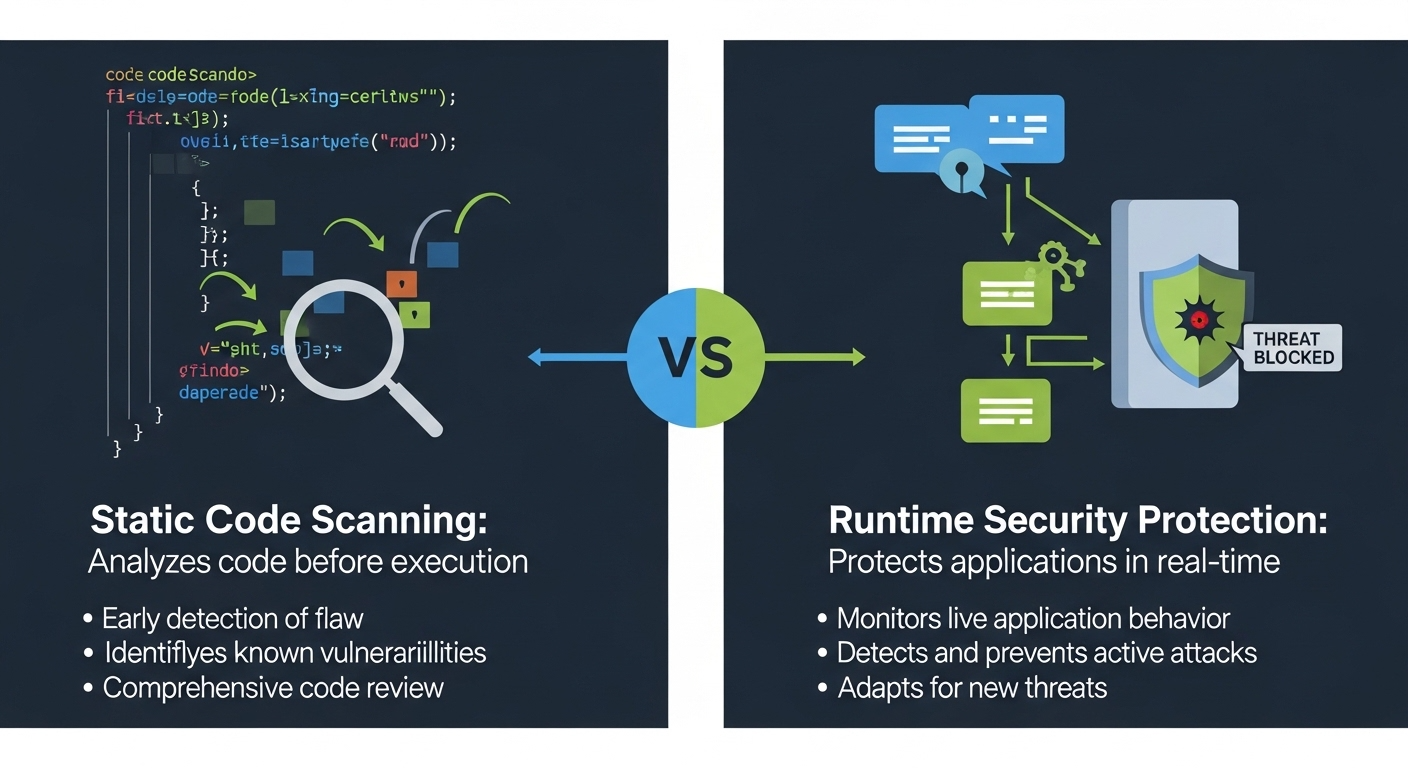
Runtime Security Is Overtaking Static-Only Approaches

For more than a decade, application security programs were built primarily around static analysis. Security teams scanned code before deployment, generated vulnerability reports, and sent findings back to developers for remediation. This “scan → fix → release” cycle became standard practice across enterprises.

But in 2026, that model alone is no longer sufficient.

Modern applications are dynamic, distributed, API-driven, and continuously deployed. Static testing still plays an important role but it cannot keep up with real-time threats, cloud-native complexity, and evolving attack techniques.

As a result, runtime security is overtaking static-only approaches as the dominant strategy in modern application security.

Security is shifting from prediction to protection.

The Traditional Static Security Model

Static Application Security Testing (SAST) analyzes source code without executing it. It identifies patterns that may represent vulnerabilities, such as:

  • SQL injection risks
  • Cross-site scripting flaws
  • Hard-coded credentials
  • Unsafe memory handling
  • Known vulnerable dependencies

The strength of static testing lies in early detection. By scanning code before release, teams can reduce risk before deployment.

However, static analysis has inherent limitations.

The Structural Limitations of Static-Only Security

1. Lack of Runtime Context

Static tools analyze code in isolation. They cannot see:

  • How services interact at runtime
  • Whether vulnerable code paths are actually reachable
  • Which APIs are publicly exposed
  • How user roles affect access control

Without runtime context, risk assessment becomes theoretical.

2. High False Positive Rates

Security teams often spend significant time triaging findings that may not be exploitable in practice. This creates:

  • Alert fatigue
  • Remediation delays
  • Developer frustration
  • Reduced trust in security tools

When everything looks critical, nothing feels urgent.

3. Inability to Detect Business Logic Abuse

Many modern attacks do not exploit coding flaws they exploit flawed workflows.

For example:

  • Manipulating pricing logic
  • Bypassing rate limits
  • Abusing API sequencing
  • Circumventing authentication flows

Static analysis cannot simulate or detect these runtime abuses.

4. Cloud-Native and Microservices Complexity

Modern systems include:

  • Containers
  • Serverless functions
  • Dynamic infrastructure
  • Third-party APIs
  • Continuous deployments

Static scans performed before deployment cannot account for configuration drift, environment variables, or evolving infrastructure states.

Why Runtime Security Is Gaining Dominance

Runtime security shifts the focus from code inspection to live behavioral monitoring.

Instead of asking:

“Could this code be vulnerable?”

Runtime security asks:

“Is this vulnerability being exploited right now?”

This shift offers several advantages.

Real-Time Threat Detection

Runtime systems monitor live traffic and execution patterns. They can detect:

  • Injection attempts
  • API abuse
  • Token manipulation
  • Privilege escalation
  • Suspicious request patterns
  • Exploit payload signatures

This allows organizations to block threats instantly rather than discovering them after damage occurs.

Context-Aware Risk Evaluation

Runtime protection evaluates:

  • User identity and permissions
  • Network exposure
  • Deployment environment
  • Data sensitivity
  • Active exploit behavior

This contextual intelligence allows security teams to prioritize genuine threats over theoretical risks.

Runtime Application Self-Protection (RASP)

RASP solutions embed directly into the application runtime environment. They:

  • Monitor execution
  • Detect malicious behavior
  • Block exploit attempts in real time

Unlike perimeter defenses, RASP protects applications internally even if attackers bypass external controls.

Interactive Application Security Testing (IAST)

IAST operates during testing phases but leverages runtime instrumentation. It provides deeper insight into:

  • Code coverage during tests
  • Real execution paths
  • Confirmed vulnerabilities

IAST bridges the gap between static and dynamic testing.

Runtime Protection and DevSecOps

As organizations adopt DevSecOps and continuous deployment, security must operate at the same speed as development.

Runtime protection supports:

  • Rapid release cycles
  • Frequent feature updates
  • Continuous validation
  • Immediate feedback loops

Security becomes an always-on layer rather than a pre-release checkpoint.

Business Impact of Runtime Security

The shift toward runtime security is not purely technical it is strategic.

Revenue Protection

Production attacks directly affect transactions, subscription renewals, and user trust. Runtime blocking mechanisms reduce financial loss.

Reduced Incident Response Time

By detecting and blocking attacks instantly, runtime security lowers:

  • Mean Time to Detect (MTTD)
  • Mean Time to Respond (MTTR)

Faster containment reduces operational disruption.

Compliance and Regulatory Alignment

Modern compliance frameworks increasingly require:

  • Continuous monitoring
  • Active incident detection
  • Real-time reporting capabilities

Runtime security supports these mandates.

Runtime vs Static: A Layered Strategy

It is important to emphasize that runtime security does not eliminate the need for static analysis.

A mature strategy includes:

  • SAST for early code review
  • DAST for simulated attack testing
  • IAST for execution-aware scanning
  • RASP for production protection
  • Dependency scanning for supply chain security

The key difference in 2026 is prioritization. Static-only strategies are no longer enough.

Runtime validation is becoming central.

Emerging Trends in Runtime Security

AI-Driven Behavioral Detection

Machine learning models now analyze traffic anomalies and detect patterns that traditional rule-based systems miss.

Zero-Trust Runtime Policies

Applications enforce strict access controls internally, verifying every request based on identity and context.

Runtime Security Observability

Security metrics are increasingly integrated into observability dashboards alongside performance and reliability metrics.

This unifies security, operations, and engineering teams.

Challenges to Adoption

Runtime protection introduces considerations:

  • Performance overhead concerns
  • Integration complexity
  • Need for skilled interpretation of alerts
  • Balancing automation with human oversight

However, as tooling matures, these barriers are decreasing.

The Future of Application Security

The future of application security is:

  • Continuous
  • Context-aware
  • Runtime-driven
  • Business-aligned

Security will increasingly operate inside the application itself, monitoring execution behavior rather than relying solely on pre-deployment predictions.

Applications will defend themselves dynamically.

Conclusion

Static analysis established the foundation of secure development practices. But in today’s fast-moving, cloud-native environments, it cannot stand alone.

Runtime security provides real-time visibility, contextual intelligence, and active protection against modern threats.

The organizations that succeed in 2026 and beyond will adopt layered strategies but they will prioritize runtime defense as a core capability.

Static testing identifies potential weaknesses.
Runtime security stops real attacks.

The shift is not optional. It is evolutionary.

For more Contact US

7 Critical AI-Powered Cyberattacks Trends Transforming Cybersecurity in 2026

AI-Powered Cyberattacks are no longer theoretical risks. These AI-Powered Cyberattacks are actively reshaping how modern breaches occur across cloud, API, and enterprise environments. AI-powered cyberattacks are accelerating, reshaping the global threat landscape and forcing organizations to rethink how they approach application security.

Cybercriminals are no longer relying solely on manual exploitation techniques. Instead, they are deploying AI systems capable of automating reconnaissance, crafting hyper-personalized phishing attacks, generating malware variants, and moving laterally across enterprise networks in minutes.

This is not just an evolution of cybercrime it is a scale shift.

The Speed Problem: Attacks Are Moving Faster Than Ever

Recent threat intelligence reports from firms like CrowdStrike highlight a disturbing trend: attackers are now moving within compromised environments in under 30 minutes.

Traditionally, breaches followed a slower pattern:

  1. Initial compromise
  2. Manual reconnaissance
  3. Privilege escalation
  4. Data exfiltration

With AI, this lifecycle is compressed dramatically. Automation allows attackers to:

  • Identify weak endpoints instantly
  • Scan internal systems for misconfigurations
  • Escalate privileges using known patterns
  • Deploy ransomware without delay

The reduced dwell time leaves security teams with a shrinking response window.

How AI Is Supercharging Cybercrime

AI enhances nearly every phase of the attack lifecycle.

1. AI-Driven Reconnaissance

AI-Powered Cyberattacks attackers use machine learning tools to scrape public data, analyze employee profiles on social media, and map digital infrastructure footprints. AI can process vast datasets quickly, identifying exploitable entry points more efficiently than manual attackers.

2. Hyper-Personalized Phishing

Generative AI models can mimic corporate tone, executive communication styles, and industry terminology. Phishing emails now:

  • Contain fewer grammatical errors
  • Reference specific projects or colleagues
  • Use contextual data from breached datasets

This significantly increases click-through and credential theft rates.

3. Automated Malware Development

AI can:

  • Modify malware signatures dynamically
  • Generate polymorphic code
  • Test exploit payloads against detection systems

Instead of manually coding malicious software, attackers can instruct AI tools to create variants that evade signature-based detection.

4. Lateral Movement at Machine Speed

Once inside a system, AI-driven scripts analyze network architecture, identify privilege escalation opportunities, and pivot across endpoints quickly. Automation reduces human error and increases precision.

This explains why modern breaches escalate so rapidly

Why Application Security Is Especially at Risk

Application security teams are under increasing pressure because modern software environments are complex:

  • Cloud-native architectures
  • Microservices and APIs
  • Rapid DevOps release cycles
  • Open-source dependencies
  • AI-assisted coding tools

Each component introduces potential vulnerabilities. Attackers use automated scanners to test thousands of endpoints simultaneously.

Unpatched APIs, misconfigured cloud storage, and exposed credentials become easy targets.

Organizations relying on reactive patch management are especially vulnerable.

The AI Arms Race in Cybersecurity

The cybersecurity ecosystem is now engaged in an AI arms race.

While attackers use AI offensively, defenders are deploying AI defensively.

Security vendors like Palo Alto Networks, Microsoft, and CrowdStrike are integrating machine learning into:

  • Behavioral anomaly detection
  • Endpoint threat monitoring
  • Automated threat hunting
  • Predictive risk modeling
  • Security information and event management (SIEM) systems

AI-powered defense systems can detect suspicious behavior patterns rather than relying solely on known attack signatures.

However, automation benefits both sides and attackers often experiment faster.

Business Impact: Beyond IT Departments

AI-powered cyberattacks have enterprise-wide consequences.

Financial Risk

  • Ransomware payouts
  • Operational downtime
  • Incident response costs
  • Regulatory fines

Reputational Damage

Customers lose trust when data breaches expose personal information.

Legal Exposure

Data privacy regulations increase liability for compromised user data.

Competitive Loss

Intellectual property theft can undermine years of research and development.

Small and mid-sized businesses face heightened risk because they often lack advanced monitoring infrastructure.

Emerging AI-Driven Threat Trends

Looking ahead, we can expect:

1. Autonomous Attack Bots

Self-learning attack systems capable of adapting in real time.

2. AI Deepfake Social Engineering

Voice and video impersonation targeting executives and finance teams.

3. Continuous Vulnerability Discovery

AI scanning open-source repositories and public assets for zero-day opportunities.

4. Credential Harvesting at Scale

AI analyzing breached datasets to identify password reuse patterns.

The sophistication of attacks will increase alongside accessibility of AI tools.

How Organizations Must Respond

To counter AI-powered threats, companies must evolve beyond traditional security practices.

1. Adopt AI-Driven Security Solutions

Behavior-based detection can identify unusual system activity before damage escalates.

2. Implement Zero Trust Architecture

Restrict access permissions and verify identity continuously.

3. Strengthen Secure Development Practices

Integrate automated code scanning into CI/CD pipelines.

4. Reduce Attack Surface

Audit APIs, cloud storage, and third-party integrations regularly.

5. Prioritize Incident Response Readiness

Automated containment tools can isolate compromised systems immediately.

6. Invest in Employee Awareness

AI-enhanced phishing attacks demand heightened human vigilance.

The Future of Application Security

Cybersecurity strategies must transition from reactive to predictive.

Instead of waiting for alerts, AI-powered defense systems will:

  • Anticipate vulnerabilities
  • Model attack simulations
  • Recommend remediation actions
  • Continuously adapt to emerging threat patterns

Application security will become deeply integrated into DevSecOps processes, ensuring vulnerabilities are addressed before deployment.

Conclusion

AI-powered cyberattacks are accelerating at an unprecedented rate, transforming the digital threat landscape. Automation, machine learning, and generative AI are empowering attackers with tools that increase speed, precision, and scale.

But the solution is not to resist AI it is to harness it responsibly.

Organizations that adopt intelligent security frameworks, invest in AI-driven defenses, and embed security into every layer of application development will be best positioned to thrive in this new era.

In 2026 and beyond, cybersecurity will not be defined by who builds the strongest walls but by who deploys the smartest systems. AI-Powered Cyberattacks represent one of the most critical cybersecurity challenges of 2026.

For more Contact US