

7 Powerful Reasons Profitability Consulting Is Replacing Growth-Only Advisory

For more than a decade, startup consulting was heavily centered around one objective: growth. Advisors helped founders optimize acquisition funnels, increase user signups, accelerate funding rounds, and expand market presence as quickly as possible.

Revenue growth was the primary metric. Profitability could wait.

In 2026, that mindset has shifted dramatically.

Profitability consulting is replacing growth-only advisory as investors, founders, and boards demand sustainable financial models instead of aggressive expansion at all costs. The new era of startup consulting prioritizes disciplined scaling, unit economics, and capital efficiency over vanity metrics.

Growth is still important but it must now be profitable growth.

The End of “Growth at Any Cost”

In the low-interest-rate era, startups were incentivized to prioritize market capture over margin discipline. Venture capital flowed aggressively, rewarding:

  • User growth
  • Market share
  • Brand visibility
  • Revenue multiples
  • Expansion speed

Startups often operated at heavy losses while justifying burn rates with projected future dominance.

That environment has changed.

Capital has become more selective. Investors now scrutinize:

  • Cash runway
  • Burn multiple
  • Gross margin stability
  • Customer acquisition efficiency
  • Contribution margin

Consulting models must adapt accordingly.

Why Profitability Consulting Is Rising

1. Investor Expectations Have Evolved

Investors now require startups to demonstrate:

  • Clear break-even timelines
  • Sustainable cost structures
  • Realistic valuation narratives
  • Financial resilience under downturn scenarios

Consultants are increasingly tasked with preparing startups for this scrutiny.

2. Market Conditions Demand Discipline

Economic volatility and increased competition mean startups cannot rely solely on external capital for survival.

Profitability consulting focuses on:

  • Expense rationalization
  • Operational efficiency
  • Pricing optimization
  • Margin forecasting

This creates businesses that can sustain growth without constant funding injections.

3. Valuation Multiples Are Compressing

In today’s environment, revenue growth alone does not justify high valuations. Investors now reward:

  • EBITDA visibility
  • Path-to-profitability clarity
  • Strong unit economics

Advisors who can structure profitability narratives enhance startup credibility.

What Profitability Consulting Includes

Modern startup consulting now emphasizes measurable financial frameworks.

Unit Economics Optimization

Consultants analyze:

  • Customer Acquisition Cost (CAC)
  • Lifetime Value (LTV)
  • Contribution margin
  • Churn impact
  • Retention cohorts

Improving these metrics directly impacts sustainable growth.

Pricing Strategy Refinement

Pricing is often under-optimized in early-stage companies. Profitability consultants:

  • Test pricing tiers
  • Introduce value-based pricing
  • Optimize subscription models
  • Reduce discount dependency

Small pricing adjustments can dramatically increase margins.

Burn Rate & Runway Planning

Startups must understand:

  • Monthly burn rate
  • Cash runway under multiple scenarios
  • Sensitivity analysis
  • Cost structure flexibility

Consultants help model best-case and worst-case forecasts to reduce financial surprises.

Margin Engineering

Rather than simply increasing revenue, profitability consulting focuses on:

  • Gross margin improvement
  • Vendor cost negotiation
  • Infrastructure cost optimization
  • Automation-driven cost reduction

Margin expansion often produces greater impact than pure revenue growth.

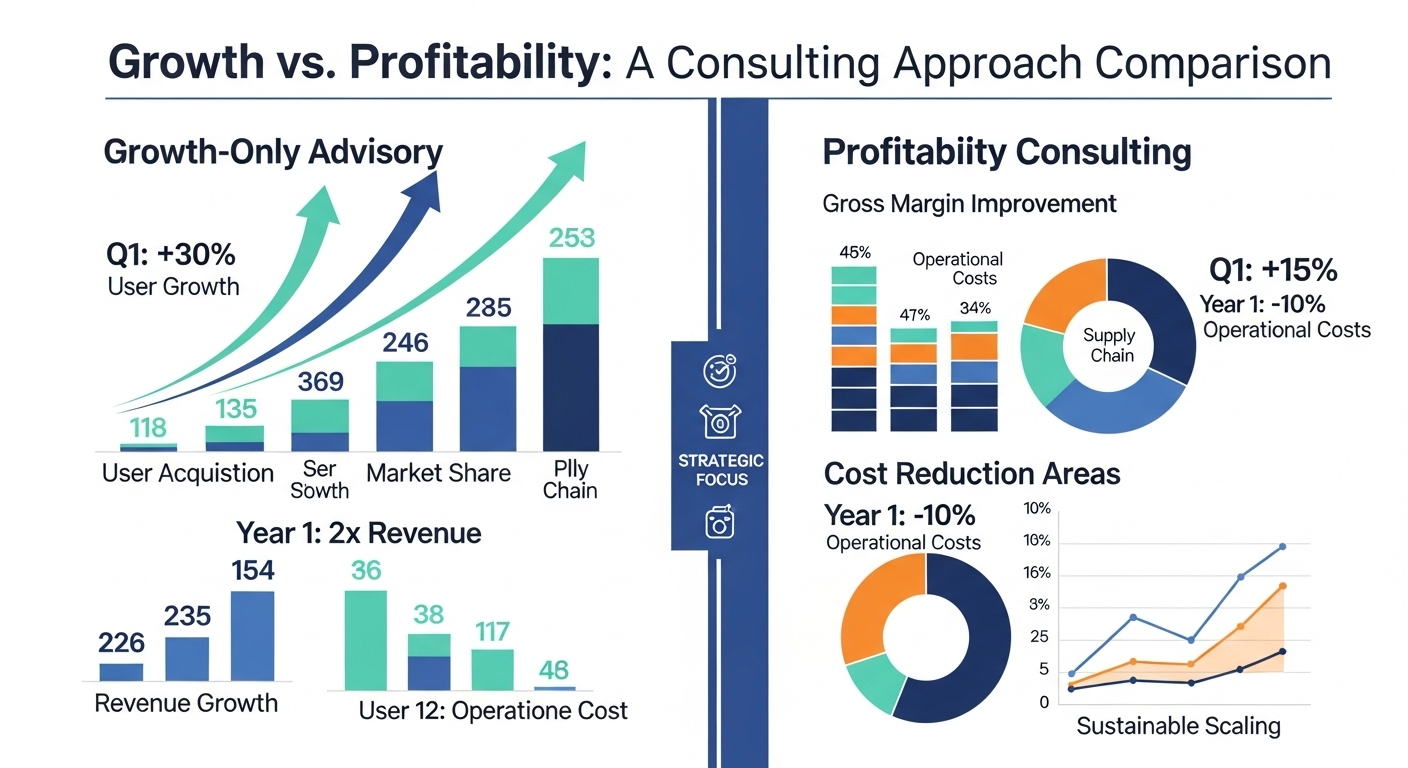
Growth vs Profitable Growth

Growth-only advisory focuses on scale.

Profitability consulting focuses on sustainable scale.

The difference lies in:

Growth-Only AdvisoryProfitability Consulting
Prioritizes acquisitionPrioritizes retention efficiency
Encourages rapid expansionEncourages measured scaling
Accepts high burn ratesControls burn strategically
Focuses on top-line metricsFocuses on bottom-line health
Valuation-driven narrativeSustainability-driven narrative

This does not eliminate growth ambition it refines it.

The Strategic Role of Data in Profitability Consulting

Profitability consulting is inherently data-driven. Advisors now rely on:

  • Cohort analysis
  • Conversion rate diagnostics
  • Cost-to-serve modeling
  • Customer profitability segmentation
  • Scenario-based forecasting

Modern consulting is no longer theoretical it is analytical.

Fractional CFO & Embedded Advisory Models

The rise of profitability consulting has accelerated demand for:

  • Fractional CFO services
  • Financial modeling advisors
  • Embedded operational consultants

Rather than producing slide decks, consultants integrate into execution frameworks.

They:

  • Review monthly financial dashboards
  • Guide pricing experiments
  • Support investor reporting
  • Validate capital allocation decisions

Advisory becomes operational.

Benefits for Founders

Startups that embrace profitability consulting gain:

  • Greater investor confidence
  • Improved fundraising positioning
  • Longer runway
  • Reduced financial stress
  • Sustainable scaling foundation

Financial clarity improves strategic clarity.

Challenges in Transitioning from Growth to Profitability

Shifting mindset is not always easy.

1. Cultural Resistance

Teams accustomed to aggressive expansion may resist cost discipline.

2. Short-Term Revenue Pressure

Some profitability measures may initially slow growth momentum.

3. Organizational Realignment

Pricing changes and cost optimization require cross-functional coordination.

However, long-term stability outweighs short-term discomfort.

The Future of Startup Consulting

Startup consulting is becoming:

  • Financially rigorous
  • Operationally embedded
  • Data-driven
  • Capital-efficient
  • Risk-aware

Advisors who continue focusing solely on growth metrics risk becoming outdated.

The next generation of startup consulting integrates strategy with financial sustainability.

Conclusion

Profitability consulting is replacing growth-only advisory because the startup ecosystem has matured. Investors, founders, and markets now demand disciplined execution, efficient scaling, and sustainable financial models.

Growth without profitability is fragile.
Profitability without growth is stagnant.

The future belongs to startups that balance both.

Consultants who help founders engineer profitable growth not just rapid expansion will define the next era of startup success.
For more Contact Us
How Startup Funding Is Unlocking New Opportunities Across Europe

For more than a decade, European tech funding has been dominated by a handful of major hubs cities like London, Berlin, Paris, and Stockholm. These ecosystems became magnets for investors, policymakers, founders, and talent. But something significant is happening in 2026: startup funding is decentralizing across Europe.

Today’s trend reflects a deeper shift in how capital flows, how ecosystems mature, and how founders think about growth. It’s not just about where you raise money it’s about where your business can scale sustainably.

This change has profound implications for founders, investors, and consultants alike.

The Traditional European Funding Landscape

Historically, European startups faced a clear reality:

  • Capital was concentrated in a few major tech hubs
  • Early-stage funding was harder outside metro centers
  • Investors preferred familiar ecosystems
  • Talent gravitated toward big-city networks

Startup Funding model worked while Europe’s startup infrastructure was emerging. Concentration created flywheel effects communities, accelerators, angels, and later-stage funds clustered in predictable places.

But as the continent’s digital economy matured, so did the limitations of this model.

Why Decentralization Is Happening Now

Several forces are driving this shift:

1. Regional Governments Are Actively Funding Startups

Across Europe, cities and regions are launching their own investment funds, innovation grants, and co-investment programs. For example:

  • Spain and Portugal are offering competitive tech grants
  • Nordic countries are co-investing with private funds
  • CEE countries are creating early-stage matching programs

Public capital is seeding ecosystems that were previously overlooked.

This reduces dependency on traditional VC hubs and empowers local entrepreneurs.

2. Remote Work Has Permanently Changed Geography

The pandemic demonstrated that tech work does not require physical proximity. Today:

  • Founders can build teams distributed across countries
  • Investors participate in remote pitches
  • Global acceleration programs can scout regional startups

This means startups can raise capital without relocating, and investors are scouting talent beyond traditional centers.

3. Sophisticated Angel Networks Are Emerging Outside Big Cities

Previously, seed capital was dominated by Angel groups in London or Berlin.

Now we see:

  • Cross-border angel syndicates
  • Regional business angel networks
  • Founders angel investing locally
  • Micro-VCs emerging in smaller European markets

Startup Funding gives regional startups earlier access to capital and mentorship.

4. EU Policy and Funds Encourage Distributed Growth

The European Union has shifted funding programs to reward inclusivity and regional scaling.

Initiatives such as:

  • EU Innovation Funds
  • Horizon grants
  • Regional digital transformation funds

These programs focus on spreading capital across member states not just traditional hubs.

This trend will only grow in the next decade.

What Decentralization Means for Founders

1. You’re No Longer Forced to Relocate

A decade ago, relocating to a major city was often a prerequisite for serious funding. Today:

  • Investors meet founders virtually
  • Regional accelerators have funding partnerships
  • Ecosystem maturity is being built outside capitals

This democratizes opportunity and reduces the cost and disruption of relocation.

2. You Can Build Local Advantage

Startups outside big cities now have unique strengths:

  • Proximity to local industries
  • Lower operating costs
  • Access to regional talent
  • Less competition for attention

These advantages can become differentiators for investor interest.

3. Localization Attracts Specialized Investors

Investors are increasingly specializing by sector and region because:

  • Industry clusters drive strategic value
  • Regional partners reduce regulatory friction
  • Local capital is patient capital

This means startups with strong product-market fit in niche regional markets can secure better-aligned Startup Funding.

What This Means for Investors

The decentralization trend isn’t just good for founders it’s strategic for investors too.

1. Early Mover Advantage in New Ecosystems

Investors who engage early in smaller, rising ecosystems get access to:

  • Less competition for deals
  • Higher ownership concentration
  • First rights to future growth companies

Startups with strong regional traction often scale globally.

2. Better Valuation Discipline

Decentralized markets often offer more disciplined valuation environments than overheated hubs.

This leads to:

  • More sustainable investment returns
  • Higher capital efficiency
  • Portfolio resilience

Investors can optimize deployment strategies by combining urban and regional deals.

3. Collaboration With Regional Funds

Major VCs are increasingly partnering with regional funds accelerating scout networks and deal flow.

Examples include:

  • Co-investment agreements
  • Regional syndicate partnerships
  • Shared due diligence frameworks

This expands investment coverage across Europe efficiently.

Why This Trend Aligns With Startup Consulting

Consultants advising founders now need to incorporate geographic strategy into fundraising planning.

Advisory practices are evolving to include:

1. Cross-Border Funding Strategies

Guidance on:

  • Regional grants versus VC capital
  • EU funding eligibility
  • Investor networks outside major hubs
  • Pitch adaptation for different investor types

This is no longer niche consulting. it’s core advice.

2. Ecosystem Mapping & Growth Planning

Startup consultants now help founders:

  • Evaluate regional ecosystem strengths
  • Build networks early with local angels and funds
  • Leverage government-backed programs
  • Access cross-border acceleration platforms

This contextual consulting adds measurable value.

3. Hybrid Fundraising Support

Consultants now:

  • Prepare funding decks optimized for multiple markets
  • Coach teams on diverse investor expectations
  • Create stage-based fundraising roadmaps
  • Support remote investor relations

This hybrid model reflects the decentralization trend.

Challenges That Still Remain

Despite the positive trend, decentralization is not without challenges:

1. Uneven Ecosystem Maturity

Regional ecosystems vary in:

  • Mentorship availability
  • Later-stage fund availability
  • Market access

Some regions are still maturing.

2. Talent Shortages

Smaller markets may lack deep engineering or domain-specific talent, requiring strategic hiring plans or remote teams.

3. Investor Confidence Gaps

Investors still show bias toward known ecosystems; overcoming perception barriers is ongoing work.

The Future of European Startup Funding

As we move deeper into the decade:

  • Multinational accelerators will establish remote-first scouting
  • Cross-border syndicates will standardize co-investment
  • EU-funded programs will reward decentralization
  • Regional innovation clusters will crystallize into global players

What used to be emerging is now strategic.

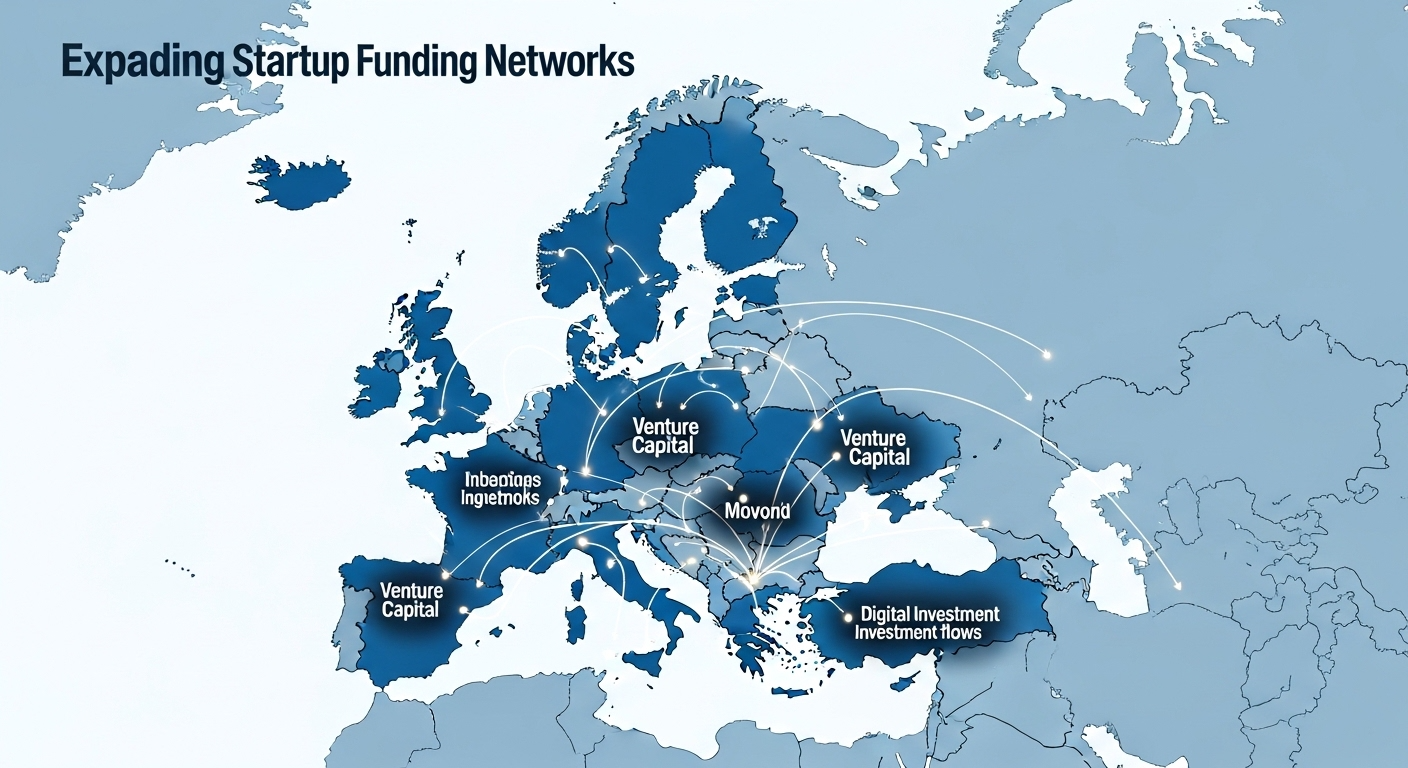
Europe’s startup funding map is expanding and founders should treat geography as a strategic advantage, not a limitation.

Conclusion

The decentralization of European startup funding is real, measurable, and accelerating. Capital is flowing into smaller ecosystems, governments are incentivizing regional growth, remote work has removed physical constraints, and investors are adapting their models.

For founders, this means:

  • More capital accessibility
  • More funding options
  • Geographical freedom
  • Strategic alignment with local markets

For advisors and consultants, it means:

  • Evolving funding frameworks
  • Broader investor networks
  • More nuanced growth strategies

European startup funding is no longer confined to a few metro hubs. The next wave of innovation will come from everywhere.

And the startups and advisors who see opportunity beyond the obvious will be the ones that lead Europe’s next generation of tech success stories.

For more information Connect with us