

Generative AI Tools Is Revolutionizing Web & App Development in 2026

Introduction: Development Has Crossed a Structural Line

Web and app development has always evolved new frameworks, better tooling, faster runtimes. But in 2026, the change is not incremental. It is structural.

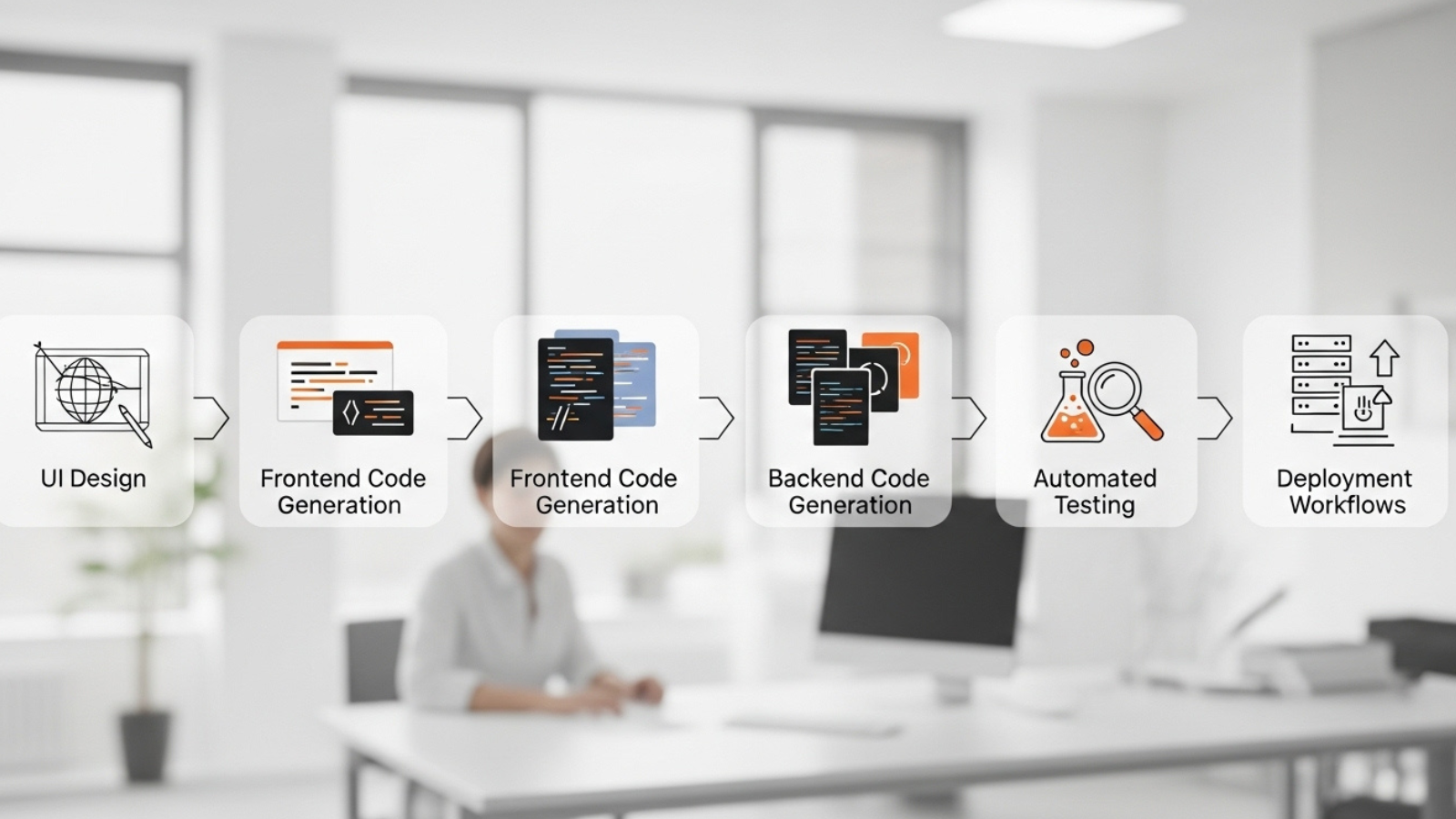
Generative AI tools are no longer experimental assistants or novelty code generators. They are actively reshaping how applications are designed, built, tested, deployed, and maintained. The developer’s role is shifting from writing every line of code to orchestrating systems, validating outputs, and designing outcomes.

This is not about replacing developers. It’s about redefining what development work actually means.

What “Generative AI Tools” Mean in 2026

In earlier years, generative AI in development mostly meant:

  • Code autocomplete
  • Basic snippet generation
  • Simple bug explanations

In 2026, generative AI tools operate across the entire development lifecycle, including:

  • UI and UX generation
  • Frontend and backend scaffolding
  • API design and documentation
  • Automated testing and test data generation
  • Performance tuning and refactoring
  • Deployment configuration and monitoring

These tools don’t just assist they actively participate in building software. Telegram

Faster Prototyping and Shorter Build Cycles

One of the most visible changes is speed.

Generative AI enables teams to:

  • Convert product ideas into working prototypes in hours
  • Generate production-ready UI components from design prompts
  • Scaffold full applications with consistent architecture

This dramatically reduces the time between concept and validation. Product teams can test ideas faster, discard weak concepts earlier, and iterate with real user feedback.

In 2026, speed is no longer a competitive advantage it’s the baseline expectation.

Frontend Development Is Becoming Intent-Driven

Frontend work has traditionally been labor-intensive:

  • Styling
  • Responsive layouts
  • Accessibility fixes
  • Cross-browser issues

Generative AI tools now generate:

  • Semantic HTML
  • Responsive CSS layouts
  • Component libraries aligned with design systems
  • Accessibility-aware UI structures

Developers increasingly describe what they want rather than building it piece by piece. The role shifts from construction to review, refinement, and integration.

This doesn’t reduce frontend complexity it changes where expertise is applied.

Backend Development Is Becoming More Declarative

Backend development is also being reshaped.

Generative AI can:

  • Design REST or GraphQL APIs
  • Generate database schemas
  • Produce validation logic and error handling
  • Draft authentication and authorization flows

Developers still define rules, constraints, and architecture but much of the boilerplate work is automated.

As a result, backend engineers spend more time on:

  • Data modeling decisions
  • Performance considerations
  • Security and compliance
  • System scalability

The work becomes higher leverage, not simpler.

Testing and QA Are Being Transformed

Testing has historically lagged behind development speed. Generative AI is changing that balance.

Modern AI tools can:

  • Generate unit, integration, and API tests
  • Create realistic test data
  • Identify edge cases developers overlook
  • Update tests automatically when code changes

This supports continuous testing models and aligns perfectly with QAOps and CI/CD pipelines.

However, human oversight remains critical. AI-generated tests still require:

  • Validation of test relevance
  • Risk-based prioritization
  • Business logic understanding

Quality is improving but only where teams use AI responsibly.

Design and Development Are Converging

Generative AI is narrowing the gap between design and development.

Design artifacts wireframes, mockups, design systems can now be translated directly into code. This reduces:

  • Misinterpretation
  • Rework
  • Design-to-dev handoff delays

Developers collaborate earlier with designers, focusing on behavior and usability rather than pixel replication.

In 2026, the most effective teams treat design and development as a single, continuous workflow.

The Rise of the “AI-Augmented Developer”

The developer role itself is evolving.

Successful developers in 2026:

  • Understand how to prompt and guide AI tools
  • Know when to trust output and when not to
  • Focus on system thinking, not syntax
  • Take responsibility for correctness, security, and maintainability

Coding skills still matter but they are no longer sufficient on their own.

The new competitive edge is judgment.

Risks and New Responsibilities

Generative AI introduces new risks that teams must manage carefully.

Verification Debt

Blindly trusting AI-generated code can lead to:

  • Hidden bugs
  • Security vulnerabilities
  • Performance issues

Teams must establish strong review and validation processes.

Security and Compliance Concerns

AI-generated code may:

  • Introduce insecure patterns
  • Violate internal standards
  • Miss regulatory requirements

Security reviews cannot be automated away.

Over-Reliance on Tooling

When teams stop understanding their own systems, long-term maintainability suffers.

The smartest organizations treat AI as:

An accelerator not a replacement for engineering discipline

Architecture and Governance Matter More Than Ever

As generative AI accelerates development, architecture decisions become more critical, not less.

Without strong:

  • Coding standards
  • Design patterns
  • Review processes
  • Governance frameworks

AI simply helps teams build bad systems faster.

In 2026, mature organizations pair generative AI with:

  • Clear architectural principles
  • Automated quality gates
  • Strong DevOps and QAOps practices

Business Impact: Faster Delivery, Leaner Teams

From a business perspective, the impact is clear:

  • Faster time to market
  • Smaller but more capable teams
  • Reduced development costs per feature
  • Greater ability to experiment and pivot

Companies that adopt generative AI responsibly gain compounding advantages.

Those that resist fall behind quickly.

What Web & App Teams Should Do Now

To adapt effectively, teams should:

  1. Introduce generative AI gradually not everywhere at once
  2. Define clear quality and security standards
  3. Train developers in AI-assisted workflows
  4. Maintain strong human review practices
  5. Focus on outcomes, not lines of code

Generative AI is powerful but only when paired with intent and discipline.

Final Thoughts: Development Is Becoming More Strategic

Generative AI tools are not making development less important. They are making it more strategic.

In 2026, the value of developers lies not in how fast they type but in:

  • How well they design systems
  • How clearly they define intent
  • How responsibly they manage risk
  • How effectively they deliver outcomes

Web and app development isn’t being automated away.
It’s being elevated.

If your organization is navigating AI-driven changes in web or app development and wants to modernize delivery without sacrificing quality, a clear development and AI strategy is now essential. For more Details please contact Contact Us

GitHub Reinvents Itself for the AI Era: 3 Game-Changing Moves Developers Must Know

Introduction: GitHub Is No Longer Just a Repository

For years, GitHub was the backbone of modern software development a place to store code, collaborate, and ship. But in the AI era, that’s no longer enough.

Under the direction of Microsoft, GitHub is transforming itself from a passive platform into an active AI-driven development environment.

This shift isn’t cosmetic. Github fundamentally changes how developers write, review, and maintain software.

Why GitHub Had to Change

The rise of AI-native coding tools exposed a weakness in traditional platforms:

  • Repositories store code
  • AI tools create code

If Tools didn’t adapt, it risked becoming irrelevant reduced to storage while intelligence moved elsewhere.

Competitors offering AI-first development environments forced tools to evolve or lose influence over the developer workflow.

GitHub’s New Role in the AI Stack

This tool is moving from: Code host → Intelligent development platform

Key changes include:

  • Deep AI integration across workflows
  • AI-assisted code generation and review
  • Smarter pull requests and issue handling
  • Context-aware development suggestions

This positions GitHub as the control plane for AI-assisted software engineering.

AI Becomes a First-Class Contributor

In the new GitHub model:

  • AI doesn’t just suggest code
  • It participates in reviews
  • It flags potential issues
  • It assists with refactoring

This changes the dynamics of teams. Developers now collaborate not just with humans, but with AI agents embedded in their tools.

The Rise of “Agentic” Development

GitHub’s direction aligns with a broader trend: agentic AI systems that can:

  • Understand tasks
  • Break them into steps
  • Execute across repositories

This Tool reduces manual overhead but introduces new risks:

  • Reduced code comprehension
  • Over-reliance on automation
  • Weaker architectural thinking

Without strong governance, teams risk building systems they no longer fully control.

What This Means for Developers

Developers must adapt in three critical ways:

1. From Coders to Reviewers

AI will write more code. Humans must:

  • Review behavior
  • Validate intent
  • Protect architecture

2. Stronger Fundamentals Matter More

AI amplifies skill gaps. Developers without solid foundations will struggle to catch errors AI introduces.

3. Tool Literacy Becomes a Core Skill

Understanding how AI tools work limits, biases, failure modes is now part of being a professional engineer.

What This Means for Organizations

For companies, This tool’s evolution brings opportunity and responsibility:

  • Faster delivery
  • Lower development friction
  • Higher risk if governance is weak

Organizations must define:

  • AI usage policies
  • Review standards
  • Security controls

AI-driven platforms reward discipline. Chaos will be punished.

The Future of GitHub

GitHub is positioning itself as:

  • The orchestrator of AI-assisted development
  • The source of truth for human AI collaboration
  • A platform where code, context, and intelligence converge

This makes tools more powerful and more dangerous depending on how it’s used.

Final Thoughts

GitHub’s reinvention signals a clear future: software development will be AI-accelerated, not AI-replaced. Developers who adapt will become more effective. Those who surrender judgment to automation will lose relevance.

Tools are changing. The responsibility is not.

If your organization needs help navigating AI-driven development platforms, governance, and scalable engineering practices, explore technology consulting at Contact Us

Verification Debt in AI-Generated Code: The Hidden Risk Developers Can’t Ignore in 2026

Verification Debt in AI-Generated Code: The Hidden Risk Developers Can’t Ignore

AI-assisted coding is no longer optional. From autocomplete to full function generation, AI tools now sit at the center of modern development workflows. Teams are shipping faster than ever but beneath this speed lies a growing, dangerous problem: verification debt.

Verification debt happens when AI-generated code is accepted, merged, and deployed without sufficient human review. Unlike technical debt, it doesn’t show up immediately. It hides quietly until it explodes in production, security incidents, or unmaintainable systems.

Developers who ignore this problem are not moving faster. They’re just postponing failure.

What Is Verification Debt?

Verification debt is the accumulated risk created when developers trust AI-generated code without validating:

  • Correctness
  • Security
  • Performance
  • Maintainability

AI tools generate plausible code, not guaranteed correct code. They optimize for probability, not truth. When teams treat AI output like peer-reviewed code, they introduce silent errors that compound over time.

This debt grows invisibly until systems become fragile, unpredictable, and expensive to fix.

Why Developers Are Skipping Code Verification

Let’s be honest. Verification debt exists because:

  • Reviewing AI code takes time
  • AI outputs look confident and clean
  • Teams are under pressure to ship faster
  • “It works” passes as “It’s correct”

Many developers now spend more time prompting than reviewing. That’s backwards. AI should reduce boilerplate, not eliminate responsibility.

Speed without scrutiny is not productivity it’s gambling.

Where AI-Generated Code Fails Most Often

AI-generated code usually breaks in subtle, high-risk areas:

1. Edge Cases

AI often handles the “happy path” well and fails silently on:

  • Null conditions
  • Concurrency issues
  • Race conditions
  • Unexpected inputs

2. Security

AI frequently:

  • Misses authorization checks
  • Introduces insecure defaults
  • Misuses cryptography
  • Copies unsafe patterns from public code

3. Architecture & Design

AI doesn’t understand your system context. It may:

  • Duplicate logic
  • Violate design patterns
  • Create tight coupling
  • Increase long-term maintenance cost

These issues rarely appear in unit tests but surface months later.

The Illusion of Productivity

Teams often celebrate AI-assisted speed without measuring downstream cost:

  • Debugging time
  • Incident response
  • Refactoring cycles
  • Security audits

The truth is brutal:

Unverified AI code shifts effort from development to firefighting.

Verification debt is not saving time it’s relocating it to the most expensive phase of software delivery.

Why This Problem Will Get Worse in 2026

AI coding tools are evolving fast:

  • More autonomy
  • Multi-file generation
  • Agent-based development

As AI takes on larger responsibilities, verification becomes harder not easier. When AI writes entire modules, human oversight must shift from line-level review to system-level validation.

Teams that don’t adapt will lose control of their own codebases.

How Teams Can Manage Verification Debt

Ignoring AI is not the answer. Controlling it is.

1. Redefine “Done”

AI-generated code is not complete until:

  • Logic is reviewed
  • Security is validated
  • Tests are extended, not assumed

2. Strengthen Code Review Culture

Code reviews must evolve from:

  • Syntax checks
    to
  • Behavioral and architectural reviews

3. Invest in Automated Testing

AI-generated code demands stronger:

  • Unit tests
  • Integration tests
  • Security scanning

Automation is your safety net.

4. Treat AI as a Junior Developer

AI is fast, helpful, and inconsistent.
Trust it like a junior engineer never blindly.

Final Thoughts

Verification debt is the hidden cost of AI-driven development. Teams that acknowledge it will build faster and safer. Teams that ignore it will spend the next few years untangling systems they no longer understand.

AI doesn’t remove responsibility. It raises the bar for engineering discipline.

If your team is adopting AI-assisted development and needs help building safe, scalable engineering practices, explore consulting and development services at Contact Us